Code Mixing and Code Switching Quiz : 15 MCQs

By Girdhari Lal Suthar

Published On:

Follow Us
Code Mixing and Code Switching Quiz

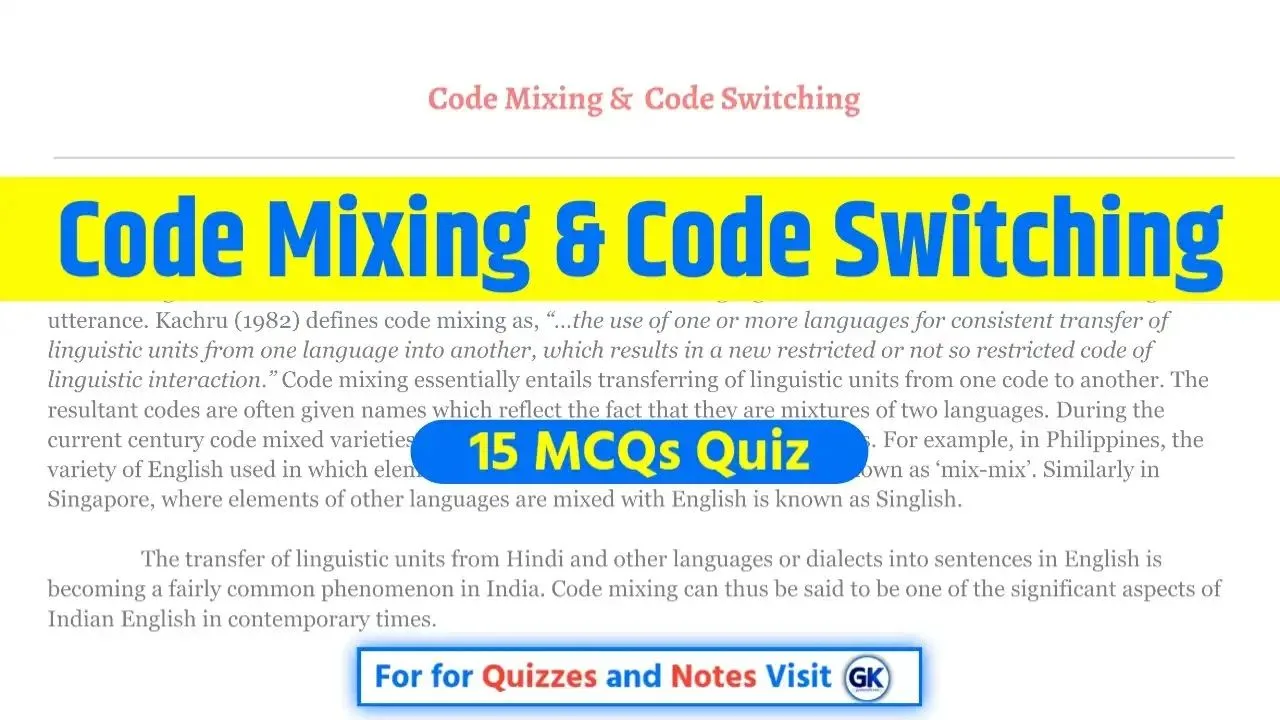
Code Mixing and Code Switching Quiz : In a country like India, where people speak more than one language every day, it is very common to mix or switch between languages while speaking. This habit is called Code Mixing and Code Switching. These terms are important in linguistics and sociolinguistics and are widely studied in Indian language contexts.

What is Code Mixing?

Code Mixing is when a speaker blends words or phrases from one language into another language during the same sentence or conversation. It usually happens without changing the topic or language structure.

Definition (According to Muysken, 2000):
Code mixing refers to the embedding of linguistic units such as phrases, words, or morphemes from one language into an utterance of another.”


What is Code Switching?

Code Switching is when a speaker changes from one language to another between sentences or sometimes even within a sentence, depending on the situation or listener.

Definition (According to Gumperz, 1982):
Code switching is the juxtaposition within the same speech exchange of passages of speech belonging to two different grammatical systems or subsystems.”


Code Mixing and Code Switching Quiz

Welcome to your Code Mixing and Code Switching Quiz

1. Who defined code mixing as the consistent transfer of linguistic units from one language into another?

2. Which country uses the term “mix-mix” for its code-mixed variety of English?

3. What is Singlish?

4. In which domains is code mixing increasingly observed in India?

5. Which Hindi intensifier + English adjective pair is an example of code mixing?

6. What does the term “speech economy” refer to in the context of code mixing/switching?

7. Which of the following is a culturally bound word often used in code mixing?

8. Which register frequently uses code-mixed words like “supari,” “bandh,” and “gherao”?

9. The statement “He’s ekdum horrified” is an example of:

10. In code mixing, what does "desi producers have this ajeeb desire" illustrate?

11. Which element is not a typical motivation for code mixing?

12. In contemporary India, code mixing is most commonly observed in:

13. Which of the following is an example of idiom and collocation insertion?

14. What is code switching?

15. How does code switching differ from borrowing?


Read this also : Code Mixing & Code Switching Pdf Notes


Discover more from Gyankundli

Subscribe to get the latest posts sent to your email.
Girdhari Lal Suthar is an experienced English teacher and education content creator in India, specialising in English Grammar and English Literature for competitive and academic exams. With over 8 years of teaching experience, he has guided aspirants preparing for RPSC, SSC, school teaching exams, and college-level English courses. He holds an M.A. in English Literature and is the founder of Gyankundli, an educational platform that offers clear explanations, exam-oriented notes, MCQs, quizzes, and literary analysis in simple Indian English. His content is designed to help students and teachers master grammar rules, literary concepts, and exam strategies with ease. Connect on LinkedIn: Girdhari Lal Suthar

3 thoughts on “Code Mixing and Code Switching Quiz : 15 MCQs”

Leave a Reply