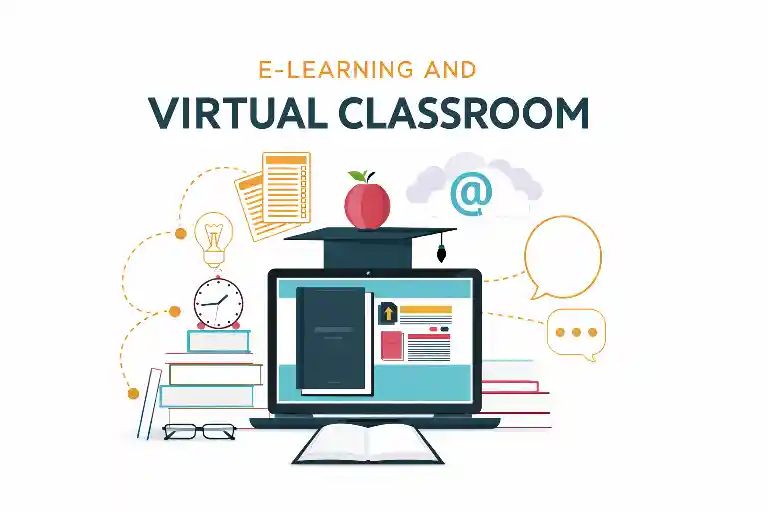

E-Learning and Virtual Classroom : E-learning has changed the meaning of education in the twenty-first century. Earlier, the idea of a classroom immediately brought to mind a picture of students sitting in front of a teacher, exchanging information face-to-face. Today, that picture is only a part of learning. The growth of computers, the Internet, and digital communication has expanded the boundaries of education beyond physical walls and rigid timetables. The concepts of web-based instruction, online learning, virtual learning and e-learning highlight this transformation and show how pedagogy now intersects technology.
This article explains the meaning of E-learning, its strengths and limitations, features of digital learning systems, instructional designs, technological foundations, course development processes and the growth of virtual universities worldwide and in India.
Understanding Key E-Learning Concepts





Web-Based Instruction
This approach uses the hypermedia capacity of the web to create structured instruction. Learners travel through text, graphics, video, hyperlinks and interactive components. Students access content anytime and anywhere, as long as they are connected.
Virtual Learning
Virtual learning removes physical presence from the learning equation. The teaching, interaction and feedback take place through digital tools such as email, chat, videoconferencing and shared materials.
Online Learning
Online learning is the delivery of content through the Internet using browser-based tools. It works on open networks (Internet) or controlled networks (intranets).
E-Learning
E-learning has now become the umbrella term that includes:
- Computer-assisted learning
- Online courses
- Web-based instruction
- Virtual classrooms
- Digital collaboration
Based on all these descriptions, a common definition becomes clear: E-learning is the use of networked digital tools for teaching, learning, assessing and collaborating.
Benefits and Limitations of E-Learning
The rise of E-learning is not accidental. It has grown rapidly because it removes many barriers of distance, cost and classroom shortage. At the same time, E-learning brings new challenges that educators must handle.
Advantages of E-learning
| Advantage | Practical Meaning |
|---|---|
| Quick updating of material | Teachers revise lessons anytime |
| Flexible access | Students learn at home or workplace |
| Large outreach | Many learners enrol without new classrooms |
| Interactive learning | Videos, simulations, quizzes enhance understanding |
| Simple interface | Browser-based learning is easy |
| Learner autonomy | Students choose what to learn and when |
| Multimedia support | Combines text, audio, video and images |
| Enhanced interaction | Students communicate with teachers and peers |
Disadvantages of E-learning
| Challenge | Effect on learners and teachers |
|---|---|
| Limited Internet access | Excludes rural and low-income learners |
| Low bandwidth | Slow downloads and video failures |
| Higher device cost | Computers and data plans create burden |
| Low digital readiness | Teachers may struggle to adopt new methods |
| Quality inconsistency | Weak standards allow poor teaching sites |
| Copyright confusion | Digital material is easily copied |
| Authentication problems | Online cheating and identity issues |
| Higher self-direction needed | Students may disengage without motivation |
The disadvantages show that e-learning must be supported by policy, investment, faculty training and thoughtful planning.
Characteristics of Robust E-learning Systems
Modern e-learning is a complete ecosystem combining multimedia content, user support, monitoring tools and assessment systems. The following table summarises key features described in the uploaded material.
Characteristics of a Typical E-learning Solution
| Domain | Key Components |
|---|---|
| Assessment and curriculum | Needs analysis, standards, goal-setting |
| Content | High-quality material, updated regularly |
| Access | Any device, anytime, multiple modes |
| User experience | Multimedia, simulation, role-play |
| Reinforcement | Mentors, workshops, exercises |
| Communities | Interaction with teachers and peers |
| Tracking | Monitoring, analytics, evaluation tools |
| Scalability | Works with small or large numbers |
| Integration | Links with HR systems, programmes, training |
Constructivism and the Role of Web Tools
Digital learning environments support constructivist principles, encouraging learners to develop meaning by interacting with information and collaborating with others. Constructivism works through expression, reflection and revision. The uploaded content provides a comparative table showing how constructivist tasks match digital tools.
Constructivist Tasks vs Web Tools
| Constructivist Activity | Supporting Tool |
|---|---|
| Setting group goals | Email, discussion forums |
| Debating ideas | Voice chat, discussion groups |
| Collecting information | Web pages, bookmarking tools |
| Organising ideas | Charts, maps, data software |
| Integrating sources | Annotation and note-taking tools |
| Creating new knowledge | HTML editors, writing tools |
| Manipulating information | Simulations |
| Understanding real world context | Streaming media |
Comparing Behaviourism, Cognitivism and Constructivism
Approaches to Instruction
| Theory | Key Beliefs | Strategy | Online Application |
|---|---|---|---|
| Behaviourism | Learning through reinforcement | Repeated practice | Web quizzes and self-tests |
| Cognitivism | New learning builds on existing mental models | Stepwise instruction | Guided reading, annotation |
| Constructivism | Knowledge constructed socially and individually | Collaborative tasks | Forums, peer feedback, group work |
Types of Learning Interactions in E-Learning
Interaction lies at the heart of successful teaching. Online environments allow more combinations of interactions than traditional classrooms.
Interaction Patterns in E-learning
| Interaction | One-alone | One-to-one | One-to-many | Many-to-many |
|---|---|---|---|---|
| Learner–content | Web pages, simulations | – | – | – |
| Learner–teacher | Diary, assignments | Email, chat | Mailing lists, boards | Group chat |
| Learner–learner | – | Email, chat | Mailing lists | Peer projects, discussions |
Designing for Online Learning
Designing online learning demands:
- Clear goals
- User-friendly platforms
- Appropriate media
- Flexible schedules
- Continuous assessment
Educators must consider:
- Learner profile
- Technologies available
- Affordability and access
- Institutional capacity
- Faculty development
After a course is designed, its materials, interface and assessment must undergo field-testing and modification.
Media Creation for E-Learning
E-learning uses various formats:
Text, images, audio, video
Animations and 3-D models
Interactive simulations
Each format has strengths:
- Text = simple and flexible
- Images = support visual learning
- Audio-video = realism and demonstration
- Simulations = experimentation without danger
Educators need minimum skills in editing and compressing media to ensure fast download.
Communication Tools in Online Classrooms
Some tools work asynchronously:
- Mailing lists
- Discussion boards
Some work in real time:
- Chat
- Audio conferencing
- Video lectures
New-generation tools such as blog, wiki and micro-blogging foster collaborative knowledge construction across students, teachers and professional practitioners.
Building E-learning Environments
Key steps in the development cycle:
- Needs analysis
- Learner profiling
- Content creation
- Faculty preparation
- Infrastructure planning
- Pilot testing
- Revision
- Launch
- Promotion
- Maintenance
Institutions must recognise that E-learning requires cultural change. Teachers become facilitators, students take responsibility, and administration ensures security, quality and sustainability.
The Rise of Virtual Universities
Across the world, several universities now run completely online. These include Western Governors’ University, African Virtual University, Michigan Virtual University and many others.
Global Virtual Universities
| University | Year |
|---|---|
| Jones International University | 1993 |
| Kentucky Virtual University | 1997 |
| African Virtual University | 1997 |
| Western Governors University | 1998 |
| Michigan Virtual University | 1998 |
| Swiss Virtual Campus | 1999 |
| California Virtual Campus | 1999 |
| Canadian Virtual University | 2000 |
| Dutch Digital University | 2001 |
| Finnish Virtual University | 2001 |
| Tamil Virtual Academy ( Tamil Virtual University) | 2001 |
| Global Virtual University | 2002 |
| Swedish Net University | 2002 |
| Syrian Virtual University | 2002 |
| Virtual University of Pakistan | 2002 |
| Danish Virtual University | 2003 |
| Virtual University of Tunis | 2003 |
| Mediterranean Virtual University | 2004 |
Virtual Education in India
India has experienced rapid expansion in e-learning, despite low computer penetration. Milestones include:
- Netvarsity
- IGNOU’s Virtual Campus
- Symbiosis Centre for Distance Learning
- BITS Pilani WILP
- IIT CDEEP
- NPTEL
- NMEICT
These examples show private-public partnership and national policy alignment.
Indian Virtual Education Initiatives
| Platform | Focus | Managed By |
|---|---|---|
| Netvarsity | IT training | NIIT Online |
| IGNOU VCI | Social sciences and IT | IGNOU |
| YCMOU e-learning | Tech courses | Maharashtra Govt |
| Tamil Virtual University | Tamil language | Tamil Nadu Govt |
| PTU Online | Technical degrees | Punjab Govt |
| BITS Pilani Virtual University | Engineering | BITS |
| IMT Online | Management | Trust-approved |
| Symbiosis CDL | PG Diploma | Symbiosis |
| IIT Mumbai CDEEP | IT programmes | IIT Bombay |
| NPTEL | Engineering courseware | IIT + IISc |
Conclusion
E-learning and virtual classrooms are transforming education not only in terms of delivery but also through pedagogy, collaboration, assessment and learner independence. Technology now supports:

- Lifelong learning
- Upskilling
- Professional certification
- Access to difficult subjects
- Global student interaction
Yet, E-learning is not a miracle solution. It demands:
- Infrastructure investment
- Teacher training
- Student motivation
- Robust content
- Continuous quality assurance
Future education is not about replacing teachers but empowering them with tools that extend learning across time zones and social boundaries. With national missions, open-source innovation, and mobile Internet access, India stands to become a global leader in digital learning and virtual education.
Share this article on:

Discover more from Gyankundli
Subscribe to get the latest posts sent to your email.