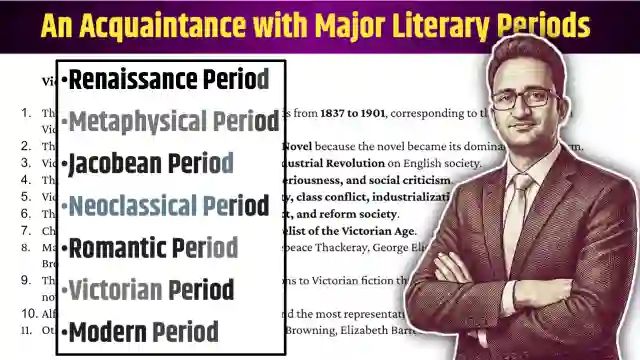
An Acquaintance with Major Literary Periods: For competitive exams such as RPSC, UGC NET, SET, TGT, PGT, and other English literature examinations, questions on literary periods are asked regularly. This article, “An Acquaintance with Major Literary Periods,” presents the Renaissance, Metaphysical, Jacobean, Neoclassical, Romantic, Victorian, and Modern periods in a simple and easy-to-remember way. The key points given here are short, clear, and exam-oriented, making them useful for quick revision as well as concept building.
Renaissance Period in English Literature
- The Renaissance in English literature marks the transition from the Medieval Age to the Modern Age.
- The English Renaissance is generally dated from the late 15th century to the early 17th century.
- Humanism is the central philosophy of the Renaissance, emphasizing human dignity, reason, and potential.
- Renaissance writers revived the classical learning of ancient Greece and Rome.
- Literature shifted its focus from religious themes to human life and worldly experiences.
- The Elizabethan Age (1558–1603) is regarded as the Golden Age of the English Renaissance.
- The Renaissance witnessed the golden age of English drama.
- Blank verse became the most important dramatic verse form of the period.
- The sonnet gained immense popularity during the Renaissance through Italian influence.
- Renaissance literature celebrates individualism, curiosity, and self-expression.
- Writers emphasized reason, education, and intellectual inquiry over blind tradition.
- The printing press helped spread Renaissance ideas and made literature widely accessible.
- Renaissance prose became more polished, elegant, and expressive.
- The period encouraged experimentation with new literary forms and styles.
- William Shakespeare is the greatest literary figure of the English Renaissance.
- Renaissance literature reflects optimism, confidence, and faith in human achievement.
- Themes of love, ambition, power, beauty, and nature dominate Renaissance writing.
- Renaissance literature combines classical ideals with Christian beliefs.
- Patronage by the Tudor monarchs, especially Queen Elizabeth I, promoted literary growth.
Metaphysical Period in English Literature
- The Metaphysical Period flourished mainly during the early 17th century (c. 1600–1660).
- The term “Metaphysical Poets” was first used by Samuel Johnson in Lives of the Poets.
- John Donne is regarded as the father and leading poet of the Metaphysical School.
- Metaphysical poetry is known for its fusion of intellect and emotion.
- The most distinctive feature of Metaphysical poetry is the use of conceits (far-fetched and ingenious comparisons).
- Metaphysical poets employed wit to express profound philosophical and emotional ideas.
- Their poems often explore the themes of love, religion, death, immortality, and spirituality.
- They frequently used paradox to reveal deeper truths.
- Argumentative and logical reasoning is a hallmark of Metaphysical poetry.
- Metaphysical poets preferred colloquial and conversational language over ornamental diction.
- Their poetry contains unexpected imagery drawn from science, astronomy, geography, and mathematics.
- Metaphysical poems often begin with an abrupt or dramatic opening.
- The poetry reflects the influence of the Scientific Revolution and Renaissance learning.
- George Herbert is best known for his devotional and religious Metaphysical poetry.
- Andrew Marvell combined love, politics, and philosophy in his Metaphysical verse.
- Other important Metaphysical poets include Henry Vaughan, Richard Crashaw, and Abraham Cowley.
- Metaphysical poetry gives equal importance to thought and feeling, unlike purely emotional poetry.
- The style is often complex, compact, and intellectually challenging.
- The Metaphysical poets were revived and highly praised in the 20th century by T. S. Eliot for their unified sensibility.
- Conceit, wit, paradox, irony, and intellectual depth are the five most frequently tested characteristics of Metaphysical poetry in competitive examinations.
Jacobean Period in English Literature
- The Jacobean Period corresponds to the reign of James VI and I from 1603 to 1625.
- The word “Jacobean” is derived from Jacobus, the Latin form of the name James.
- The Jacobean Age immediately followed the Elizabethan Age and preceded the Caroline Age.
- Jacobean literature is marked by a darker, more pessimistic outlook than Elizabethan literature.
- Revenge tragedy reached its peak during the Jacobean Period.
- Themes of corruption, ambition, betrayal, greed, and moral decay dominate Jacobean literature.
- William Shakespeare wrote his greatest tragic plays during the Jacobean Age, including Macbeth, King Lear, Othello, and The Tempest.
- Ben Jonson became the leading dramatist after Shakespeare during the Jacobean Period.
- Jacobean drama often portrays violent crimes, political intrigue, and psychological conflict.
- The influence of the Metaphysical Poets, especially John Donne, became prominent during this period.
- The King James Bible (1611) is one of the greatest prose works of the Jacobean Age.
- Court patronage under King James I encouraged the growth of drama, poetry, and prose.
- Jacobean playwrights frequently explored the conflict between appearance and reality.
- The period saw the rise of city comedies, depicting urban life with satire and realism.
- Jacobean tragedies generally have complex plots, shocking endings, and tragic heroes.
- Blank verse remained the dominant verse form in Jacobean drama.
- The literature of the period reflects political uncertainty and religious tensions in early 17th-century England.
- The Jacobean Age witnessed the continued popularity of public theatres such as Globe Theatre.
- Major Jacobean dramatists include John Webster, Thomas Middleton, Francis Beaumont, and John Fletcher.
- King James I, revenge tragedy, dark realism, Shakespeare’s major tragedies, Ben Jonson, and the King James Bible are the most frequently tested Jacobean topics in competitive examinations.
Neoclassical Period in English Literature
- The Neoclassical Period in English literature is generally dated from 1660 to 1798.
- The period began with the Restoration of the monarchy under Charles II in 1660.
- Neoclassicism was inspired by the classical literature of ancient Greece and Rome.
- Reason, order, balance, and restraint are the chief ideals of Neoclassical literature.
- The Neoclassical Age is also known as the Age of Reason.
- The period is commonly divided into the Restoration Age (1660–1700), Augustan Age (1700–1745), and Age of Sensibility (1745–1798).
- The heroic couplet became the dominant poetic form of the Neoclassical Age.
- Alexander Pope is regarded as the greatest poet of the Neoclassical Age.
- John Dryden is known as the Father of English Literary Criticism and the first great writer of the Neoclassical Age.
- Satire emerged as the most popular literary form during this period.
- Neoclassical writers emphasized decorum, discipline, and adherence to established literary rules.
- Literature was considered a means to instruct as well as entertain.
- Samuel Johnson became the leading literary critic and lexicographer of the age.
- The essay flourished through writers like Joseph Addison and Richard Steele.
- The rise of the English novel began during the Neoclassical Period with writers such as Daniel Defoe, Samuel Richardson, and Henry Fielding.
- Neoclassical literature values clarity, simplicity, precision, and logical expression.
- Writers believed that human nature is constant and universal, reflecting classical ideals.
- The Age of Sensibility gradually shifted emphasis from reason to emotion, preparing the way for Romanticism.
- The Neoclassical Period ended with the publication of Lyrical Ballads (1798) by William Wordsworth and Samuel Taylor Coleridge.
- Reason, satire, heroic couplet, Alexander Pope, John Dryden, Samuel Johnson, and the three divisions of the age are the most frequently asked topics in competitive examinations.
Romantic Period in English Literature
- The Romantic Period in English literature is generally dated from 1798 to 1837.
- The publication of Lyrical Ballads (1798) by William Wordsworth and Samuel Taylor Coleridge marks the beginning of the Romantic Age.
- Romanticism emerged as a reaction against the reason and formalism of Neoclassicism.
- Imagination is regarded as the supreme creative power in Romantic literature.
- Romantic poets celebrated nature as a source of beauty, truth, and spiritual inspiration.
- The movement emphasized emotion, feeling, and individual experience over reason.
- Romantic literature values freedom, originality, and self-expression.
- The French Revolution (1789) greatly influenced the ideals of the Romantic Movement.
- The first generation of Romantic poets consists of William Wordsworth, Samuel Taylor Coleridge, and Robert Southey, collectively known as the Lake Poets.
- The second generation includes Lord Byron, Percy Bysshe Shelley, and John Keats.
- William Wordsworth defined poetry as “the spontaneous overflow of powerful feelings.”
- Romantic poetry favors simple language and the lives of ordinary people.
- The Romantic hero is typically rebellious, imaginative, and independent.
- Romantic writers often explored the supernatural, mystery, dreams, and medievalism.
- Childhood is presented as a state of innocence and spiritual purity in Romantic literature.
- The movement gave prominence to lyric poetry as the finest expression of personal emotion.
- Jane Austen and Walter Scott are major novelists associated with the Romantic Age.
- The Romantic Period witnessed a renewed interest in folk traditions, legends, and the Middle Ages.
- The Romantic Age gradually ended with the accession of Queen Victoria in 1837, ushering in the Victorian Age.
- Lyrical Ballads, imagination, nature, emotion, Lake Poets, French Revolution, and Wordsworth’s definition of poetry are among the most frequently asked Romantic Age topics in competitive examinations.
Victorian Period in English Literature
- The Victorian Period in English literature extends from 1837 to 1901, corresponding to the reign of Queen Victoria.
- The Victorian Age is often called the Age of the Novel because the novel became its dominant literary form.
- Victorian literature reflects the impact of the Industrial Revolution on English society.
- The period is characterized by realism, moral seriousness, and social criticism.
- Victorian writers explored issues such as poverty, class conflict, industrialization, and urbanization.
- The Victorian novel aimed to entertain, instruct, and reform society.
- Charles Dickens is regarded as the greatest novelist of the Victorian Age.
- Major Victorian novelists include William Makepeace Thackeray, George Eliot, Thomas Hardy, and Charlotte Brontë.
- The Brontë sisters made significant contributions to Victorian fiction through psychological and social novels.
- Alfred, Lord Tennyson was the Poet Laureate and the most representative poet of the Victorian Age.
- Other important Victorian poets include Robert Browning, Elizabeth Barrett Browning, and Matthew Arnold.
- The dramatic monologue became a major poetic form during the Victorian Period.
- Victorian literature often reflects a conflict between religious faith and scientific discovery.
- Charles Darwin’s On the Origin of Species profoundly influenced Victorian thought.
- Victorian prose flourished through the essays and criticism of Thomas Carlyle, John Ruskin, and Matthew Arnold.
- Victorian literature emphasizes duty, respectability, family values, and moral responsibility.
- Realistic characterization and detailed descriptions of everyday life are hallmarks of Victorian fiction.
- The Victorian Age also witnessed the growth of children’s literature and detective fiction.
- The Victorian Period ended with the death of Queen Victoria in 1901, leading into the Modern Age.
- Age of the Novel, Charles Dickens, Alfred Tennyson, dramatic monologue, realism, Industrial Revolution, and Darwin’s influence are the most frequently asked Victorian topics in competitive examinations.
Modern Period in English Literature
- The Modern Period in English literature is generally dated from 1901 to 1945, though some scholars extend it to the mid-20th century.
- Modernism emerged as a reaction against Victorian values, traditions, and literary conventions.
- The First World War (1914–1918) profoundly shaped Modern literature.
- Modern writers expressed disillusionment, alienation, and the loss of traditional beliefs.
- Experimentation in form and style is the defining characteristic of Modern literature.
- The stream of consciousness technique became a major narrative method in Modern fiction.
- James Joyce and Virginia Woolf are the foremost practitioners of the stream of consciousness technique.
- T. S. Eliot is regarded as the most influential poet of the Modern Age.
- The Waste Land (1922) is considered the greatest poem of Modernism.
- Modern poetry is marked by free verse, symbolism, fragmentation, and allusion.
- Modern literature often presents psychological realism rather than external action.
- Themes of identity, isolation, anxiety, and the meaninglessness of life dominate Modern writing.
- W. B. Yeats serves as a bridge between the Victorian and Modern periods.
- D. H. Lawrence explored human relationships, sexuality, and industrial society in his novels.
- Modern drama was transformed by George Bernard Shaw through his plays of ideas and social criticism.
- The influence of Sigmund Freud and Carl Jung encouraged writers to explore the human subconscious.
- Modern literature rejected ornamental language in favor of precision, ambiguity, and suggestiveness.
- The Second World War (1939–1945) further intensified themes of despair, uncertainty, and cultural crisis.
- Important Modern novelists include E. M. Forster, Joseph Conrad, and Virginia Woolf.
- The Waste Land, stream of consciousness, T. S. Eliot, James Joyce, Virginia Woolf, World Wars, and experimentation are the most frequently asked Modern Age topics in competitive examinations.
Download Major Literary Periods as PDF : Click Here
Discover more from GYANKUNDLI
Subscribe to get the latest posts sent to your email.