John Keats’s Ode to a Nightingale begins with birdsong but soon enters a far more troubled space. The speaker longs to leave behind illness, worry, ageing, and death, yet the beauty of the nightingale’s song makes that escape feel possible for a moment.
Written in May 1819 at Hampstead, the poem came after Keats had nursed his brother Tom, who died of tuberculosis in December 1818. Keats also faced financial pressure and early signs of the illness that would end his life in 1821. This article gives a clear stanza-by-stanza summary, followed by themes, symbols, and poetic devices useful for literature study and examinations.
Ode to a Nightingale Key Takeaways
- Ode to a Nightingale is an 80-line Romantic ode about beauty, suffering, imagination, and death.
- The nightingale’s song suggests joy and artistic permanence, while human life appears fragile and temporary.
- The speaker first considers wine as an escape, then chooses poetry and imagination.
- The poem ends without certainty, as the speaker cannot tell whether his experience was real or dreamlike.
- Keats balances pleasure with pain, rather than offering an easy escape from reality.
What Is Ode to a Nightingale About?
Keats’s poem contains eight stanzas of ten lines each. It follows the rhyme pattern ABABCDECDE and is written mainly in iambic pentameter. Its regular music gives the poem a controlled form, even while the speaker’s thoughts move through longing, delight, fear, and confusion.
The ode belongs to English Romanticism, a movement that gave great importance to nature, powerful emotion, imagination, and individual experience. Romantic poets often saw nature as more than scenery. A bird, a stream, or a season could open the mind to beauty and mystery.
In this poem, the nightingale sings without concern for human suffering. Its music seems free from illness, old age, and loss. By contrast, the speaker feels trapped in a world where people grow tired, fall ill, and die. The poem’s central conflict lies between the bird’s apparently joyful existence and the speaker’s awareness of mortality.
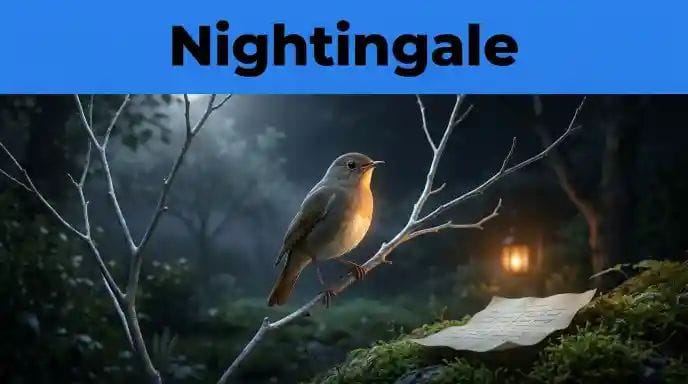
Keats wrote the poem after hearing a real nightingale near Wentworth Place, where he stayed with his friend Charles Armitage Brown. The bird is real, yet it becomes a symbol of something larger: art, freedom, and beauty that seem to outlast an individual human life. For a useful overview of the poem’s movement between joy and human loss, read this summary and analysis of Keats’s ode.
Ode to a Nightingale: Stanza-by-Stanza Summary
In the first stanza, the speaker feels physical and mental numbness. His heart aches, and he compares his condition to having taken hemlock or opium. However, he is not jealous of the nightingale. He feels “too happy” because he has entered so fully into the bird’s happiness. This is a striking paradox: pleasure becomes so intense that it causes pain.
The second stanza introduces wine as a possible escape. The speaker wishes for a vintage drink that would allow him to disappear into the forest with the bird. Wine promises warmth, forgetfulness, and freedom from ordinary life. He wants to leave the human world without being seen.
By the third stanza, the reason for his wish becomes clear. Human life is full of weariness, fever, anxiety, and disappointment. Young people grow pale and die. Beauty fades, and love cannot remain new forever. Keats presents human happiness as brief because time changes everything.
In the fourth stanza, the speaker rejects wine. Instead, he chooses “Poesy”, meaning poetry and imagination. Poetry becomes a stronger means of escape because it needs no physical drink. The imagination seems to carry him through the darkness and into the nightingale’s world.
This shift matters in exam answers. Wine offers temporary forgetfulness, while poetry offers a creative experience. Yet the poem later shows that even imagination cannot remove the speaker from reality permanently. A detailed close reading of Keats’s major odes can help students compare this poem with his other work from 1819.
The forest, the wish for death, and the immortal song
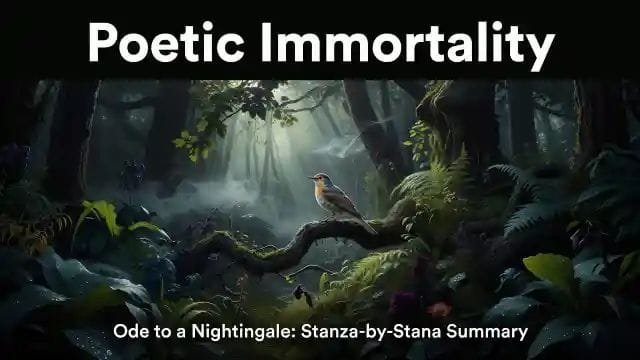
The fifth stanza places the speaker in a dark forest. He cannot see the flowers around him, but he can recognise them through scent. Keats creates a rich sensory scene through fragrances of hawthorn, eglantine, violets, and musk-rose. The darkness does not feel empty. Instead, it is alive with natural growth and birdsong.
In the sixth stanza, the speaker thinks of death. He calls it “rich” because dying at that moment would allow him to leave life while hearing the nightingale’s perfect song. Death seems peaceful and beautiful beside the misery of human life. Still, the idea contains sadness. If he dies, the bird will continue to sing, but he will no longer be able to hear it.
The seventh stanza calls the nightingale “immortal”. Keats does not mean that one particular bird lives forever. Rather, the song seems eternal because generations have heard similar birdsong. The same voice may have comforted Ruth when she stood in a foreign land, remembering her home. It has also reached emperors and clowns, which suggests that music crosses differences of class and power.
The final stanza breaks the dream. The word “Forlorn” sounds like a bell that calls the speaker back to ordinary consciousness. The nightingale flies away, and its song fades across fields and valleys. Left alone, the speaker asks whether the experience was a vision or a waking dream. Keats gives no firm answer.
Key Themes and Literary Devices in the Poem
Mortality, transience, and the desire for permanence
Human mortality shapes every stage of the ode. The speaker thinks of sickness, old age, fading beauty, and death because these experiences belong to human life. His memories of pain make the nightingale’s freedom seem almost impossible to reach.
Keats had recently lost Tom, and this personal grief gives force to the poem’s language of weakness and loss. The speaker does not simply admire a lovely bird. He hears in its song an alternative to the human condition.
The contrast between the speaker and the nightingale is also a contrast between change and permanence. Human youth disappears. Love may fade. The bird’s song, however, seems to continue across centuries. The poem therefore becomes an elegy for beautiful moments that cannot last.
The speaker wants permanence, but he can only experience it briefly through art and imagination.
Imagination, nature, and the conflict between ideal and reality
Nature offers the speaker relief from the crowded world of human suffering. The forest is dark, fragrant, and full of unseen life. It gives him a momentary sense of belonging beyond his own grief.
However, the speaker cannot remain there. Imagination carries him towards the nightingale, but “Forlorn” brings him back. The final question proves that the poem does not settle the difference between dream and reality.
This uncertainty connects with Keats’s idea of negative capability. He valued the ability to remain with mystery without forcing a neat answer. The ending is powerful because it leaves the speaker suspended between two states of mind.
The nightingale appears free because it sings naturally, without self-conscious thought. The speaker, by contrast, cannot forget his own identity or mortality for long. A clear study guide on the poem’s themes can support revision of this conflict between art and ordinary life.
Symbols, imagery, allusion, and sound patterns
The nightingale is the poem’s central symbol. It suggests joy, freedom, natural beauty, and the lasting power of art. Its song survives in the speaker’s imagination even after the bird disappears.
Wine symbolises a bodily escape through intoxication. “Poesy” symbolises the imaginative power of poetry. The word “Forlorn” acts like a warning bell, ending the speaker’s temporary union with the bird’s world.
Keats uses sensory imagery throughout the ode:
- Sound appears in the nightingale’s song, the word “Forlorn”, and the fading music.
- Scent appears in the flowers of the dark forest.
- Colour appears in the imagined wine and summer landscape.
- Touch and taste appear in the speaker’s desire for cool drink and physical release.
The poem also includes the biblical allusion to Ruth, whose loneliness makes the nightingale’s song seem ancient and universal. The mention of “emperor and clown” widens the song’s reach across social divisions.
Alliteration strengthens the poem’s musical quality, while the regular stanza form gives shape to the speaker’s wandering thoughts. Paradoxes such as “too happy” and “aching pleasure” show that beauty can create pain when it reminds us of what we cannot keep.
Critical Appreciation and Exam-Focused Takeaways
Ode to a Nightingale is powerful because Keats does not treat escape as a complete answer. The speaker reaches a beautiful world through song and imagination, but illness, loneliness, and mortality return. The poem’s movement is emotional, yet its thought remains disciplined.
For examination answers, students can focus on these points:
- The poem has major Romantic features, including nature, emotion, imagination, and subjective experience.
- The nightingale suggests artistic permanence and freedom from human suffering.
- Keats contrasts the changing human world with the apparently timeless song.
- Death attracts the speaker because it seems peaceful, but it would also end his ability to hear beauty.
- “Forlorn” breaks the imaginative spell and returns him to reality.
- The ending remains unresolved because Keats accepts uncertainty.
A strong answer should explain both sides of the poem. The nightingale offers comfort, yet that comfort is temporary. Keats never allows the reader to forget the limits of human life.
Conclusion
Keats’s Ode to a Nightingale remains memorable because it expresses a universal wish to escape pain and enter a world of beauty. The nightingale’s song gives the speaker temporary comfort through nature and imagination.
However, the poem does not allow that dream to last. Reality returns with its loneliness, suffering, and awareness of death. Its lasting strength lies in this balance of pleasure and sadness, hope and loss, dream and waking life.
Discover more from GYANKUNDLI
Subscribe to get the latest posts sent to your email.