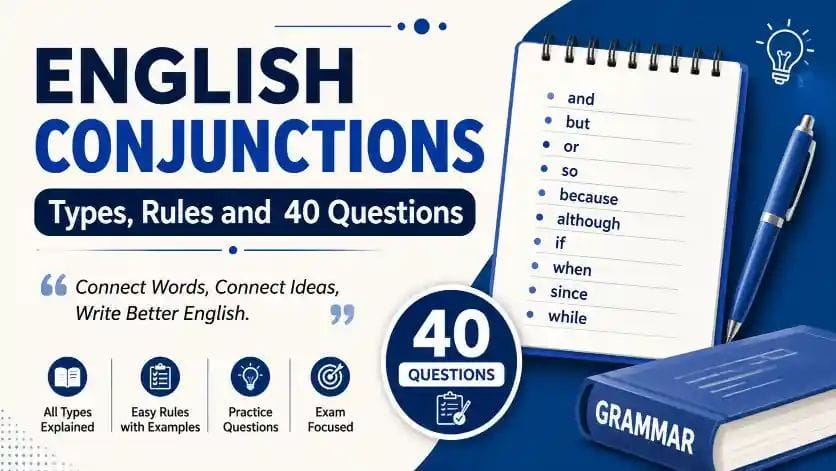
A sentence can contain strong ideas but still feel broken if the links between them are missing. English conjunctions connect words, phrases, and clauses, so your writing sounds complete and logical.
Students often know common linking words such as and, but, and because, yet punctuation and the way these connecting words function can cause mistakes. Mastering the different types of conjunctions helps you choose the right term and improves your overall sentence structure.
Conjunctions Key Takeaways
- Conjunctions serve as essential connectors that link words, phrases, and clauses within a sentence.
- Coordinating conjunctions join equal grammatical units, such as words or independent clauses, to create fluid sentences.
- Subordinating conjunctions establish clear relationships between clauses, indicating factors like reason, time, condition, and contrast.
- Correlative conjunctions work in specific pairs to connect sentence elements and require a balanced, parallel structure.
- Proper use of commas depends on the specific type of clause being linked, rather than relying solely on the conjunction used.
What Is a Conjunction?
A conjunction is a joining word, often referred to as a linking word or connecting word. It serves to connect two nouns, two verb phrases, two complete clauses, or a main clause and a dependent clause.
For some common conjunction examples, consider the following:
- Riya bought a notebook and a dictionary.
- The students listened carefully but did not take notes.
- We stayed indoors because the weather became stormy.
In the first sentence, and joins two nouns. In the second, but joins two verb phrases. In the third, because connects an action with its reason.
Conjunctions prevent writing from becoming a series of short, disconnected statements. Compare these examples:
The library was closed. We studied at home.
The ideas make sense, but the relationship is unclear. A conjunction adds that missing relationship, helping to establish logical relationships between your ideas:
The library was closed, so we studied at home.
The word so shows result. In contrast, but would show an unexpected difference, while because would introduce a reason.
For a broader explanation with examples, see this guide to conjunctions and their uses, which explores these essential parts of speech in greater detail. In grammar questions, first identify what the joining word connects. That step usually reveals its type.
The Three Main Types of Conjunctions
English grammar usually classifies conjunctions into three main categories: coordinating, subordinating, and correlative. Each type serves a specific function in constructing clear and accurate sentences.
Coordinating conjunctions and FANBOYS
A coordinating conjunction joins items of equal grammatical importance, such as words, phrases, or clauses. Our conjunctions list is easily remembered through the acronym FANBOYS. By using these coordinating conjunctions, you can link two ideas effectively.
| Letter | Conjunction | Main use | Example |
|---|---|---|---|
| F | for | reason or explanation | I took a taxi, for the last bus had gone. |
| A | and | addition | Meera wrote the answers and checked them twice. |
| N | nor | negative addition | He did not apologise, nor did he explain. |
| B | but | contrast | The film was long, but the acting was excellent. |
| O | or | choice | Would you like tea or coffee? |
| Y | yet | surprising contrast | The path was steep, yet the children reached the top. |
| S | so | result | The roads flooded, so the match was postponed. |
For has a formal tone and is less common in everyday speech. It means roughly the same as because in some sentences. For example, “I left early, for I had an appointment” is grammatically correct, though “because” sounds more natural in conversation.
Use nor after a negative idea. It often requires inversion when it joins two complete clauses:
- She did not call, nor did she send a message.
- The museum was not open, nor was the cafe.
A coordinating conjunction joins two independent clauses when each side could stand alone as a sentence. To maintain proper grammar, you must use a comma before the conjunction when it links a full independent clause to another independent clause.
- The bell rang, and the candidates entered the hall.
- I wanted to attend, but I had a fever.
However, a comma is usually unnecessary when the conjunction joins shorter phrases:
- Kabir packed pens and pencils.
- The teacher spoke clearly but firmly.
- You can revise tonight or tomorrow morning.
A useful video lesson on conjunction types can help you remember the FANBOYS through spoken examples.
Subordinating conjunctions and dependent clauses
Subordinating conjunctions connect a dependent clause to an independent clause. You may also hear these referred to as a subordinate clause. These conjunctions are essential when you want to build complex sentences to demonstrate a specific cause and effect or show a relationship between ideas.
Consider this group of words:
Although the test was difficult.
It has a subject and verb, but it is incomplete. Although what? Add a main clause:
Although the test was difficult, most students finished it.
Common subordinating conjunctions include after, although, as, because, before, if, once, since, than, though, unless, until, when, whenever, where, while, and whereas.
| Relationship | Common conjunctions | Example |
|---|---|---|
| Reason | because, since, as | The class ended early because the teacher was unwell. |
| Time | when, before, after, until, while | Put your phone away before the lesson begins. |
| Condition | if, unless | You will improve if you practise daily. |
| Contrast | although, though, whereas, while | Although I revised, I felt nervous. |
| Purpose | so that | Speak clearly so that everyone can hear. |
| Comparison | than, as…as | The second paper was easier than we expected. |
The position of the dependent clause affects punctuation. If the dependent clause comes first, use a comma after it to separate it from the main clause. If the dependent clause follows the main clause, you generally do not need a comma.
- Because the printer failed, the office delayed the notices.
- The office delayed the notices because the printer failed.
Be careful with unless, which means “if not”. Avoid using both unless and not in a way that creates a double negative. Write “Unless you hurry, you will miss the train,” rather than “Unless you do not hurry, you will miss the train.”
Although and but both express contrast, but they do not belong in the same two-part structure.
- Correct: Although the shop was crowded, we found a seat.
- Correct: The shop was crowded, but we found a seat.
- Incorrect: Although the shop was crowded, but we found a seat.
For extra revision, this conjunction rules lesson gives further examples of how clauses connect.
Correlative conjunctions that work in pairs
Correlative conjunctions always appear in matching pairs. They link equal structures, so the words following each part should have the same grammatical form. Key pairs include either or, neither nor, and not only but also.
| Pair | Example |
|---|---|
| both…and | Both Neha and Farah answered correctly. |
| either…or | You can either submit the form online or hand it in at school. |
| neither…nor | Neither the rain nor the wind stopped the parade. |
| not only…but also | Arjun not only read the chapter but also made notes. |
| whether…or | I do not know whether the results will arrive today or tomorrow. |
Parallel structure is vital. If either comes before a verb phrase, or should introduce another verb phrase.
- Correct: The students will either revise at home or attend the workshop.
- Incorrect: The students will either revise at home or the workshop.
The incorrect sentence links a verb phrase with a noun phrase, making the grammar uneven. With either or and neither nor, the verb usually agrees with the subject nearest to it. Remember that a comma is often used for clarity in longer sentences involving these pairs.
- Either the teacher or the students are presenting.
- Either the students or the teacher is presenting.
- Neither the captain nor the players were ready.
Use this rule carefully in exams. In ordinary writing, you can often rewrite an awkward sentence to avoid confusion.
Rules and Punctuation for Conjunctions
Mastering the grammar rules for conjunctions is essential for clear writing. A conjunction does not automatically require a comma; instead, the structure on each side of the word determines whether punctuation is necessary.
Use a comma before FANBOYS when joining full clauses
When you use a coordinating conjunction to link two independent clauses, each side must have its own subject and verb. In these instances, you should place a comma before the conjunction.
- Correct: The bus arrived late, so we missed the first ten minutes.
- Correct: Sana checked the date, but she entered the wrong room.
- No comma needed: Sana checked the date but entered the wrong room.
In the final example, the subject Sana applies to both verbs. Because the second part does not form a full clause, a comma is not required.
Do not create a comma splice
A comma splice occurs when a writer incorrectly joins two independent clauses using only a comma. To avoid this, you can use a semicolon or include a conjunction to connect the ideas.
- Incorrect: The rain stopped, we left the centre.
- Correct: The rain stopped, so we left the centre.
- Correct: The rain stopped; we left the centre.
- Correct: The rain stopped. We left the centre.
While a semicolon can join closely related independent clauses, it does not work in every sentence. It is often better to use a conjunction when you want to show a clear relationship, such as a result.
Do not confuse conjunctions with conjunctive adverbs
Words such as however, therefore, instead, and meanwhile are technically conjunctive adverbs, not coordinating conjunctions. Because of this, they cannot join two complete clauses with a comma alone.
- Incorrect: I revised carefully, however, I forgot the formula.
- Correct: I revised carefully; however, I forgot the formula.
- Correct: I revised carefully. However, I forgot the formula.
Keep paired conjunctions balanced
When using paired conjunctions, also known as correlative conjunctions, you must ensure they connect matching grammatical forms to maintain balance.
- Correct: Both the principal and the teachers attended.
- Correct: She is interested not only in poetry but also in drama.
- Incorrect: She is interested not only in poetry but also to act.
The final sentence is incorrect because it mixes a prepositional phrase with an infinitive. To fix this, you should write, “She is interested not only in poetry but also in drama,” or “She likes not only reading poetry but also acting.”
Choose conjunctions by meaning
Grammar alone cannot select the right word; the relationship between your ideas is what matters most. Whether you are highlighting a contrast or establishing a timeline, your choice of conjunction directs the reader.
- Use because for a reason: We cancelled the trip because the train strike continued.
- Use so for a result: The train strike continued, so we cancelled the trip.
- Use although for contrast: Although the train strike continued, some passengers reached the city.
- Use if for a possible condition: If the train arrives, we will board it.
- Use unless for a negative condition: We will not leave unless the train arrives.
A good conjunction tells the reader how one idea relates to the next.
40 Conjunction Practice Questions and Examples
Identify the conjunction and its logical relationship
| No. | Question |
|---|---|
| 1 | Identify the conjunction and its type: “I wanted to help, but I had no information.” |
| 2 | Identify the conjunction and its type: “When the lights returned, the class cheered.” |
| 3 | Identify the conjunction and its type: “Both the coach and the players arrived early.” |
| 4 | Identify the conjunction and its type: “Would you prefer a window seat or an aisle seat?” |
| 5 | Identify the conjunction and its type: “Although the road was narrow, the driver remained calm.” |
| 6 | Identify the conjunction and its type: “Neither Amina nor Rahul knew the answer.” |
| 7 | Identify the conjunction and its type: “The dog barked because it heard thunder.” |
| 8 | Identify the conjunction and its type: “The suitcase was heavy, yet Mira carried it upstairs.” |
| 9 | Identify the conjunction and its type: “Stay here until I return.” |
| 10 | Identify the conjunction and its type: “Not only did he apologise, but he also repaired the chair.” |
These conjunction examples help you practice identifying the logical relationships that connect different parts of a sentence.
Fill in the blanks
| No. | Question |
|---|---|
| 11 | I wore a coat ______ the morning was cold. |
| 12 | You may borrow my calculator, ______ please return it tomorrow. |
| 13 | ______ you revise regularly, you will remember more. |
| 14 | The film had started ______ we reached the cinema. |
| 15 | Neither the manager ______ the receptionist was available. |
| 16 | We can leave now ______ wait for the next bus. |
| 17 | ______ she was tired, Priya completed her assignment. |
| 18 | The baby slept ______ her father cooked dinner. |
| 19 | You will not pass ______ you answer enough questions correctly. |
| 20 | The teacher asked whether we had read the poem ______ watched the lecture. |
Join each pair of sentences
| No. | Question |
|---|---|
| 21 | Join with and: The bell rang. The pupils entered the classroom. |
| 22 | Join with but: I invited Omar. He could not attend. |
| 23 | Join with because: The match was cancelled. The ground was wet. |
| 24 | Join with although: The bag was small. It held all my books. |
| 25 | Join with so: The shop had no envelopes. We went to another shop. |
| 26 | Join with unless: You must carry your identity card. You cannot enter the examination hall without it. |
| 27 | Join with either…or: We can travel by bus. We can travel by train. |
| 28 | Join with not only…but also: Lata sings well. Lata plays the violin well. |
Add punctuation or correct the error
| No. | Question |
|---|---|
| 29 | Add punctuation: “The bell rang and the candidates entered.” |
| 30 | Add punctuation: “Because the roads were blocked we arrived late.” |
| 31 | Correct the comma splice: “The sky became dark, we switched on the lights.” |
| 32 | Correct the sentence: “Although it was late but we continued studying.” |
| 33 | Correct the sentence: “Either the teachers or the principal are attending the meeting.” |
| 34 | Add punctuation: “I packed a ruler a pen and a notebook for the test.” |
| 35 | Correct the sentence: “She neither likes coffee or tea.” |
| 36 | Correct the sentence: “I was unwell, therefore I stayed at home.” |
| 37 | Correct the sentence: “Both Rohan as well as Zoya won prizes.” |
| 38 | Correct the sentence: “He asked that if I had completed the work.” |
| 39 | Correct the sentence: “The students revised because they wanted to pass, and.” |
| 40 | Correct the sentence: “Unless you do not leave now, you will miss the bus.” |
Answers to the Practice Questions
Use these conjunction examples to check your understanding of the grammar rules covered in this guide.
| No. | Answer |
|---|---|
| 1 | But, coordinating conjunction. It shows contrast between two independent clauses. |
| 2 | When, subordinating conjunction. It introduces a time clause. |
| 3 | Both…and, correlative conjunctions. |
| 4 | Or, coordinating conjunction. It presents a choice. |
| 5 | Although, subordinating conjunction. It introduces contrast. |
| 6 | Neither…nor, correlative conjunctions. |
| 7 | Because, subordinating conjunction. It gives a reason. |
| 8 | Yet, coordinating conjunction. It shows unexpected contrast. |
| 9 | Until, subordinating conjunction. It expresses time. |
| 10 | Not only…but also, correlative conjunctions. |
| 11 | because |
| 12 | but |
| 13 | If |
| 14 | before |
| 15 | nor |
| 16 | or |
| 17 | Although |
| 18 | while |
| 19 | unless |
| 20 | or |
| 21 | The bell rang, and the pupils entered the classroom. |
| 22 | I invited Omar, but he could not attend. |
| 23 | The match was cancelled because the ground was wet. |
| 24 | Although the bag was small, it held all my books. |
| 25 | The shop had no envelopes, so we went to another shop. |
| 26 | You cannot enter the examination hall unless you carry your identity card. |
| 27 | We can travel either by bus or by train. |
| 28 | Lata not only sings well but also plays the violin well. |
| 29 | The bell rang, and the candidates entered. A comma is needed because both sides are complete clauses. |
| 30 | Because the roads were blocked, we arrived late. |
| 31 | The sky became dark, so we switched on the lights. A full stop or semicolon would also work. |
| 32 | Although it was late, we continued studying. Remove but because although already shows contrast in these conjunction examples. |
| 33 | Either the teachers or the principal is attending the meeting. The nearer subject, principal, is singular. |
| 34 | I packed a ruler, a pen and a notebook for the test. |
| 35 | She likes neither coffee nor tea. Use neither…nor as a correlative pair. |
| 36 | I was unwell; therefore, I stayed at home. Therefore is a linking adverb, not a coordinating conjunction. |
| 37 | Both Rohan and Zoya won prizes. Do not combine both…and with as well as. |
| 38 | He asked if I had completed the work. Remove that before an if clause. |
| 39 | The students revised because they wanted to pass. Remove the unnecessary and. |
| 40 | Unless you leave now, you will miss the bus. Unless already carries a negative meaning. |
Frequently Asked Questions
What is the main difference between coordinating and subordinating conjunctions?
Coordinating conjunctions link two equal grammatical elements, such as two independent clauses, and are easily remembered by the FANBOYS acronym. Subordinating conjunctions connect a dependent clause to an independent one, establishing specific relationships like time, reason, or condition.
Do I always need a comma before a conjunction?
No, you only need a comma before a coordinating conjunction when it connects two independent clauses. If the conjunction links shorter phrases or a dependent clause to an independent one, a comma is usually unnecessary or governed by different placement rules.
Can I start a sentence with a conjunction?
Yes, it is perfectly acceptable in modern English to start a sentence with a coordinating or subordinating conjunction. This technique can be an effective way to transition between ideas or add emphasis to your writing.
Final Thoughts
Conjunctions give sentences shape because they show addition, contrast, reason, time, choice, and condition. Once you can identify the clauses around a conjunction, choosing the right word and punctuation becomes much easier. Mastering English conjunctions allows you to connect ideas more effectively and refine your overall English grammar.
Practise by joining short sentences in more than one way. A change from because to although can change the whole meaning of a sentence, as these linking words are essential for improving your sentence structure. By focusing on how different conjunctions highlight logical relationships, you will find it much simpler to communicate your thoughts with precision and clarity.
Discover more from GYANKUNDLI
Subscribe to get the latest posts sent to your email.