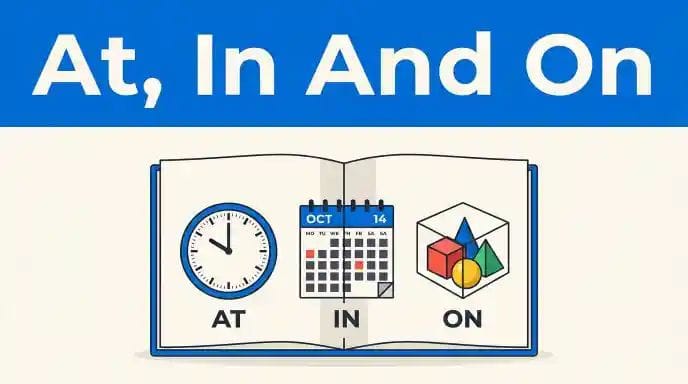
At In On Prepositions : Small words can cause large mistakes. Mastering the at in on prepositions is essential for clear communication, as these words often look interchangeable despite carrying different meanings. Whether you are dealing with prepositions of time or prepositions of place, each one provides a distinct perspective.
The useful pattern is simple: at points to a precise point, on connects to a surface or a day, and in places something inside a space or a longer period. Once you see that pattern, many grammar questions become significantly easier to solve.
At, In and On Prepositions : Key Takeaways
- Use at for specific times and precise points, such as at 8.00 or at the bus stop.
- Use on for days of the week, dates, surfaces and public transport, such as on Monday or on the table.
- Use in for months and years, an enclosed space and larger areas, such as in July or in London.
- Learn common fixed phrases, including at night, in the morning, on time and in time.
- Read the whole sentence before choosing a preposition in an exam.
Using At, In and On for Prepositions of Time
When you describe time, the choice depends on how exact the period is. At is the most precise, on usually refers to a particular day or date, and in refers to a longer period.
The British Council’s guide to prepositions of time gives a useful starting point: use at with clock times, then widen the time period for on and in.
| Preposition | Main time use | Examples |
|---|---|---|
| at | Exact clock times or a short point | at 7.30, at noon, at midnight |
| on | Days and specific dates | on Tuesday, on 15 August, on my birthday |
| in | Months, years, seasons and longer periods | in May, in 2026, in winter |
Use at with clock times and specific times:
- The lesson begins at 9.00.
- We had lunch at noon.
- The train arrived at midnight.
Use on with a named day, specific dates, or a part of a particular day:
- My exam is on Thursday.
- India’s Independence Day is on 15 August.
- We met on Friday evening.
Use in with months and years, seasons, and parts of the day:
- Her birthday is in November.
- Charles Dickens was born in 1812.
- It often rains in summer.
- I revise grammar in the morning, afternoon evening, or at night.
Some phrases do not follow the broad pattern exactly, so learn them as complete expressions. We say at night, but we use in the morning, in the afternoon and in the evening. We also include holiday periods such as at Christmas, and in UK English, we use at the weekend or at weekends.
Do not add a preposition before expressions such as this morning, next week, last year or every day. Write, “I have a test next Monday”, not “I have a test on next Monday”.
Using At, In and On as Prepositions of Place
Prepositions of place follow a similar logic to time. We use at to identify a point of location, on when something rests upon a flat surface, and in when something is contained within an enclosed space.
| Preposition | Main place use | Examples |
|---|---|---|
| at | A point, event or specific location | at the gate, at school, at the station |
| on | A surface, line or public transport | on the floor, on page 10, on the bus |
| in | An enclosed space or larger area | in a box, in a room, in Scotland |
Use at when referring to a specific location where the exact size is less important than the point itself:
- Meet me at the library.
- She is waiting at the entrance.
- My sister studies at university.
- They stopped at a petrol station.
Use on when an item rests upon a flat surface:
- Your phone is on the desk.
- There is a map on the wall.
- Read the paragraph on page 24.
We also use on with various forms of public transport, such as buses, trains, planes and ships, because you can move around inside them. Conversely, use in when referring to a private vehicle like a car or a taxi:
- We travelled on the train.
- He left his umbrella in the taxi.
Use in for an enclosed space, such as a room or a building, or for geographical areas with defined boundaries:
- The students are in the classroom.
- My uncle lives in Birmingham.
- There is milk in the fridge.
- She found the answer in the book.
For further examples of how these prepositions function, see Grammarly’s explanation of in, on and at.
Important Exceptions and Common Confusions
A prepositional phrase can often be part of fixed expressions that change the meaning of a sentence entirely. These are frequently featured in grammar tests because the incorrect choice may seem plausible at first glance.
One common source of confusion is the distinction between on time vs in time. Using on time means that something is punctual or happens at the scheduled moment, while in time means that something is done early enough before a deadline or event.
- The candidate reached the examination centre on time.
- We arrived in time to catch the last bus.
Similarly, at the end refers to the final point of something, such as a book or a movie. In contrast, in the end means finally, after a period of time or a series of difficulties.
- Write your name at the end of the answer sheet.
- In the end, the team completed the project.
Location can also change meaning. A visitor waiting for a friend stands at the hospital, while a patient is in hospital receiving treatment. Likewise, someone might be at school as part of their daily routine, whereas a pupil is in school when discussing their formal education.
Always choose the correct preposition by considering the relationship between the noun and the specific context of time or place, rather than translating directly from another language.
When discussing location, there is a clear hierarchy of precision. Street names usually take on, as in on King Street. For larger areas such as cities and countries, use in, such as in London or in England. When providing full addresses, use at, as in at 10 Downing Street. Mastering these nuances for addresses will help you navigate both casual conversation and formal writing with greater accuracy.
A Quick Method for Grammar Exams
When you are preparing for grammar exams, the most effective strategy is to use the triangle method. This technique involves moving from general to specific when choosing the correct preposition for both time and location. Start by identifying whether the sentence describes time or place. Next, ask yourself if the noun refers to a broad area, a specific surface, or a precise point. Following this general to specific approach significantly narrows down your choices and helps you avoid common pitfalls.
For time questions, look for clues such as a clock time, date, month, or part of the day. For place questions, notice whether the noun represents a surface, a building, a city, or a vehicle. By visualising these categories, you can easily determine whether to use at, in, or on based on the level of specificity required.
When using an OMR sheet, decide on the answer before filling the circle. Once you have made your choice, read the whole sentence once more to ensure it sounds natural. Engaging in regular practice with an at, in, and on grammar challenge can help you build the speed and confidence needed to master these prepositions without relying on guesswork.
30 Questions on At, In and On
If you want to master these common prepositions, practice is essential. Choose the correct option of at, in, or on to complete each sentence below. These exercises cover the rules for time and place discussed in our guide.
- The train leaves ___ 8.40.
- My birthday is ___ 3 September.
- Our final examinations are ___ June.
- I usually study ___ the evening.
- Many people sleep ___ night.
- We have a science test ___ Friday afternoon.
- Please arrive ___ time for the interview.
- We reached the station ___ time to catch the train.
- My family moved to this town ___ 2024.
- The cafe closes ___ noon.
- Your keys are ___ the table.
- I will wait for you ___ the bus stop.
- My cousins live ___ Manchester.
- The diagram is ___ page 12.
- My aunt works ___ St Thomas’ Hospital.
- The pupils are sitting ___ the classroom.
- We travelled to London ___ the bus.
- She arrived ___ a taxi.
- The library is ___ King Street.
- I left my bag ___ the car.
- Meet me ___ the main entrance.
- There is a painting ___ the wall.
- The fish are swimming ___ the aquarium.
- Our flight lands ___ Heathrow Airport.
- He lives ___ 18 Rose Road.
- The restaurant is ___ the city centre.
- The pharmacy is ___ the left side of the road.
- My brother is ___ university this year.
- Put your notebook ___ the desk.
- My parents are ___ home.
Answer Key
Use this comprehensive answer key to check your progress as you master the rules for using at, in and on. If you have been working through these 30 practice questions to improve your English grammar, compare your results below to identify which preposition of time or place you might still need to review.
- at
- on
- in
- in
- at
- on
- on
- in
- in
- at
- on
- at
- in
- on
- at
- in
- on
- in
- on
- in
- at
- on
- in
- at
- at
- in
- on
- at
- on
- at
Frequently Asked Questions
Why do we say ‘in the morning’ but ‘at night’?
English follows specific idiomatic patterns for different parts of the day. While ‘in’ is generally used for periods like mornings, afternoons, and evenings, ‘at night’ is a fixed expression that functions as an exception to the standard rules.
Can I use ‘at’, ‘in’, and ‘on’ for transport interchangeably?
No, the choice depends on whether you can walk around inside the vehicle. We use ‘on’ for large public transport like buses, trains, and planes, but we use ‘in’ for private vehicles like cars and taxis where space is more confined.
What is the difference between ‘on time’ and ‘in time’?
‘On time’ means arriving exactly at the scheduled moment, suggesting punctuality according to a plan. ‘In time’ means arriving with enough time to spare before a specific deadline or event occurs.
Why is it ‘at 10 Downing Street’ but ‘on King Street’?
‘At’ is used for a precise address when providing a specific building number or location. ‘On’ is the standard preposition for streets or roads when referring to the location along that specific thoroughfare.
Final Thoughts
Mastering at in on prepositions is primarily about understanding the relationship between size and position. To summarise, use at for a specific point, on for a surface or a calendar day, and in for a larger period of time or an enclosed space. By categorising these as either prepositions of time or prepositions of place, you can quickly determine the correct usage for almost any sentence.
While these rules cover the vast majority of situations, remember that some expressions must be learned by heart. Keeping common phrases like at night, at the weekend, on time, and in time in mind will help you avoid hesitation. Regular practice and consistent review will ensure that these grammar choices feel natural rather than uncertain, allowing you to use these essential components of English with complete confidence.
Discover more from GYANKUNDLI
Subscribe to get the latest posts sent to your email.