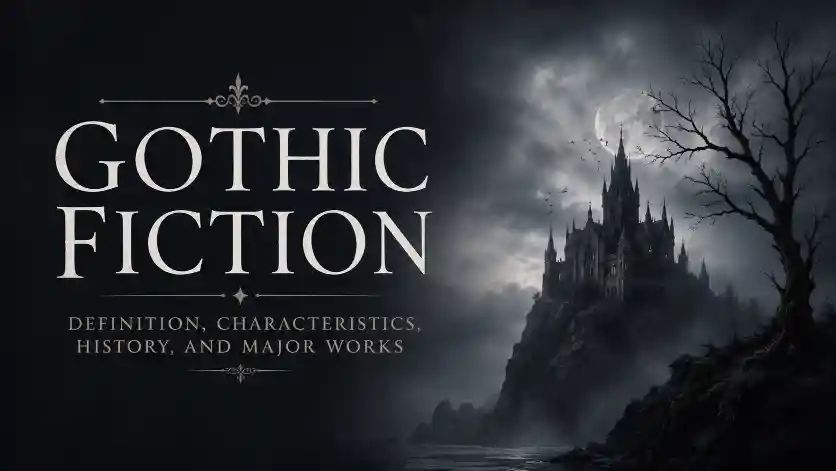
Gothic fiction is one of the most exciting and dark literary genres in the history of English literature. If you are preparing for RPSC 1st Grade, 2nd Grade, or UGC-NET English exams, understanding Gothic fiction is absolutely necessary. This article covers everything — definition, origin, key features, famous works, and the complete timeline of Gothic literature.
What is Gothic Fiction?
Gothic fiction is a type of story that mixes horror, death, romance, and supernatural events together. The stories are usually set in dark, mysterious, and ancient places like old castles, haunted mansions, and ruined monasteries.
The genre creates a feeling of fear, awe, and deep emotion in the reader’s mind. The main themes of Gothic fiction include:
- Transgression (breaking social or moral rules)
- Decay (physical and moral rotting)
- Fear and terror
- The sublime (something so vast or powerful it fills you with awe and dread at the same time)
The very first Gothic novel was written by Horace Walpole — The Castle of Otranto (1764). He actually used the word “Gothic” in the subtitle of this book.
Where Does the Word “Gothic” Come From?
The word “Gothic” originally comes from the Goths — Germanic tribes that attacked and destroyed the Roman Empire. Over time, the word came to mean anything that was:
- Barbaric (rough and uncivilised)
- Medieval (belonging to the Middle Ages)
In architecture, “Gothic” refers to the grand and ornate cathedrals built in Europe between the 12th and 16th centuries. These dark and towering buildings became the perfect setting for Gothic stories.
As a literary movement, Gothic fiction appeared in the mid-18th century as a strong reaction against the Age of Enlightenment. While Enlightenment thinkers valued reason and logic, Gothic writers preferred:
- Emotion over reason
- Imagination over logic
- Mystery over clarity
Historical Background: Why Did Gothic Fiction Appear?
Gothic fiction did not appear by accident. Three major forces of 18th-century England shaped its birth:
1. Industrial Revolution and Urbanisation
The rapid growth of cities and factories created anxiety, loneliness, and a deep longing for a simpler, romanticised past.
2. Edmund Burke’s Concept of the Sublime (1757)
In his famous work A Philosophical Enquiry, Edmund Burke described the “sublime” as a feeling of terror mixed with awe — something you experience when you face something vast, dark, or overwhelmingly powerful. This idea became the emotional backbone of Gothic writing.
3. Rise of the Novel
Gothic fiction grew alongside the popular novel in the 18th century. It offered something exciting and thrilling — a strong contrast to the realistic and letter-based (epistolary) fiction that was popular at the time.
Key Characteristics of Gothic Fiction
1. Atmosphere and Setting
Gothic fiction almost always takes place in a specific kind of place and time:
| Feature | Details |
|---|---|
| Time | Medieval or pseudo-medieval period |
| Place | Predominantly Catholic countries — Italy, Spain |
| Spaces | Castles, abbeys, monasteries, ruined mansions, dungeons, vaults, secret passages, trapdoors, locked rooms |
| Landscape | Storms, jagged mountains, dense forests, precipices |
The Gothic building or castle itself is a powerful symbol. It represents:
- A decaying aristocracy
- A troubled and secret-filled past
- The disturbed mind of the protagonist
2. Stock Characters and Archetypes
Every Gothic story has a familiar set of characters:
The Virginal Maiden / Damsel in Distress
An innocent heroine who is persecuted, imprisoned, or threatened throughout the story.
The Villain / Byronic Hero
A charismatic but cruel and morally corrupt character — often with a dark secret. He is attractive yet dangerous.
The Tyrannical Patriarch
An oppressive father figure or authority who controls and dominates others.
Servants and Rustics
They provide comic relief and carry old folk legends and superstitions.
Supernatural Agents
Ghosts, vampires, animated corpses, and mysterious disappearing figures. In many Gothic works, these supernatural events are later given a rational explanation.
3. Central Themes and Motifs
| Theme | What It Means |
|---|---|
| The Uncanny | Reality and imagination blur together |
| Transgression and Taboo | Incest, murder, forbidden desires |
| Confinement and Pursuit | Physical and mental imprisonment, relentless chase |
| Madness and Fragmented Psyche | Dreams, hallucinations, split identity |
| Past Haunting the Present | Ancestral curses, buried secrets, literal or symbolic ghosts |
| Sexual and Social Anxiety | Threatened virtue, moral corruption, breaking of social norms |
4. Narrative Style and Devices
Gothic writers use specific storytelling techniques:
- Hyperbolic emotional language — exaggerated feelings and descriptions
- Framed and fragmented narratives — stories told through found manuscripts or stories within stories
- Ominous foreshadowing — dreams, prophecies, curses, and dark signs that hint at what is coming
5. Purpose and Effect
The main aim of Gothic fiction is to:
- Create terror and fear in the reader
- Cause psychological disturbance
- Use mystery, horror, and suspense to keep the reader gripped
6. Literary Significance
The greatest Gothic works go beyond simple horror. They:
- Explore the irrational side of human nature
- Reveal hidden and perverse human impulses
- Expose the dark, unconscious side that lies beneath the surface of civilised society
Extended Meaning: Psychological Gothic
Gothic fiction is not only about castles and ghosts. In its broader meaning, it includes any work that:
- Creates a deep, brooding atmosphere of fear
- Depicts uncanny events, disturbing violence, and melodramatic horror
- Focuses on disturbed psychological states
In this sense, Gothic fiction moves away from physical settings (castles and dungeons) and moves towards the inner world of the human mind — fear, obsession, and mental confinement.
Key Examples of Psychological Gothic
- William Godwin — Caleb Williams (1794) → Psychological oppression and moral terror
- Mary Shelley — Frankenstein (1818) → Gothic + science + deep psychological exploration
- E. T. A. Hoffmann → Tales of terror and the uncanny
Satire of Gothic Fiction
Not everyone took Gothic fiction seriously. Jane Austen wrote Northanger Abbey (1818) as a playful parody that made fun of Gothic conventions. The heroine reads too many Gothic novels and starts imagining horror everywhere she goes.
Feminist Perspectives on Gothic Fiction
Feminist critics have offered two important readings of Gothic fiction:
- Gothic as a way of expressing suppressed female sexuality and psychological confinement
- Gothic as a challenge to patriarchal power structures
Key Critical Texts
- Sandra Gilbert & Susan Gubar — The Madwoman in the Attic (1979)
- Juliann E. Fleenor (ed.) — The Female Gothic (1983)
Chronological Evolution of Gothic Fiction: All Four Phases
Phase 1: The Genesis and Golden Age (1764–1810)
| Author | Work | Key Feature |
|---|---|---|
| Horace Walpole | The Castle of Otranto (1764) | First Gothic novel; subtitled “A Gothic Story” |
| William Beckford | Vathek (1786) | Medieval and Oriental setting; erotic and sadistic themes |
| Ann Radcliffe | The Mysteries of Udolpho (1794) | Female Gothic |
| Matthew Lewis | The Monk (1796) | Male/Radical Gothic; graphic violence, rape, incest, demons, Satanism |
| William Godwin | Caleb Williams (1794) | Political Gothic |
Phase 2: Romantic Gothic and Masterpieces (c. 1810–1840)
| Author | Work | Key Feature |
|---|---|---|
| Mary Shelley | Frankenstein (1818) | Gothic-Science Fiction |
| John Polidori | The Vampyre (1819) | Early vampire fiction |
| Edgar Allan Poe | “The Fall of the House of Usher” (1839), “The Tell-Tale Heart” (1843) | Psychological Gothic; short stories |
Phase 3: Victorian Gothic (c. 1840–1900)
| Author | Work | Key Feature |
|---|---|---|
| Emily Brontë | Wuthering Heights (1847) | Gothic Romance |
| Charlotte Brontë | Jane Eyre (1847) | Female Gothic; Bildungsroman; Bertha Mason as the “Madwoman in the Attic”; Rochester as Byronic hero |
| Sheridan Le Fanu | Carmilla (1872) | Lesbian vampire Gothic |
| Robert Louis Stevenson | Dr Jekyll and Mr Hyde (1886) | Urban Gothic; duality of self |
| Oscar Wilde | The Picture of Dorian Gray (1890) | Aesthetic/Decadent Gothic |
| Bram Stoker | Dracula (1897) | Definitive vampire novel; written in epistolary (letter) form |
| Charles Dickens | Bleak House (chapters 11, 16, 47) | Victorian Gothic elements |
| Charles Dickens | Great Expectations | Miss Havisham episodes |
Phase 4: Modern and Postmodern Gothic (20th Century Onwards)
Southern Gothic (USA)
Writers: William Faulkner (Sanctuary, Absalom, Absalom), Flannery O’Connor, Truman Capote, Tennessee Williams
Theme: The decaying American South — race, history, poverty
Modernist Gothic
Writers: Daphne du Maurier (Rebecca, 1938), Shirley Jackson (The Haunting of Hill House)
Theme: Psychological and existential horror
Postmodern Gothic
Writers: Angela Carter (The Bloody Chamber), Iris Murdoch (The Unicorn, 1963), Margaret Atwood, Toni Morrison (Beloved)
Theme: Self-referential storytelling, genre-blending, trauma
Quick Revision: Most Important Points for Exams
- First Gothic novel: The Castle of Otranto by Horace Walpole (1764)
- Inaugurator of Gothic fiction: Horace Walpole
- Term “Gothic” derives from: The Goths (Germanic tribes)
- Edmund Burke’s contribution: A Philosophical Enquiry (1757) — concept of the Sublime
- Female Gothic pioneer: Ann Radcliffe
- First vampire story: The Vampyre by John Polidori (1819)
- Definitive vampire novel: Dracula by Bram Stoker (1897)
- Parody of Gothic fiction: Northanger Abbey by Jane Austen (1818)
- Key feminist text on Gothic: The Madwoman in the Attic by Gilbert and Gubar (1979)
- Psychological Gothic examples: Caleb Williams, Frankenstein, Poe’s stories
- Postmodern Gothic: Angela Carter, Toni Morrison
Conclusion
Gothic fiction is much more than just ghost stories and haunted castles. It is a deeply important literary tradition that reflects society’s deepest fears, anxieties, and hidden desires. From Horace Walpole’s Castle of Otranto in 1764 to Toni Morrison’s Beloved in the 20th century, Gothic writing has continuously evolved — moving from physical darkness to psychological darkness, from external monsters to the monsters within us.
For RPSC and UGC-NET English exam aspirants, a thorough understanding of Gothic fiction — its phases, key authors, and themes — is extremely important. For more study material and practice MCQs on English literature topics like Gothic fiction, visit GyanKundli.com
Here is a Quiz on Gothic Literature : Quiz on Literary Forms Gothic Literature : 20 MCQs
Source of the Article : Jeet Coaching Sikar
Discover more from GYANKUNDLI
Subscribe to get the latest posts sent to your email.