NCERT · English Textbook POORVI · Class VII
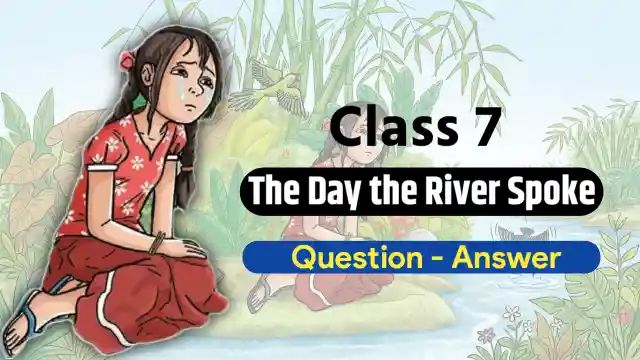
Lesson 1— The Day the River Spoke
Complete Solutions with Teacher’s Notes · By Girdhari Lal
Let us discuss Let us think & reflect Let us learn Let us speak Let us write
Before We Read — Pre-Reading Activities Warm-up discussion responses
Activity I — Listening to Sounds Around You
Q1 Are the sounds around you trying to tell you something?
✓ Suggested Answer
Yes, the sounds around us often seem to carry messages. The chirping of birds in the morning tells us that a new day has begun. The patter of raindrops signals that it is time to take shelter. The rustling of leaves warns us of an approaching wind. Nature’s sounds, if we listen carefully, communicate the rhythm and mood of the world around us.
Q2 Do you think the things around you also listen to you all day long?
✓ Suggested Answer
It is a beautiful thought to imagine that nature listens to us. Rivers, trees, and the wind seem to respond to our presence — the river flows steadily when we sit by its banks, the trees sway as if nodding. While nature may not truly understand our words, it responds to our actions. The story we are about to read beautifully imagines this idea through the talking River.
Activity II — Jahnavi’s Dream
Q1 What could Jahnavi’s dream be?
✓ Suggested Answer
Jahnavi’s dream is to go to school and get an education. She wants to learn to read and write like her brothers Gopi (Ettan) and Meena. She is also deeply curious about the natural world and wants to find answers to her many questions about nature.
Q2 How could she make her dream come true?
✓ Suggested Answer
She could make her dream come true by gathering courage and approaching her parents or the teacher directly. She could also seek the help of a sympathetic elder — as she eventually does through the River’s encouragement — to talk to her father about allowing her to attend school.
Let Us Discuss — Mid-Story Questions (After Section I — Page 3)
Q1 What was Jahnavi’s dream? Was it important to her? Why?
✓ Answer
Jahnavi’s dream was to go to school and get an education. It was deeply important to her because she had a burning curiosity about the world around her — she wanted to understand why spiders are yellow in yellow flowers, why bamboo trees rustle, why the moon comes from behind the hills, and why baby fish turn into frogs. Education was her key to answering these questions. Moreover, she saw her brothers going to school while she was kept at home to mind the younger children, which made her desire for education even stronger. Her dream represented not just learning, but also equality and self-worth.
Q2 Do you think the river can help her in fulfilling her dream? How?
✓ Answer
Yes, the River helps Jahnavi in an important way — not by doing things for her, but by building her confidence. The River listens patiently, encourages Jahnavi to believe in herself, and gives her the practical advice to simply walk into school one morning and listen. The River also reminds her that she is already brave enough to face lizards, snakes, and loud trains, so she should not be afraid of a classroom. This moral support is what Jahnavi truly needed, and it enables her to take action.
Let Us Discuss — Question & Answer Table (Page 6 — After the complete story)
Task Complete the table with Jahnavi’s questions (Column 1) and the River’s answers (Column 2).
✓ Completed Table
| Column 1 — Jahnavi’s Question | Column 2 — The River’s Answer |
|---|---|
| …why the moon always comes from behind the hills? | The moon goes down towards the sea. It always takes the same way — over the mountains and down to the sea, like the River itself. |
| Can I do something to go to school? / How can I get into school? | Little girls can do as much as little boys. Just slip along one morning, sit in the school and listen to what is going on — maybe the teacher will let you stay. |
| What are ships? | Big boats, so big that they can take hundreds of people, and they sail along the sea with lights that shine all night. |
| Will they (ships) come here? | No, they are too large. But Chandu can take you to see a ship someday. |
Let Us Think and Reflect (Pages 7–8)
I. Extract-Based Questions
Extract 1: “You shouldn’t cry, you know…” — “I’ve got to hurry to reach the sea, you know.”
I.1(i) The tone of the River in the given extract is __________. (assuring / sympathising)
✓ Answer
The tone of the River in the given extract is assuring. The River tells Jahnavi she should not cry or be scared, reassuring her that it is a familiar friend she visits every day.
I.1(ii) Select a phrase from the extract which shows that Jahnavi was a frequent visitor to the spot.
✓ Answer
The phrase is: “you have been coming here to see me every day, well, almost every day.”
I.1(iii) The use of an exclamation mark at the end of ‘It couldn’t be the river!’ expresses __________.
✓ Answer
D. Disbelief. Jahnavi finds it impossible to believe that a river could speak. The exclamation mark conveys her shock and utter disbelief at the idea.
I.1(iv) Choose three qualities of the River from: affectionate, forgiving, thoughtful, impatient, kind-hearted.
✓ Answer
The three qualities of the River highlighted in the extract are:
1. Affectionate — It says “Dear, dear!” showing warmth and care.
2. Thoughtful — It notices Jahnavi’s sadness and invites her to share her problem.
3. Kind-hearted — It patiently listens and comforts her despite being in a hurry to reach the sea.
1. Affectionate — It says “Dear, dear!” showing warmth and care.
2. Thoughtful — It notices Jahnavi’s sadness and invites her to share her problem.
3. Kind-hearted — It patiently listens and comforts her despite being in a hurry to reach the sea.
Extract 2: “Can I do something?” — “They’d chase me out.”
I.2(i) According to the River, there was no difference between girls and boys because __________.
✓ Answer
…little girls can do as much as little boys — they swim as fast as little boys. The River argues that girls are just as capable as boys in every respect.
I.2(ii) The River encourages Jahnavi to have faith in herself and fulfill her desire to go to school. True or False?
✓ Answer
True. The River tells Jahnavi to simply walk into school one morning, sit down, and listen. It assures her that the teacher might let her stay, and reminds her that “it’s up to you” — encouraging self-belief and initiative.
I.2(iii) When the River suggests Jahnavi should ‘slip along’, it means she should move __________.
✓ Answer
C. Quietly. ‘Slip along’ means to move quietly and unobtrusively, without drawing attention to oneself, so that she can enter the school without creating a scene.
I.2(iv) What does the repetition of the phrase ‘I couldn’t’ tell us?
✓ Answer
The repetition of ‘I couldn’t’ reveals Jahnavi’s deep fear and self-doubt. She has been denied education for so long that she has begun to doubt her own worth and ability. The repetition also shows the intensity of her anxiety — she is overwhelmed by the thought of entering a school where she has never been formally welcomed. It reflects how years of being overlooked and excluded have made her lose confidence in herself.
II. Answer the Following Questions
II.1 Why does the writer describe different aspects of nature in great detail at the beginning of the story? Why do you think the writer does this?
✓ Answer
The writer describes nature in great detail at the beginning — a kingfisher sweeping down, a green lizard basking in the sun, parrots in the bamboo thicket — to set the scene and create a vivid, living world where nature is alert and present. This description serves two important purposes. First, it establishes the natural setting by the river where Jahnavi comes regularly, making it feel like a safe and familiar space for her. Second, it prepares the reader for the magical element — a talking River — by showing that this is a world where nature is active, observant, and deeply connected to Jahnavi’s life. The richness of detail also reflects Jahnavi’s own curiosity about the natural world, which is central to her character.
II.2 How did the River know so much about Jahnavi?
✓ Answer
The River knew so much about Jahnavi because she visited it almost every day. Jahnavi used to come to the riverbank regularly, and the River had been silently observing her all along — her habits, her emotions, and her surroundings. The River had watched her interact with the lizard, remain unafraid of the snake in the bamboo clump, and stand fearlessly near the railway bridge. The River, as a personified figure of nature, embodies the idea that the natural world is aware of those who come to it in peace and honesty.
II.3 Jahnavi says, “And I’m so old now, they’ll never let me go.” What can you infer about Jahnavi and the school from this line?
✓ Answer
From this line, we can infer several things. First, Jahnavi is nearly ten years old, which was considered old to begin school in her rural setting. She feels embarrassed and believes she is too old to join younger children. Second, it reflects the social reality of the time and place where girls’ education was not prioritised — Jahnavi had been asking to go to school since she was young, and each time she was refused or asked to wait. Third, it shows that the local school likely admitted younger children from Class 1, making Jahnavi feel out of place. Her statement also reveals deep internalised despair — she has begun to accept that she may never get the opportunity.
II.4 Why did the River laugh when Jahnavi said she would be scared at school?
✓ Answer
The River laughed because it knew from observation that Jahnavi was actually a very brave girl. She was not afraid of the green lizard, she lived near a snake in the bamboo clump (though she did not know about it), and she was not frightened by the loud, rattling trains on the bridge nearby. The River found it amusing and somewhat illogical that a girl who was unafraid of such things should be scared of a classroom and a teacher. The laughter was not mocking but affectionate — the River was gently pointing out the contradiction to shake Jahnavi out of her self-doubt.
II.5 Why should Jahnavi follow the River’s advice?
✓ Answer
Jahnavi should follow the River’s advice because it is practical, encouraging, and well-founded. The River knows Jahnavi well and understands both her desire and her ability. Its advice — to simply walk into the school, sit quietly, and listen — is a concrete, actionable step that does not require anyone’s permission initially. The River also reminds Jahnavi that she is braver than she thinks. Its assurance that “little girls can do as much as little boys” is an empowering message. Most importantly, the River emphasises personal responsibility by saying “it’s up to you”, urging Jahnavi to take charge of her own destiny rather than waiting for others to act.
II.6 How does the conversation between Jahnavi and the River make the story more appealing?
✓ Answer
The conversation between Jahnavi and the River makes the story more appealing in several ways. The device of personification — giving the River a voice, a personality, and wisdom — transforms a realistic story about a girl’s struggle into a gentle, magical tale. The River’s “sleepy, murmuring voice” is consistent with the sound of flowing water, making its speech feel natural rather than forced. The dialogue also adds humour (the River preferring ships to trains, worrying about getting Jahnavi’s feet wet), warmth (the River’s affectionate concern), and wisdom (its advice on courage and self-belief). The conversation allows the writer to convey the story’s message about gender equality and education in a tender, non-preachy way, making it accessible and enjoyable for young readers.
II.7 What is the main message that the writer intends to convey?
✓ Answer
The main message of the story is that education is the right of every child, regardless of gender. The writer, Kamala Nair, conveys that girls are as capable as boys and deserve equal opportunities to learn. The story also emphasises the importance of self-belief and courage — Jahnavi’s dream could only be realised when she gathered the confidence to act. A secondary message is that nature can be a source of wisdom and comfort, and that curiosity is the foundation of learning. Jahnavi’s dream of becoming a teacher who will educate all the girls of her village further reinforces the idea that educated individuals must work to uplift those around them.
Let Us Learn Grammar, Vocabulary & Language Exercises (Pages 8–12)
I. The River — Capital Letter for a Common Noun
I Why has the author used a capital letter for ‘River’ even when it is a common noun?
✓ Answer
The author uses a capital letter for ‘River’ because the River has been given the qualities of a human being — it speaks, listens, laughs, shows concern, gives advice, and has opinions (preferring ships to trains). This literary technique is called personification. When a common noun is personified and treated as a character with an identity, it is often capitalised to distinguish it from an ordinary noun. By writing ‘River’ with a capital letter, the author signals to the reader that this River is not just a body of water but a living, breathing character in the story — a wise friend to Jahnavi.
II. Words Related to Sound
II Match the sound words from the text to the correct definitions (1–9).
✓ Answers
- 1.Shrieked— made a high-pitched piercing sound
- 2.Splashed— to cause liquid to strike or fall on something
- 3.Murmuring— a low continuous background noise
- 4.Wailed— cry with loud uncontrollable gasps
- 5.Rustle— to make a soft dry sound, like paper or leaves moving
- 6.Gasped— took a short quick breath through the mouth due to surprise, pain or shock
- 7.Rattling— shaking rapidly to make continuous short, sharp sounds
- 8.Noisy— making a lot of noise
- 9.Shrieked / Wailed— made a long, high cry, usually because of pain or sadness (wailed fits best)
II (Fill in the blanks) Fill in the blanks with suitable sound words.
✓ Completed Passage
The classroom grew (i) noisy as the students noticed the teacher carrying the answer papers. As the teacher turned the pages with a (ii) rustle, the children (iii) murmured, wondering what comments awaited. Someone (iv) wailed in frustration, and the (v) murmuring of the students steadily increased. Finally, when the teacher praised the students for their excellent performance, the students (vi) shrieked with excitement.
III. Words Borrowed from Indian Languages
III Find the meanings of the given words and the Indian languages they were borrowed from.
✓ Answers
| Word | Meaning | Language of Origin |
|---|---|---|
| karma | Action or deed; the law of cause and effect; one’s destiny shaped by past actions | Sanskrit (given as example) |
| sahib | A title of respect; used to address a master or a person of authority | Arabic / Urdu (via Hindustani) |
| chutney | A spicy condiment made from fruit, vegetables, herbs, and spices | Hindi / Sanskrit (chatni) |
| guru | A spiritual teacher, guide, or expert in a particular field | Sanskrit |
| verandah | A roofed platform along the outside of a house; a porch | Hindi / Portuguese (varanda; some trace it to Bengali/Odia) |
| jungle | A dense forest, especially in a tropical region | Hindi / Sanskrit (jangal) |
| areca | A type of palm tree whose nut (betel nut) is widely used in South and Southeast Asia | Malayalam / Portuguese (areca from Malayalam adakka) |
| palanquin | A covered litter carried on poles by two or four people, used to transport a person | Hindi / Sanskrit (palankī) |
V. Crossword — Water Transport Words
V Solve the crossword puzzle based on words related to water transport.
✓ Answers
Across 1.SHIP — a large vessel used for transporting goods or passengers by sea
Across 2.BOAT — a small vessel for travelling on water, propelled by oars, sails, or an engine
Across 3.RAFT — a flat floating structure for travelling across water
Across 4.STEAMER — a boat or ship driven by steam
Down 5.CANOE — a small, light, narrow boat pointed at both ends, moved using a paddle
Down 6.TUGBOAT — a powerful boat used to pull large ships into and out of port
Down 7.YACHT — a boat with sails used for racing or pleasure (rhymes with ‘cot’)
VI. Prepositions — Fill in the Blanks
VI Fill in the blanks with suitable prepositions (from brackets).
✓ Answers
Jahnavi takes the River’s advice and goes to school. On her first day (1) at school, Jahnavi stood nervously (2) outside the gate, clutching her bag close to her. The bell rang and she hurried (3) inside the bustling classroom. She found a seat (4) between two friendly classmates. The teacher greeted them warmly and started the lesson (5) about numbers. Jahnavi listened attentively, feeling excited (6) about the new adventure ahead.
Teacher’s Note: “At school” refers to the institution; “in school” is also acceptable but “at” is more precise here. “Outside the gate” shows position. “Inside the classroom” shows direction of movement. “Between two classmates” specifies two people. “About numbers” and “about the new adventure” indicate the subject/topic of the lesson/feeling.
VII. Prepositions or Adverbs — Fill in the Blanks
VII Fill in the blanks with prepositions or adverbs as indicated.
✓ Answers
- 1.onto / on— The cat jumped onto the table. (preposition — followed by ‘the table’)
- 2.outside— The children played outside until dark. (adverb — modifies ‘played’)
- 3.through— She quickly ran through the park. (preposition — followed by ‘the park’)
- 4.above— The helicopter was hovering above. (adverb — modifies ‘hovering’)
- 5.along— We were just walking along, chatting. (adverb — modifies ‘walking’)
- 6.inside / in— After thoroughly wiping his shoes, he stepped inside. (adverb — no object follows)
- 7.around— She drove slowly around the sharp curve. (preposition — followed by ‘the sharp curve’)
- 8.under / beneath— He placed the keys under the mat before leaving. (preposition — followed by ‘the mat’)
Let Us Speak Oral Activity (Page 13)
I. Speaking the Same Sentence in Different Voices
I Speak the River’s sentence in different voices: happy, surprised, angry, scared, sad, worried.
✓ Teacher’s Guidance Notes
| Voice / Mood | How to Deliver | Sample Tone Description |
|---|---|---|
| Sleepy (original) | Slow, dragging, low pitch | Soft and dreamy, as if half-asleep |
| Happy | Bright, fast, rising pitch at end | Cheerful and light, almost singing |
| Surprised | Wide eyes, short pause, raised eyebrows | Emphasise “you have been coming here — every day?!“ |
| Angry | Firm, clipped, slightly louder | Stress “you really shouldn’t be scared” |
| Scared | Whispered, quivering, hesitant | Voice trembles, pauses between words |
| Sad | Slow, soft, low pitch, trailing off | As if sympathising with Jahnavi’s sorrow |
| Worried | Fast, slightly breathless, concerned | Stress “you shouldn’t cry” with urgency |
Teacher’s Note: Students should work in pairs, alternate roles, and focus on how changes in pitch, speed, stress, and facial expression alter the meaning and mood of the same sentence. This builds oral reading fluency and emotional comprehension.
II. Asking for and Giving Advice
II Sample dialogues for each situation using the prompts provided.
✓ Sample Dialogues
Situation (i): Football — all-boys’ team only
Student A: I have a problem with sports at school. I really want to play football, but the team is all boys. What do you think I should do?
Student B: I think you should talk to the PE teacher and request that they allow girls to join or form a separate girls’ team. Why don’t you also talk to your classmates and get a few more girls interested? The more of you who ask, the stronger your case will be.
Student B: I think you should talk to the PE teacher and request that they allow girls to join or form a separate girls’ team. Why don’t you also talk to your classmates and get a few more girls interested? The more of you who ask, the stronger your case will be.
Situation (ii): Unable to score well in Maths due to nervousness
Student A: I have a problem with my Maths exams. I know the subject well, but nervousness makes me go blank during the test. I’d appreciate your advice on this.
Student B: If I were you, I would practise a few deep-breathing exercises before the exam. The best thing to do is also to practise timed mock tests at home so that you get used to working under pressure. That way, exams won’t feel so frightening.
Student B: If I were you, I would practise a few deep-breathing exercises before the exam. The best thing to do is also to practise timed mock tests at home so that you get used to working under pressure. That way, exams won’t feel so frightening.
Situation (iii): Music — not enough practice time
Student A: I have a problem with my schedule. I love my music classes but I don’t get enough time to practise. What would you do in my position?
Student B: I think you should make a daily timetable and set aside even fifteen to twenty minutes each day specifically for music. Why don’t you also speak to your parents and explain how important it is to you? A small amount of regular practice is better than no practice at all.
Student B: I think you should make a daily timetable and set aside even fifteen to twenty minutes each day specifically for music. Why don’t you also speak to your parents and explain how important it is to you? A small amount of regular practice is better than no practice at all.
Situation (iv): Cannot see the blackboard from the last bench
Student A: I have a problem in class. I sit at the last bench and cannot see the blackboard clearly. Do you think I should tell the teacher?
Student B: Yes, absolutely — the best thing to do is to tell your class teacher immediately. Why don’t you also ask your parents to take you for an eye check-up? It is important not to strain your eyes, as it could affect your learning.
Student B: Yes, absolutely — the best thing to do is to tell your class teacher immediately. Why don’t you also ask your parents to take you for an eye check-up? It is important not to strain your eyes, as it could affect your learning.
Let Us Write — Observing Nature Descriptive Paragraph (Page 14)
Task Write a descriptive paragraph based on your observation of nature. Use the idea-prompt table for guidance.
✓ Model Answer
The World Outside My Window
Every day, I see a small neem tree just outside my window, and I find it very interesting that it is never the same twice. In the early morning, its leaves catch the first pale gold of the sun, each one glowing like a tiny green lamp. By afternoon, its shadows have stretched long and cool across the courtyard. I like the tree because it moves constantly, even when the air seems still — a faint trembling runs through its leaves as if it is whispering secrets. I feel calm when I watch it, the way I imagine one feels standing beside a river. The sparrows that dart through its branches add tiny flashes of brown and grey to the picture. I want to tell you that the world around us is alive with colour, texture, and sound — we only need to slow down and look. My advice to all is: spend five minutes each day simply observing nature. You will be surprised by how much beauty you have been walking past without noticing.
Teacher’s Note: Students should write their own observations from personal experience. The model above demonstrates the use of the given prompts (Every day I see…, I find it very interesting that…, I like…because…, I feel…as…, I want to tell you that…, My advice to all is…). Encourage vivid sensory language — sight, sound, touch, and movement.
Let Us Explore (Pages 14–15)
I. Rivers in India — Sacred and Female
I Discuss why rivers in India are considered sacred and most are referred to as female. Some (like Brahmaputra and Sone) are referred to as male.
✓ Discussion Points
In Indian culture and tradition, rivers have been worshipped as divine beings since ancient times. Rivers like the Ganga, Yamuna, Saraswati, Godavari, and Cauvery are personified as goddesses and addressed as Mata (Mother). This is because rivers are life-giving — they provide water for drinking, farming, and daily needs — just as a mother nurtures her children. The rivers are believed to purify sins when one bathes in them, which adds to their sacred status. They are also central to religious rituals, festivals (like Kumbh Mela), and cremation rites.
Rivers are called female because they are seen as nurturing, gentle, and giving — qualities associated with motherhood in Indian tradition. They are also ever-flowing and persistent, sustaining life along their banks.
In contrast, rivers like the Brahmaputra (meaning “Son of Brahma”) and the Sone (meaning “golden”) are referred to as male due to their names, myths, and the powerful, turbulent nature of their flow. The Brahmaputra is also one of the largest and most forceful rivers in the world, which may have contributed to its masculine association.
Rivers are called female because they are seen as nurturing, gentle, and giving — qualities associated with motherhood in Indian tradition. They are also ever-flowing and persistent, sustaining life along their banks.
In contrast, rivers like the Brahmaputra (meaning “Son of Brahma”) and the Sone (meaning “golden”) are referred to as male due to their names, myths, and the powerful, turbulent nature of their flow. The Brahmaputra is also one of the largest and most forceful rivers in the world, which may have contributed to its masculine association.
III. Poster Discussion — “The Happiness of a Nation lies in the Dignity of its Daughters”
III.1 What are the things you can observe in the poster?
✓ Answer
The poster shows a group of young girls, likely in a school setting, smiling and laughing. They appear happy and engaged. The text on the poster reads: “The Happiness of a Nation lies in the Dignity of its Daughters.” The image suggests that when girls are educated, respected, and treated with dignity, they thrive — and their joy reflects the health and progress of the nation as a whole.
III.2 Why do you think the girls look happy?
✓ Answer
The girls look happy because they are in school, learning, and surrounded by friends. Education gives them confidence, knowledge, and a sense of purpose. When girls are allowed to study, grow, and pursue their dreams, they experience genuine happiness. The presence of books and a school environment suggests that access to education is the source of their joy.
III.3 Dignity means ‘self-respect’. What is the relation between ‘dignity’ and ‘happiness’?
✓ Answer
Dignity and happiness are closely linked. When a person is treated with self-respect — when their rights, choices, and aspirations are honoured — they feel valued and secure. This sense of being valued is the foundation of true happiness. If girls are denied education, freedom, or equal opportunities, their dignity is undermined, and they cannot be truly happy. The poster suggests that a nation can only be happy and prosperous when its daughters are treated with the dignity they deserve.
III.4 How does a Nation prosper when its daughters are happy?
✓ Answer
When daughters are happy, educated, and empowered, they contribute actively to the nation’s progress. An educated woman can work, earn, make informed decisions, and raise educated children in turn. Studies show that when girls are educated, families become healthier, economies grow stronger, and communities develop faster. A nation where daughters are respected and given equal opportunities benefits from the talent, creativity, and dedication of its entire population — not just half of it. As Jahnavi herself resolved: “When I grow up, I’ll be a teacher and I’ll go from house to house and ask all the little girls to come to my school.” This ripple effect of one girl’s education uplifts an entire community.
IV. Government Schemes for Girl Child Education
IV Find out more government schemes for education of the girl child.
✓ Key Schemes (for reference)
| Scheme | Brief Description |
|---|---|
| Beti Bachao Beti Padhao | National campaign to save and educate the girl child; targets states with low child sex ratio |
| Balika Samridhi Yojana | Scholarship scheme for girls from below-poverty-line families to encourage school attendance |
| Kasturba Gandhi Balika Vidyalayas (KGBV) | Residential schools for girls from marginalised communities in educationally backward blocks |
| Sukanya Samridhi Yojana | Savings scheme for girl children to secure their financial future for education and marriage |
| National Scheme of Incentive to Girls for Secondary Education | Fixed deposit in the name of girls who pass Class 8 to encourage them to continue studying |
| Mukhyamantri Rajshri Yojana (Rajasthan) | Financial assistance at different stages of a girl’s education, from birth to Class 12 |
Teacher’s Note: Encourage students to research these schemes further and create awareness pamphlets or posters to display in the school and share in their neighbourhoods. This builds civic awareness and a sense of responsibility.
Discover more from GYANKUNDLI
Subscribe to get the latest posts sent to your email.