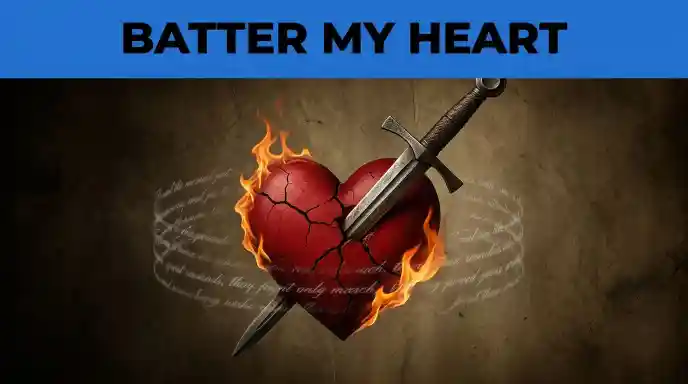
John Donne’s “Batter My Heart, Three-Person’d God”, also known as Holy Sonnet 14, is a passionate prayer from an English metaphysical poet and poet-priest. The speaker feels trapped by sin and asks God to use overwhelming force to rescue him, because human effort alone cannot restore his spiritual life.
Batter My Heart: Background, Form and Central Situation
John Donne’s “Batter My Heart, Three-Person’d God” belongs to the Holy Sonnets, a group of religious poems commonly associated with his spiritual and personal struggles. Donne lived from 1572 to 1631 and is regarded as a leading metaphysical poet, known for joining intense emotion with intellectual argument. The Holy Sonnets and their religious concerns provide useful context for understanding this poem’s urgent tone.
The poem is commonly identified as Holy Sonnet 14. It has fourteen lines and follows a broadly Petrarchan structure, with an octet followed by a sestet. Its approximate rhyme pattern is ABBAABBACDDCEE, while its generally iambic rhythm gives the prayer a controlled shape, even when the speaker’s emotions become turbulent. He addresses the Christian Trinity through the phrase “three-person’d God”, so the poem is both a personal confession and a direct appeal to divine power.
What the title reveals about the speaker’s desperate prayer
The verb “batter” means to attack forcefully, as an army might break down a fortified door or damage a city wall. Donne therefore begins with an image of assault rather than peaceful worship. The speaker does not request a gentle reminder, a small correction, or temporary comfort. He asks God to break through every barrier separating him from spiritual renewal.
This choice of verb reveals the speaker’s loss of confidence in his own will. His reason should guide him towards God, yet sin has weakened his judgement and left him unable to act freely. Only overwhelming divine intervention seems strong enough to reclaim him. The prayer sounds almost shocking because the speaker asks God to use force, but that violence expresses the depth of his desperation.
The title prepares readers for the poem’s powerful imagery. Donne presents spiritual change through the language of war, construction, fire, imprisonment and marriage. God must attack, rebuild, burn away corruption, release the captive soul and claim the speaker completely. For a fuller reading of the poem’s forceful religious imagery, see this Holy Sonnet 14 analysis.
The speaker’s spiritual problem in simple terms
The speaker wants to welcome God into his heart, but he cannot do so successfully. Sin has captured the part of him that should choose rightly, leaving him divided between his desire for holiness and his attachment to evil.
His conflict is not a celebration of violence. Instead, the violent language shows his belief that ordinary human effort cannot overcome his inner resistance. He asks divine grace to act like a powerful force that breaks captivity and restores his damaged spiritual life. Love for God remains present, but the speaker needs that love to become stronger than sin.
Batter My Heart Summary: How the Poem Moves from Conflict to Surrender
In John Donne’s “Batter My Heart”, the speaker’s prayer grows more urgent as the sonnet develops. The first eight lines ask God to attack and rebuild his damaged soul. After the turn, the speaker describes himself as spiritually captured, so divine love must break his false attachment and claim him completely.
The octet shows why gentle correction is not enough
The poem opens with a direct command to the Trinity: “Batter my heart”. The speaker asks God to break into him with the force of an attacking army. He then intensifies the request through a series of strong verbs. God must “o’erthrow”, “break”, “blow”, “burn” and make him new.
These commands reveal the speaker’s frustration with his own weakness. God has already tried gentler forms of action. The divine presence has knocked at the heart, breathed life into it, shone upon it and attempted to repair it. However, those quieter acts have not freed the speaker from sin. He now believes that only overwhelming force can produce lasting change.
The heart appears as a damaged building or occupied fortress. Its walls have been weakened, yet an enemy still controls the space. The speaker wants God to reclaim it, even if the rescue destroys the structure first. This explains why the poem joins images of war, building and fire. God must demolish what sin has corrupted before creating something sound.
The violence therefore has a spiritual purpose. It is not a request for meaningless punishment. The speaker asks to be broken so that he can rise, burned so that corruption can be removed, and remade into a person capable of faithful love. The paradox is clear: destruction becomes the necessary beginning of renewal. A useful comparison of these images appears in this Holy Sonnet 14 commentary.
The sestet turns spiritual struggle into captivity and marriage
At the sonnet’s turn, the language changes from assault and repair to love, captivity and marriage. The speaker says that he loves God and wants God’s love, yet he is “betroth’d unto your enemy”. Satan has a claim over him, as though he has entered a false marriage that prevents his full union with God.
The speaker therefore asks God to dissolve that bond. He must be taken prisoner by God before he can become free from sin: “I, except you enthrall me, free ne’er shall be”. This is another deliberate paradox. Ordinary captivity removes freedom, but divine captivity releases the soul from the stronger prison of evil.
The final words, “nor ever chaste, except you ravish me”, create the poem’s most disturbing image. In Donne’s religious argument, “ravish” suggests overwhelming seizure, not gentle persuasion. The speaker admits that he cannot make himself pure through willpower alone. He asks God to take complete possession of him and overpower the sinful self that resists grace.
This sexual language should be read academically within the poem’s marriage metaphor. It is not literal advice, nor does it romanticise abuse. Its force comes from the shocking collision between bodily language and spiritual surrender. The ending completes the movement of Batter My Heart: the speaker abandons self-control and accepts total dependence on divine power.
The Main Themes in John Donne’s Holy Sonnet 14
John Donne’s “Batter My Heart” presents spiritual renewal as a struggle that the speaker cannot win by willpower alone. Sin has damaged his judgement, weakened his freedom and created a false attachment to evil. The poem’s religious intensity comes from his belief that only divine grace can reclaim him.
Sin, salvation and the limits of human reason
The speaker recognises that he cannot reform himself through effort. Although he wants to belong to God, sin has weakened the very faculties that should guide him towards salvation. His appeal to the “Three-Person’d God” therefore becomes a confession of dependence. He asks God to “break, blow, burn, and make me new” because ordinary correction has failed.
Reason appears as God’s representative within the speaker, or “your viceroy in me”. A viceroy normally acts with the authority of a ruler, so reason should direct the speaker towards God. However, this representative has been captured and made unreliable by sin. The speaker’s judgement cannot defend him because it has lost control of the inner kingdom.
This idea connects the sonnet with a Reformed Christian view of human nature. In that tradition, sin affects the whole person, including the mind and will. Human beings may recognise moral truth, but they cannot save themselves through reason alone. Donne was an Anglican rather than a strictly Reformed theologian, yet the poem strongly reflects this emphasis on spiritual inability and divine grace. The religious concerns of Donne’s Holy Sonnets help place this personal prayer within its wider Christian setting.
The speaker’s desperation is therefore also evidence of faith. He would not plead so urgently if he had stopped longing for God. His helplessness does not erase hope; it directs hope towards divine action.
Freedom through imprisonment and purity through force
A paradox is a statement that seems impossible but expresses a deeper truth. Donne builds the closing part of “Batter My Heart” around two such statements. The speaker says he can become free only when God “enthrall[s]” him, and he can become chaste only through the shocking force of the final image.
These claims make sense within the poem’s religious logic. The speaker’s apparent freedom has become slavery to sin. Therefore, surrendering to God does not destroy his true identity. It rescues him from the power that has already taken control of him. Divine imprisonment becomes liberation because it breaks a more destructive captivity.
The final image is deliberately disturbing. Within the marriage metaphor, the speaker asks God to possess him completely so that sin can no longer claim him. Modern readers may find the word “ravish” troubling, but its force shows how radically the speaker rejects self-reliance. Donne makes spiritual surrender physical, forceful and unforgettable.
Love, spiritual marriage and the divided self
The speaker says he loves God, yet he remains “betroth’d unto your enemy”. This marriage language presents sin as a false relationship. He desires divine love, but his existing bond with Satan prevents full belonging to God.
As a result, the speaker’s identity remains divided. One part longs for holiness, whilst another remains bound to corruption. Donne joins intimate language with theological argument, a characteristic feature of metaphysical poetry. The mixture feels powerful because it makes an abstract religious conflict personal and bodily, but it can also seem controversial to modern readers. The poem’s unusual combination of sacred devotion and physical imagery is discussed in this analysis of Holy Sonnet 14.
How Donne’s Images, Word Choice and Structure Create Intensity
In “Batter My Heart”, John Donne makes spiritual conflict feel physical. Warfare, construction, fire, marriage and imprisonment all express one central idea: the sinful soul must be forcibly reclaimed and remade by God. The compressed fourteen-line form gives the prayer little space to settle, so each image increases the pressure.
Warfare and the image of a besieged heart
The speaker presents his heart as an “usurp’d town”, a fortified place seized by an enemy. Satan has occupied the inner city, whilst God’s authority has been displaced. The speaker therefore asks the Trinity to attack, break through the walls and recover what belongs to God.
This extended military image makes salvation sound like a siege. The verb “batter” recalls the repeated blows of a battering ram against a fortress. It is followed by forceful commands such as “o’erthrow” and “break”, which suggest sudden physical movement rather than gradual improvement. Hard consonants, especially the repeated b and k sounds, make the lines feel rough and aggressive.
The speaker’s problem is not a lack of religious knowledge. He knows where he should belong, yet he cannot free himself. Reason, described as God’s “viceroy”, has been captured inside the occupied town. Ordinary spiritual effort has therefore failed, and only divine power can remove the enemy. The image turns inner weakness into a visible battle, making the speaker’s helplessness easier to understand. This discussion of Donne’s literary devices also highlights the poem’s use of violent religious imagery.
Fire, building and remaking the damaged self
The poem moves through a sequence of destruction and renewal: God must “break, blow, burn” before he can “make me new”. The three short verbs produce a rapid burst of action. “Blow” suggests the force of wind or breath, whilst “burn” introduces fire as both destructive and cleansing. Fire consumes corruption, but it can also purify metal and prepare it for a stronger form.
The building image gives this process a further meaning. When the speaker asks God to “make me new”, he is not asking for simple disappearance. He wants reconstruction. The old structure has been damaged by sin, so it must be broken apart before a sounder spiritual self can be built.
This creates tension between injury and healing. God’s action appears violent because the speaker believes that gentle repair cannot reach the corruption within him. Yet destruction remains valuable only because it leads to renewal. The language is severe, but its purpose is restorative.
Imperatives, sound and the sonnet’s turning point
The repeated imperatives make the poem sound like an urgent plea rather than quiet reflection. “Batter”, “break”, “blow”, “burn” and “o’erthrow” place God under direct instruction, although the speaker knows that divine power remains superior. Their heavy stresses disturb the generally iambic pentameter, so the rhythm never becomes perfectly regular. It sounds controlled, but strained.
The octet concentrates on siege, construction and fire. At the turn, introduced by “Yet”, the speaker shifts into the more personal language of marriage and captivity. He is “betroth’d” to God’s enemy and asks God to “enthrall” him. Here, imprisonment becomes freedom because only divine possession can release him from sin.
The final line gathers the poem’s paradoxes into one shocking conclusion: the speaker can become chaste only when God “ravish[es]” him. Destruction leads to creation, captivity leads to liberty, and force leads to purity. The abrupt ending leaves the reader with the full intensity of the speaker’s surrender.
Batter My Heart Analysis for Exams: Meaning, Context and Key Takeaways
For exam purposes, read “Batter My Heart” as both a religious prayer and a tightly reasoned argument. The speaker believes that sin has taken control of his will, so he asks divine grace to break, cleanse and remake him. The poem’s force comes from its unusual images, urgent commands and startling claim that surrender to God brings true freedom.
Why the poem is a classic example of metaphysical poetry
Metaphysical poetry joins strong emotion with thought, argument and unusual comparisons. Rather than expressing sadness or devotion in a simple lyrical manner, the poet examines the feeling as if he were proving a difficult idea. Donne’s metaphysical poetry study resource offers useful supporting material for revision.
In “Batter My Heart”, the speaker builds an extended conceit around spiritual captivity. His heart becomes a besieged town that God must attack and reclaim. The same speaker then appears as a captured prisoner, unable to escape the enemy’s control. Finally, he describes himself as a lover wrongly betrothed to God’s enemy. These images are different, yet they all express the need for complete spiritual transformation.
The poem’s intellectual tension comes from its difficult religious logic. Why must God destroy the speaker before making him new? How can being enthralled produce freedom? Donne does not develop one simple image from the first line to the last. Instead, he connects several image systems, including warfare, construction, fire, imprisonment and marriage.
His direct address to the Trinity gives the sonnet a dramatic quality. The repeated imperative verbs, such as “batter”, “break”, “blow” and “burn”, make the prayer sound like an urgent argument. Unexpected paradoxes also force readers to think carefully. The speaker must be overthrown to rise, imprisoned to become free and overwhelmed to become pure. Sacred ideas therefore appear through physical and sometimes shocking language, which is a central feature of Donne’s metaphysical style.
A ready-made approach to a short critical answer
Begin by naming John Donne, the poem’s title and its situation as a Christian prayer for divine grace. Then explain that the speaker cannot rescue himself because sin has weakened his reason and will.
A clear answer can follow this order:
- Identify the poem as a Petrarchan sonnet, with an octet that presents the problem and a sestet that develops the solution.
- Analyse the speaker’s request for forceful grace, using the imperative language of “batter”, “o’erthrow” and “make me new”.
- Discuss two image patterns, such as the besieged town and the false marriage, rather than listing every device.
- Explain the poem’s metaphysical conceit, paradox and spiritual conflict.
- End with the idea that freedom comes through surrender to divine power.
Use brief textual references, then explain their effects. Avoid retelling each line. A balanced answer should also mention “ravish”. Modern readers may find this word disturbing because of its association with sexual violence. Within Donne’s theology, however, it expresses the speaker’s wish for complete possession by God. A strong response recognises both the disturbing modern reaction and the word’s purpose within the poem’s language of spiritual surrender.
Conclusion
John Donne’s “Batter My Heart” presents a soul caught between its longing for God and its bondage to sin. Its violent language, marital imagery and striking paradoxes show how urgently the speaker wants to be changed. He believes that complete spiritual freedom comes through surrender to divine grace, because human strength alone cannot overcome his sinful will.
For exam study, focus on the poem’s Petrarchan structure with its octave, sestet and turning point, while also noting its unusual hybrid rhyme pattern. Its metaphysical imagery, dramatic prayer-like tone and memorable paradoxes make the sonnet both challenging and rewarding to analyse. Above all, Donne presents spiritual renewal as an act of divine intervention, where surrender becomes the path to true freedom.
Discover more from GYANKUNDLI
Subscribe to get the latest posts sent to your email.