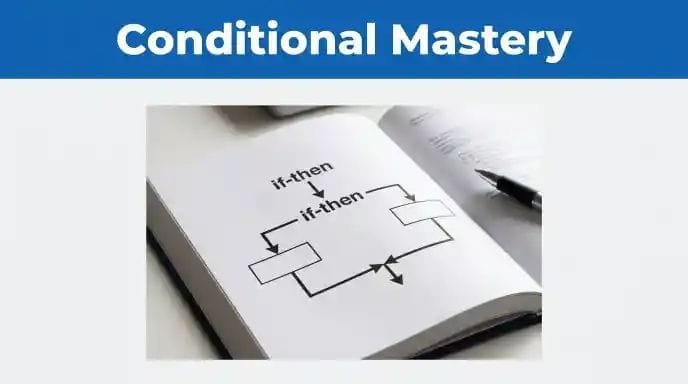
Mastering conditional sentences can feel challenging because they require you to balance two distinct ideas: a condition and its result. However, once you learn how to identify the specific time reference, choosing the correct grammatical structure becomes much more straightforward.
The four main English conditionals are used to describe objective facts, likely future events, unreal present situations, and imagined past results. These structures appear regularly in school grammar papers, competitive exams, and various error correction questions.
English Conditionals Key Takeaways
- Use the zero conditional for facts, routines, and results that always happen.
- Use the first conditional for a real or likely future possibility.
- Use the second conditional for an unreal, unlikely, or imagined present or future situation.
- Use the third conditional to discuss an unreal past and its imagined result.
- In most conditional sentences, remember that you should not use will inside the if clause.
The Pattern Behind English Conditionals
Every conditional sentence has two parts:
- The if clause, which provides the condition.
- The main clause, also known as the result clause, which describes the outcome.
For example:
If the train is late, we will take a taxi.
“If the train is late” is the if clause. “We will take a taxi” is the main clause.
You may change the order without changing the meaning:
- If the train is late, we will take a taxi.
- We will take a taxi if the train is late.
A comma is usually needed when the if clause comes first. It is usually omitted when the main clause comes first.
This quick table shows the central patterns and grammatical structure of English conditionals.
| Conditional type | If-clause | Main clause | Main use |
|---|---|---|---|
| Zero | Present simple | Present simple | Facts and routines |
| First | Present simple | Will + base verb | Likely future results |
| Second | Past simple | Would + base verb | Unreal present or future |
| Third | Past perfect | Would have + past participle | Unreal past situations |
The tense in the if clause does not always show real time. In second and third conditionals, it shows distance from reality. The past simple or past perfect form suggests that the situation is imagined, unlikely, or impossible.
For a clear reference, the British Council guide to conditionals gives useful examples of these forms in context.
Zero Conditional for Facts and Regular Results
The zero conditional describes general truths. It is a fundamental concept used to express scientific facts, rules, instructions, and everyday habits. When mastering the zero conditional, it is important to remember that the structure relies on two clauses linked together.
Structure:
If + present simple, present simple
Examples:
- If you heat ice, it melts.
- If students miss lessons, they fall behind.
- If I drink coffee late, I cannot sleep.
- Plants die if they do not get water.
In these sentences, both clauses use the present simple because the result is consistent and happens repeatedly. Because both clauses use the present simple, the sentence does not refer to a specific future occasion.
You can often replace if with when without changing the meaning:
- If people do not revise, they make mistakes.
- When people do not revise, they make mistakes.
However, when sounds more certain. It implies that the condition will occur, whereas if leaves room for doubt. Note that when the if clause comes first, you must use a comma to separate it from the main clause.
This grammatical form often appears in exams that test subject-verb agreement:
- If water reaches 100°C, it boils.
- If a child touches a flame, it gets burnt.
Always watch for singular subjects carefully. For example, “water reaches” requires the verb reaches, not reach.
Common Zero Conditional Errors
Students sometimes mistakenly add will because they associate conditional structures with the future.
Incorrect: If you will mix red and blue, you get purple. Correct: If you mix red and blue, you get purple.
The sentence states a general fact, so both clauses use the present simple tense.
Another common mistake is using a continuous tense without a specific reason.
Incorrect: If metal is getting hot, it expands. Correct: If metal gets hot, it expands.
Only use the present continuous when you are describing an action happening right now, rather than a general principle.
First Conditional for Real Future Possibilities
The first conditional is used to describe real possibilities for the future and their likely results. It does not imply that the event is guaranteed to occur, but the speaker views the outcome as a realistic prospect.
Structure:
If + present simple, simple future (will + base verb)
Examples:
- If it rains tomorrow, we will stay indoors.
- If you revise regularly, you will feel more confident.
- She will miss the bus if she does not leave soon.
- If the school announces the timetable, I will send you the details.
It is important to remember that the present simple is used in the if clause, even though the meaning refers to the future.
Incorrect: If she will arrive early, we will start the meeting.
Correct: If she arrives early, we will start the meeting.
The main clause can also incorporate other modal verbs if the context requires them:
- If you finish early, you can leave.
- If you see Mr Khan, you should tell him.
- If the weather improves, we may play outside.
These examples remain first conditional sentences because the condition refers to a potential future event.
First Conditional Signal Words
Time expressions such as tomorrow, next week, soon, later, and this evening often suggest the use of the first conditional. However, these words alone do not dictate the grammatical choice. You must focus on whether the condition is genuinely realistic.
Compare these sentences:
- If I have time this evening, I will call you.
- If I had time this evening, I would call you.
The first speaker believes that finding time is a real possibility. The second speaker suggests that having time is unlikely or purely hypothetical.
For extra practice with grammar terminology, Cambridge Dictionary’s explanation of conditionals also covers related expressions such as unless and as long as.
Second Conditional for Imagined Present and Future Situations
The second conditional is used to describe unreal or unlikely hypothetical situations in the present or future. It is a vital tool for discussing dreams, offering advice, expressing wishes, and making polite suggestions.
Structure:
If + past simple, would + infinitive (base verb)
Examples:
- If I had more time, I would learn Spanish.
- If she lived nearer, she would visit us more often.
- If we won the competition, we would celebrate.
- If I were you, I would check every answer.
Although the if-clause uses the past simple, it does not refer to the past. The phrase “If I had more time” indicates that I do not have enough time right now. In the result clause, we use the present conditional, which consists of “would” followed by the infinitive.
The phrase “If I were you” is essential for formal grammar and examinations. While some people use “If I was you” in informal speech, “were” is the standard form when discussing hypothetical situations.
Use the second conditional when a scenario is possible in theory but does not match current reality.
This grammatical form is very common in questions about ambitions or hypothetical choices:
- What would you do if you became the headteacher?
- Where would you live if you could choose any city?
- If you found a wallet, would you return it?
In these examples, the word “would” belongs in the main clause. Avoid the common mistake of using it twice.
Incorrect: If I would have a car, I would drive to college. Correct: If I had a car, I would drive to college.
Third Conditional for Regrets and Past Possibilities
The third conditional is used to look back at a past event that did not happen, allowing us to imagine an alternative outcome. Because this structure deals with situations that are impossible to change, it is often referred to as an unreal past.
Structure:
If + past perfect, would have + past participle
When forming the third conditional, we combine the past perfect in the if-clause with the perfect conditional in the result clause. This grammatical structure helps to clarify that the situation is hypothetical.
Examples:
- If I had revised more, I would have passed the test.
- If they had caught the earlier train, they would have arrived on time.
- She would have called you if she had known your number.
- If the driver had seen the signal, he would have stopped.
The speaker understands that the past cannot change. Consequently, this form often expresses regret, criticism, relief, or reflection.
Compare the time reference:
- If I study, I will pass. This refers to a possible future result.
- If I studied, I would pass. This describes an unreal present or future situation.
- If I had studied, I would have passed. This refers to an unreal past result.
Examiners often test the correct usage of the past participle after would have. Remember that irregular verbs require their correct third form:
- If he had gone, he would have seen her.
- If they had taken a map, they would not have got lost.
- If she had written earlier, I would have replied.
Do not write “would have went” or “would have saw”. After have, you must always use the past participle.
Mixed Conditionals and Other Exam Traps
Some sentences connect a past cause with a present result, or a present state with a past outcome. These structures are known as mixed conditionals. To master these, you must carefully analyse the time reference for both parts of the sentence.
- If I had taken that job, I would live in London now.
- If she had listened to the doctor, she would feel better today.
- If they were more organised, they would have finished the project yesterday.
The first two examples feature a past condition leading to a present result, whilst the final sentence demonstrates a present condition causing a past result. Because mixed conditionals require a strong grasp of verb tenses, they are frequently used in exams to test your precision. Always verify the time of each idea before deciding on the correct verb form.
Another common trap involves the word unless, which serves as a synonym for if not. You can use unless to replace an if clause, provided you adjust the sentence structure accordingly.
- Unless you leave now, you will be late.
- If you do not leave now, you will be late.
A key rule for accuracy is to avoid using a negative verb directly after unless, as the negative is already contained within the word itself.
Incorrect: Unless you do not hurry, you will miss the bus.
Correct: Unless you hurry, you will miss the bus.
Additionally, keep an eye out for phrases like provided that, as long as, and on condition that. These are excellent alternatives to standard conditional structures when you want to express specific requirements:
- You can borrow my notes provided that you return them tomorrow.
- We will go for a walk as long as the weather stays dry.
Conditional Sentences Exam Practice
Choose the correct answer in each sentence before checking the answers to test your knowledge of conditional sentences.
- If you ___ water to 0°C, it freezes.
a) cool
b) cooled
c) will cool
d) had cooled - If Riya studies tonight, she ___ ready for the test.
a) is
b) will be
c) would be
d) would have been - If I ___ a million pounds, I would buy a small cottage near the sea.
a) win
b) won
c) had won
d) will win - If they had left earlier, they ___ the flight.
a) catch
b) will catch
c) would catch
d) would have caught - If you ___ hard work, you usually get better results.
a) avoid
b) avoided
c) will avoid
d) had avoided - If I were the captain, I ___ every player a chance.
a) give
b) will give
c) would give
d) would have given - Unless he ___ now, he will miss the interview.
a) leaves
b) left
c) will leave
d) had left - If Maya had brought her umbrella, she ___ wet now.
a) is not
b) will not be
c) would not be
d) would not have been - If you see Anil, ___ him to email me.
a) tell
b) told
c) would tell
d) had told - If I ___ about the meeting, I would have attended it.
a) know
b) knew
c) had known
d) would know
Answers and Explanations
- a) cool. As this sentence refers to a scientific fact, you should use the zero conditional structure.
- b) will be. A realistic future result, such as passing a test, requires the first conditional.
- b) won. The speaker imagines a hypothetical future situation, making this a perfect example of the second conditional.
- d) would have caught. Because the condition and the result both refer to the past, the third conditional is the correct choice.
- a) avoid. This sentence describes a general truth or natural consequence, fitting the rules for the zero conditional.
- c) would give. The phrase “If I were” is a classic marker for the second conditional, used to describe unreal or imagined situations.
- a) leaves. Even with the use of “unless,” the standard rules for the first conditional apply to this sentence.
- c) would not be. This is a mixed conditional, as a past action (bringing an umbrella) affects a present state (being wet).
- a) tell. This is an imperative used within a first conditional sentence to provide a real-world instruction.
- c) had known. Since the meeting has already concluded, you must use the third conditional to express a regret about the past.
Frequently Asked Questions
Why can I not use ‘will’ in the if clause?
In English conditional sentences, the if clause sets the condition for the outcome in the main clause. Because the if clause typically refers to a state or event that precedes the result, using ‘will’ creates a redundancy that is grammatically incorrect in standard English.
What is the difference between ‘if’ and ‘when’ in the zero conditional?
While ‘if’ and ‘when’ are often interchangeable in zero conditional sentences, they carry different nuances. ‘When’ implies that the condition is certain to happen, whereas ‘if’ suggests that the condition might or might not occur.
Is it always necessary to use a comma in a conditional sentence?
A comma is required only when the if clause is placed at the start of the sentence. If the main clause comes first, you do not need a comma to separate the two parts.
Can I use ‘were’ instead of ‘was’ in the second conditional?
Yes, ‘were’ is the standard and preferred form in formal writing and examinations when discussing hypothetical situations, regardless of the subject. Using ‘were’ with singular subjects like ‘I’ or ‘he’ correctly signals that the situation is imagined rather than real.
A Reliable Way to Choose the Right Conditional
Start by deciding whether the situation is a fact, a genuine future possibility, an imagined present situation, or an impossible past change. That decision usually points you toward the correct pattern.
Once you have identified the type, check both the if clause and the main clause. A first conditional requires present simple after if, while a third conditional requires past perfect. Remember that small verb changes alter the time and meaning of the whole sentence.
When you practise English conditionals, read each sentence aloud with its intended meaning in mind. Grammar becomes much easier when you connect the form to time, possibility, and reality. If you keep these components in mind, you will find that mastering conditional sentences becomes a much more straightforward part of your exam preparation.
Discover more from GYANKUNDLI
Subscribe to get the latest posts sent to your email.