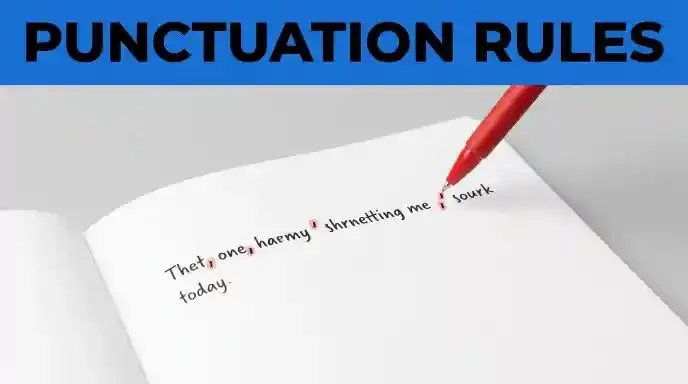
A single misplaced comma can make an otherwise correct sentence wrong in a competitive exam. Understanding punctuation rules for competitive exams is essential, as these questions often look easy, yet they test whether you can spot small breaks in grammar, meaning and sentence structure under time pressure. Developing these skills is vital for success in the writing and language section of various high-stakes tests.
Strong punctuation skills help with error detection, sentence improvement, editing tasks and objective English papers. Mastering these concepts is also a key component of effective SAT and ACT strategies for students targeting international qualifications. Learn the rule behind each mark, then practise identifying the option that is clearly correct.
Punctuation Rules Key Takeaways
- Commas are essential to separate meaningful parts of a sentence, yet they must never incorrectly split a subject from its verb or disrupt the flow of independent clauses.
- Understanding the apostrophe for possession is vital, as these marks are used to indicate ownership or omitted letters rather than to make a noun plural.
- A colon typically follows a complete statement to introduce items in a list, whereas a semicolon effectively joins two closely related independent sentences.
- Mastering the rules for direct speech, questions, and parenthetical information ensures you handle complex punctuation patterns with ease.
- In competitive exams, always read the full sentence to identify errors before committing to an option.
How Punctuation Questions Appear in Competitive Exams
Competitive exams commonly test your ability to use punctuation as essential English grammar symbols through multiple-choice questions, error spotting, and sentence correction. You may need to choose the correctly punctuated sentence or identify the specific part of a sentence containing an error.
Most questions focus on a small group of marks: commas, apostrophes, the full stop period, colons, semicolons, question marks, quotation marks, hyphens, and parentheses. The question may look like a vocabulary test, but the answer often depends on your understanding of underlying grammar.
For example, compare these sentences:
- Wrong: After the test the candidates, left the hall.
- Correct: After the test, the candidates left the hall.
The first comma wrongly separates the subject, “the candidates”, from the verb, “left”. The second sentence correctly uses a comma after an introductory clause, which functions as a dependent clause, to set the stage for the main action.
The British Council’s punctuation guidance is useful for revising standard sentence marks before attempting objective questions. However, exam success comes from applying rules quickly, not memorising isolated definitions. Whether you are using quotation marks to highlight dialogue or placing commas to separate clauses, always remember the golden rule:
Read punctuation as part of the sentence’s grammar. A comma, apostrophe, or colon must have a clear job.
Comma Rules That Frequently Cause Errors
Mastering comma rules is essential for competitive exams, as examiners often test your ability to distinguish between structural pauses and natural speech rhythms. A common mistake is adding commas where you would naturally take a breath; however, commas should instead be used to define structural boundaries.
Use a comma after an introductory clause or phrase to separate it from the main clause. If you begin a sentence with a subordinating conjunction, such as although or because, you are creating a dependent clause that requires a comma to transition into the main idea.
- Correct: Although the paper was difficult, Meera remained calm.
- Correct: In the final round, the team answered every question.
When including extra information that is not essential to the sentence meaning, use an appositive comma on both sides of the phrase. This provides context without disrupting the core message.
- Correct: Mr Sharma, our English teacher, checked the answer sheets.
- Correct: The library, which closes at six, is near the main gate.
Conversely, do not use commas around information that is necessary to identify a specific person or thing.
- Correct: Students who arrive late must report to the supervisor.
In this example, the relative clause defines which students are being discussed. Adding commas here would incorrectly suggest that all students arrive late.
When joining two complete independent clauses, place a comma before coordinating conjunctions. You can remember these using the FANBOYS acronym (for, and, nor, but, or, yet, so). Failing to use a conjunction while linking two independent clauses with only a comma results in a comma splice error.
- Correct: The bell rang, and the candidates began writing.
- Wrong: The bell rang, the candidates began writing.
To correct a comma splice error, use a full stop, a semicolon, or a coordinating conjunction. Additionally, remember that while the Oxford comma is a common stylistic choice used to separate items in a list, its application should remain consistent throughout your writing. The Cambridge Dictionary offers a helpful guide to punctuation marks for further clarity on these distinctions.
Apostrophes: Mastering the Apostrophe for Possession, Contractions and Common Traps
Apostrophes cause avoidable mistakes because the same mark has two different functions. It can show ownership or denote a contraction apostrophe where letters have been omitted.
For a singular noun, add ‘s to show possession.
- Correct: The candidate’s identity card was missing.
- Correct: The teacher’s instructions were clear.
For regular plural nouns ending in s, place the apostrophe after the final s.
- Correct: The candidates’ hall tickets were checked.
- Correct: The teachers’ room is upstairs.
Irregular plurals do not end in s, so they take ‘s.
- Correct: The children’s books are on the shelf.
- Correct: The women’s team won the debate.
A contraction apostrophe is used in phrases where letters have been left out to shorten the word.
- Correct: Don’t leave your answer sheet blank.
- Correct: It’s time to begin the test.
A major exam trap is the difference between its and it’s. “Its” shows possession, while “it’s” acts as a contraction apostrophe meaning “it is” or “it has”.
- Correct: The school changed its timetable.
- Correct: It’s raining outside.
Never use an apostrophe only to make an ordinary noun plural. Write “two pens”, not “two pen’s”.
Colons, Semicolons and Other Strong Stops
A full stop period ends a complete thought. It is often the safest correction when a sentence contains two independent clauses.
- Correct: The train was late. We still reached the centre on time.
When considering semicolon usage, remember that it joins two closely connected independent clauses. Each side of the punctuation mark must be able to stand alone as its own sentence.
- Correct: The room was silent; everyone was concentrating.
- Correct: Rohan revised daily; his confidence grew.
Regarding colon rules, this mark introduces an explanation, items in a list, an example, or a result. Critically, the words appearing before the colon must form a complete thought on their own.
- Correct: You need three items: a pen, an admit card and a photograph.
- Correct: Her decision was final: she would not withdraw her application.
Do not write, “The required items are: a pen, an admit card and a photograph.” The phrase before the colon in this example is incomplete. Write either “The required items are a pen…” or “You need three items: a pen…”
For parentheses usage, these marks are used to add extra information to a sentence. Alternatively, dash pairs can perform a similar function if you wish to provide more emphasis to the added information.
- Correct: The interview panel (including the external examiner) arrived at ten.
Hyphens join certain compound words before nouns.
- Correct: She is a well-known teacher.
- Correct: The teacher is well known.
The hyphen is needed before “teacher” because “well-known” works together as one describing unit. It is not needed after the verb “is”.
Quotation Marks, Questions and Exclamations
When you need to convey direct speech, you must repeat the speaker’s exact words by placing them inside quotation marks. This is a fundamental rule for ensuring clarity in written communication.
- Correct: The invigilator said, “Write your roll number clearly.”
- Correct: Anita asked, “Have you completed the form?”
A question mark belongs at the end of a direct question.
- Correct: Where is the examination centre?
- Correct: The officer asked, “Where is the examination centre?”
An indirect question does not need a question mark.
- Correct: The officer asked where the examination centre was.
Use an exclamation mark only where strong emotion, command or surprise is intended. Competitive exam questions often include unnecessary exclamation marks to distract candidates.
- Correct: Stop!
- Correct: Please submit the form by Friday.
British publishers may use single quotation marks more often than double quotation marks. In an exam, follow the style already used in the question. The punctuation rule matters more than the choice of single or double marks.
A Fast Revision Method Before the Exam
Revise punctuation in groups rather than trying to memorise every mark simultaneously. This targeted approach is particularly helpful when preparing for the writing and language section of your exam. Start with commas and apostrophes, as these appear most frequently, before moving on to colons, semicolons and direct speech.
When you encounter a question, first identify the subject and the verb. Next, look for introductory clauses, extra information, possession, lists or quoted speech. This methodical process helps you identify non-essential phrases and extra information, which allows you to eliminate options that use random or incorrect commas.
For OMR-based papers, decide on the answer before filling the circle. Re-read the selected sentence once, paying close attention to the placement of apostrophes and commas. Always follow the specific examination notice regarding permitted stationery and instructions for completing your answer sheet.
The Purdue OWL punctuation index offers additional examples if you need further revision after completing the questions below.
Frequently Asked Questions
Why is punctuation so critical in competitive exams?
In competitive exams, punctuation marks often signal the boundary between different grammatical structures. Examiners use these small symbols to test your ability to distinguish between independent and dependent clauses, identifying whether a student can maintain clarity under pressure.
Can I rely on ‘natural pauses’ to place commas?
No, you should avoid using pauses as a guide for punctuation, as this often leads to errors like comma splices or splitting subjects from verbs. Instead, always look for structural triggers, such as introductory phrases, coordinating conjunctions, or appositive details, which require specific marks regardless of how the sentence sounds aloud.
What is the most common mistake students make with apostrophes?
Students frequently use apostrophes to create plural nouns, which is grammatically incorrect. Remember that apostrophes are strictly for indicating possession or replacing omitted letters in contractions, whereas plural nouns should simply end in ‘s’ or ‘es’ without any added punctuation.
50 Punctuation Practice Questions
These practice questions are designed to test your understanding of items in a list, along with various punctuation rules competitive exams frequently assess. Use these to refine your grammar skills and ensure you are prepared for your assessment.
Questions 1 to 25
- Choose the correctly punctuated sentence.
A. Riya please close the window.
B. Riya, please close the window.
C. Riya please, close the window.
D. Riya, please, close the window. - Choose the correct sentence.
A. Although it was late we continued studying.
B. Although, it was late we continued studying.
C. Although it was late, we continued studying.
D. Although, it was late, we continued studying. - Choose the correct sentence.
A. The principal who was absent yesterday returned today.
B. The principal, who was absent yesterday, returned today.
C. The principal who, was absent yesterday returned today.
D. The principal, who was absent yesterday returned, today. - Choose the correct sentence.
A. Students, who carry mobile phones will be disqualified.
B. Students who carry mobile phones, will be disqualified.
C. Students who carry mobile phones will be disqualified.
D. Students, who carry mobile phones, will be disqualified. - Select the sentence with no comma splice.
A. The rain stopped, we left the centre.
B. The rain stopped; we left the centre.
C. The rain, stopped we left the centre.
D. The rain stopped, and. - Choose the correctly punctuated sentence.
A. The bell rang and the candidates entered.
B. The bell rang, and the candidates entered.
C. The bell, rang and the candidates entered.
D. The bell rang and, the candidates entered. - Choose the correct sentence.
A. My brother, lives in Jaipur.
B. My, brother lives in Jaipur.
C. My brother lives in Jaipur.
D. My brother lives, in Jaipur. - Choose the correct sentence.
A. However, the final result was delayed.
B. However the final, result was delayed.
C. However the final result, was delayed.
D. However, the final, result was delayed. - Choose the correct sentence.
A. Dr Verma our new lecturer, teaches phonetics.
B. Dr Verma, our new lecturer teaches phonetics.
C. Dr Verma, our new lecturer, teaches phonetics.
D. Dr Verma our new, lecturer teaches phonetics. - Choose the correct sentence.
A. If you revise daily, you will improve.
B. If you revise, daily you will improve.
C. If, you revise daily you will improve.
D. If you revise daily you, will improve. - Choose the correct possessive form.
A. The student’s answer was accurate.
B. The students answer was accurate.
C. The students’ answer was accurate.
D. The student answer’s was accurate. - Choose the correct possessive form.
A. The girls hostel is nearby.
B. The girl’s hostel is nearby.
C. The girls’ hostel is nearby.
D. The girls’s hostel is nearby. - Choose the correct sentence.
A. The childrens’ uniforms were clean.
B. The children’s uniforms were clean.
C. The childrens uniforms were clean.
D. The childrens’s uniforms were clean. - Choose the correct sentence.
A. The company changed it’s rules.
B. The company changed its’ rules.
C. The company changed its rules.
D. The company changed it is rules. - Choose the correct contraction.
A. Dont forget your identity card.
B. Don’t forget your identity card.
C. Dont’ forget your identity card.
D. Don,t forget your identity card. - Choose the correct plural form.
A. The 1990’s saw major changes.
B. The 1990s saw major changes.
C. The 1990s’ saw major changes.
D. The 1990’s saw major change’s. - Choose the correct sentence about one shared project.
A. Asha’s and Neel’s project won.
B. Asha and Neel’s project won.
C. Asha and Neels’ project won.
D. Asha and Neel project’ won. - Choose the correct use of a colon.
A. She bought: a pen and a notebook.
B. She bought two items: a pen and a notebook.
C. She: bought two items, a pen and a notebook.
D. She bought two: items a pen and a notebook. - Choose the correct sentence.
A. The room was full; everyone had arrived.
B. The room was full; and everyone had arrived.
C. The room was full, everyone had arrived.
D. The room; was full everyone had arrived. - Choose the correct use of a colon.
A. The message was simple: revise every day.
B. The message: was simple revise every day.
C. The message was: simple revise every day.
D. The message was simple, revise: every day. - Choose the correct sentence.
A. The teacher said, “Read the passage carefully.”
B. The teacher said “Read the passage carefully”.
C. The teacher said, Read the passage carefully.
D. The teacher, said “Read the passage carefully.” - Choose the correct sentence.
A. The officer asked, “Are you ready?”
B. The officer asked, “Are you ready”.
C. The officer asked “Are you ready”?
D. The officer asked, Are you ready? - Choose the correct indirect question.
A. She asked where is the library?
B. She asked, where the library was.
C. She asked where the library was.
D. She asked where was the library? - Choose the correct sentence.
A. What a difficult paper!
B. What a difficult paper.
C. What, a difficult paper!
D. What a, difficult paper! - Choose the correctly punctuated sentence.
A. The tutor (who arrived late) apologised.
B. The tutor, (who arrived late), apologised.
C. The tutor (who arrived late, apologised).
D. The tutor who, arrived late, apologised.
Questions 26 to 50
- Choose the correct sentence.
A. She is a well known author.
B. She is a well-known author.
C. She is a well, known author.
D. She is a well-known, author. - Choose the correct sentence.
A. The author is well-known.
B. The author is well known.
C. The author, is well-known.
D. The author is, well known. - Choose the correct sentence.
A. He is a 21 year old candidate.
B. He is a 21-year-old candidate.
C. He is a 21-years-old candidate.
D. He is a 21 year-old candidate. - Choose the correct sentence.
A. The candidate is 21-years-old.
B. The candidate is 21-year-old.
C. The candidate is 21 years old.
D. The candidate is 21 year’s old. - Choose the correct sentence.
A. First read the instructions, then begin.
B. First, read the instructions then begin.
C. First read, the instructions, then begin.
D. First, read the instructions, then begin. - Choose the correct sentence.
A. No, I haven’t received the email.
B. No I, haven’t received the email.
C. No I haven’t, received the email.
D. No, I haven’t, received the email. - Choose the correct sentence.
A. Yes please send the document.
B. Yes, please send the document.
C. Yes please, send the document.
D. Yes, please, send the document. - Choose the correct sentence.
A. The answer is clear; practise more.
B. The answer is clear: practise more.
C. The answer, is clear: practise more.
D. The answer is, clear practise more. - Choose the correct sentence.
A. We visited Delhi, India, and Nepal.
B. We visited Delhi, India and Nepal.
C. We visited Delhi India and, Nepal.
D. We visited, Delhi India and Nepal. - Choose the correct sentence.
A. Mr Khan said that he would return soon.
B. Mr Khan, said that he would return soon.
C. Mr Khan said, that he would return soon.
D. Mr Khan said that, he would return soon. - Choose the correct sentence.
A. Before the interview, check your documents.
B. Before, the interview check your documents.
C. Before the interview check, your documents.
D. Before the interview, check, your documents. - Choose the correct sentence.
A. My uncle, who lives in Leeds, is visiting.
B. My uncle who lives in Leeds is visiting.
C. My uncle, who lives in Leeds is visiting.
D. My uncle who lives, in Leeds, is visiting. - Choose the correct sentence.
A. The applicants’ names were displayed.
B. The applicant’s names were displayed.
C. The applicants names were displayed.
D. The applicants’s names were displayed. - Choose the correct sentence.
A. The dog’s collar was red.
B. The dogs’ collar was red.
C. The dogs collar was red.
D. The dog’s’ collar was red. - Choose the correct sentence.
A. The committee made its decision.
B. The committee made it’s decision.
C. The committee made its’ decision.
D. The committee made it,s decision. - Choose the correct sentence.
A. We need the following: patience, accuracy and speed.
B. We need: patience, accuracy and speed.
C. We need the following, patience: accuracy and speed.
D. We need the following patience, accuracy: and speed. - Choose the correct sentence.
A. The exam ended; the gates opened.
B. The exam ended, the gates opened.
C. The exam ended; and the gates opened.
D. The exam, ended the gates opened. - Choose the correct sentence.
A. “Please sit down,” said the clerk.
B. “Please sit down” said, the clerk.
C. Please sit down, said the clerk.
D. “Please sit down”, said the clerk. - Choose the correct sentence.
A. Did the clerk say, “Please sit down”?
B. Did the clerk say “Please sit down?”
C. Did the clerk say, “Please sit down.”?
D. Did the clerk say “Please sit down”. - Choose the correct sentence.
A. The notice reads: “No mobile phones allowed.”
B. The notice reads, “No mobile phones allowed”.
C. The notice reads “No mobile phones allowed”.
D. The notice, reads: “No mobile phones allowed.” - Choose the correct sentence.
A. My neighbour, a retired teacher, helps me study.
B. My neighbour a retired teacher helps, me study.
C. My neighbour, a retired teacher helps me study.
D. My neighbour a retired, teacher, helps me study. - Choose the correct sentence.
A. Because the road was blocked, we arrived late.
B. Because, the road was blocked we arrived late.
C. Because the road was blocked we, arrived late.
D. Because, the road was blocked, we arrived late. - Choose the correct sentence.
A. The girl who won the prize thanked her parents.
B. The girl, who won the prize thanked her parents.
C. The girl who won the prize, thanked her parents.
D. The girl, who won the prize, thanked her parents. - Choose the correct sentence.
A. “Where are you going?” asked Ravi.
B. “Where are you going”, asked Ravi?
C. Where are you going? asked Ravi.
D. “Where are you going.” asked Ravi. - Choose the correct sentence.
A. Please bring your pen, admit card and photograph.
B. Please bring, your pen admit card and photograph.
C. Please bring your pen admit card, and photograph.
D. Please, bring your pen, admit card and photograph.
Answer Key and Concise Explanations
- B. A name used in direct address takes an appositive comma for clarity.
- C. Use a comma after an opening subordinate clause.
- B. The extra detail about the principal needs commas.
- C. The clause identifies which students are meant.
- B. Proper semicolon usage allows you to join two complete related clauses.
- B. Two independent clauses need a comma plus a conjunction like “and”.
- C. Never split a subject and verb with a comma.
- A. “However” at the start takes a following comma.
- C. The appositive phrase is extra information.
- A. The opening conditional clause takes a comma.
- A. One student owns one answer.
- C. A plural noun ending in s takes a final apostrophe.
- B. “Children” is an irregular plural, so use
's. - C. “Its” is the possessive pronoun.
- B. The apostrophe replaces the missing letter in “do not”.
- B. Ordinary plurals of decades need no apostrophe.
- B. One shared project takes possession on the final name.
- B. The words before the colon form a complete clause.
- A. Both sides of the semicolon are complete sentences.
- A. A colon introduces the explanation after a full clause.
- A. Direct speech requires quotation marks and a reporting comma.
- A. The quoted direct question ends with a question mark.
- C. Indirect questions do not take question marks.
- A. An exclamation mark suits strong feeling.
- A. Parentheses contain additional information.
- B. Use a hyphen before the noun in “well-known author”.
- B. No hyphen follows the verb “is”.
- B. Compound age descriptions before nouns take hyphens.
- C. After the verb, write “21 years old”.
- D. “First” and “then” both need clear separation here.
- A. An opening reply such as “No” takes a comma.
- B. “Yes” is followed by a comma before the request.
- B. The colon introduces the instruction that explains the statement.
- B. The list has three separate place names.
- A. No comma separates “said” from its “that” clause.
- A. The opening phrase needs one comma.
- A. The Leeds detail is additional information.
- A. Several applicants own the displayed names.
- A. One dog owns one collar.
- A. “Its” shows possession.
- A. The complete clause introduces a list after the colon.
- A. A semicolon correctly links two complete clauses.
- A. The comma stays inside the closing quotation mark.
- A. The whole sentence asks a question.
- A. A colon can introduce the exact wording of a notice.
- A. The inserted description needs commas on both sides.
- A. A comma follows the opening reason clause.
- A. The clause identifies which girl won the prize.
- A. The direct question keeps its question mark inside quotation marks.
- A. The list is correctly separated without random commas.
Final Revision Point
Punctuation questions reward careful reading more than guesswork. Identify the sentence structure first, then decide which mark fits that structure.
Developing a reliable command of punctuation rules competitive exams require can turn small grammar questions into dependable marks. By applying these strategies consistently, you ensure that your accuracy improves across all sections of your assessment.
Discover more from GYANKUNDLI
Subscribe to get the latest posts sent to your email.