A sentence can appear complex because it contains several different groups of words. Yet, most grammar questions become much easier to manage once you can confidently spot the differences between phrases and clauses.
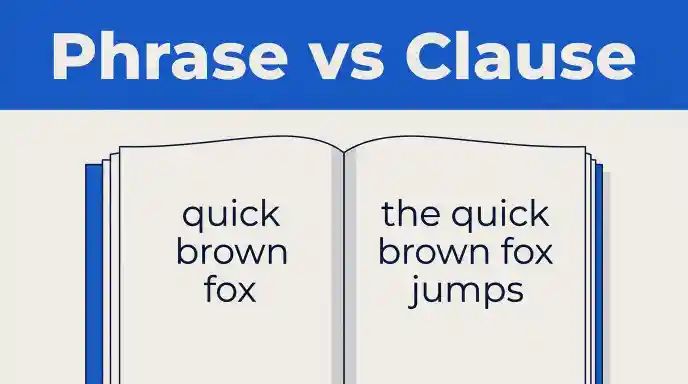
The main difference is simple. A clause is built around a verb, while a phrase is not. However, longer sentences can contain both at the same time, so it helps to examine each word group carefully to understand how they function.
Once you know what to look for, you can write clearer sentences and approach grammar questions with much more confidence.
Phrases and Clauses Key Takeaways
- A phrase is a group of related words that does not contain a complete subject-verb unit.
- A clause contains both a subject and a verb, even if the subject is sometimes implied rather than explicitly stated.
- An independent clause functions as a complete sentence and can stand entirely on its own.
- A dependent clause also features a subject and a verb, but it relies on an additional clause to make full sense within a sentence.
- Prepositional phrases, relative clauses, and the use of subordinating conjunctions are frequent sources of confusion in grammar exams.
The Main Difference Between a Phrase and a Clause
A phrase is a group of words that functions as a single part of a sentence. It may name something, describe an object, or provide extra information regarding time, place, manner, or reason. Crucially, it does not express a complete subject-verb relationship.
Consider this example:
Phrase: “under the old bridge”
This is a prepositional phrase. It tells us where something happens, but it has no subject and no verb. Therefore, it cannot form a complete sentence.
Now compare it with this:
Clause: “the cyclist waited under the old bridge”
Subject: the cyclist
Verb: waited
This word group has a subject and a verb. It expresses a complete idea, so it is a clause. Because it can stand alone, it is an independent clause.
The difference becomes clearer when the two appear together:
Sentence: “The cyclist waited under the old bridge.”
Clause: “The cyclist waited”
Subject: the cyclist
Verb: waited
Phrase: “under the old bridge”
The clause gives the sentence its basic meaning. The phrase adds detail.
| Feature | Phrase | Clause |
|---|---|---|
| Contains a subject-verb unit | No | Yes |
| Can add detail to a sentence | Yes | Yes |
| Can stand alone as a sentence | No | Sometimes |
| Example | “after lunch” | “we ate after lunch” |
In school grammar, this distinction is often taught through the concept of the subject and predicate. The Cambridge Dictionary guide to clauses and phrases also explains how these groups of words work within larger sentences.
A phrase adds meaning, while a clause contains an action, state, or event centred on a verb.
How to Recognise a Phrase
The quickest way to identify a phrase is to search for a subject linked to a verb. If that link is missing, you are likely looking at one of the many types of phrases used in English.
Look at these examples:
Noun phrase: “the extremely noisy crowd”
It names a group of people. There is no verb.
Prepositional phrase: “during the interval”
It tells us when something happened. There is no subject or verb.
Adjective phrase: “full of confidence”
It describes a noun. It does not contain a subject performing an action.
Adverbial phrase: “with great patience”
It explains how an action happens. It has no subject-verb unit.
Phrases can be short or long. Length does not turn a phrase into a clause.
For example:
Phrase: “in the small cottage beside the river”
Although this phrase contains several words, it still has no verb. It cannot tell a complete story on its own.
Now add a clause:
Sentence: “My grandparents live in the small cottage beside the river.”
Clause: “My grandparents live”
Subject: My grandparents
Verb: live
Phrase: “in the small cottage beside the river”
The phrase gives the reader a picture of the place. The clause states the main fact.
Common Types of Phrases
A noun phrase acts as a noun:
“Those new library books are popular.”
The noun phrase is “Those new library books”. Its head noun is “books”.
An adjective phrase (also known as an adjectival phrase) describes a noun:
“The water was too cold for swimming.”
The adjective phrase is “too cold for swimming”. It describes “water”.
An adverbial phrase, or adverb phrase, modifies a verb, adjective, or another adverb:
“The runner finished with surprising ease.”
The phrase “with surprising ease” tells us how the runner finished.
A prepositional phrase begins with a preposition such as “in”, “on”, “at”, “under”, “after”, or “between”:
“The keys are on the kitchen table.”
The phrase “on the kitchen table” tells us where the keys are.
Understanding the Different Types of Clauses
When learning about sentence structure, it is essential to understand the various types of clauses. Every clause contains a verb, but not every clause can stand alone. This creates two major categories: independent clauses and dependent clauses.
Independent Clauses Make Complete Sentences
An independent clause expresses a complete thought and can function as a sentence by itself.
Independent clause: “Maya revised for her exam.” Subject: Maya Verb: revised
The meaning is complete, and no extra words are needed. Here is another example:
Independent clause: “The lights went out.” Subject: The lights Verb: went out
You can join two independent clauses with a coordinating conjunction, such as “and”, “but”, “or”, “so”, “yet”, “for”, or “nor”, to form a compound sentence.
“The lights went out, so the caretaker checked the fuse box.”
This sentence contains two independent clauses:
- “The lights went out” Subject: The lights Verb: went out
- “the caretaker checked the fuse box” Subject: the caretaker Verb: checked
The word “so” joins the two complete ideas to form the compound sentence.
Dependent Clauses Need Support
A dependent clause, often referred to as a subordinate clause, contains a subject and a verb but cannot stand alone. It requires an independent clause to complete its meaning. Joining these two types of clauses creates what is known as a complex sentence.
Dependent clause: “because the lights went out” Subject: the lights Verb: went out
The word “because” makes the reader expect more information. Consequently, “Because the lights went out” is not a complete sentence. It becomes complete when joined to an independent clause:
“The caretaker checked the fuse box because the lights went out.”
This sentence contains:
- Independent clause: “The caretaker checked the fuse box” Subject: The caretaker Verb: checked
- Dependent clause: “because the lights went out” Subject: the lights Verb: went out
Subordinating conjunctions often introduce these subordinate clauses. Common examples include “because”, “although”, “if”, “when”, “while”, “since”, “unless”, and “before”.
“Although the rain stopped, the match did not continue.”
- Dependent clause: “Although the rain stopped” Subject: the rain Verb: stopped
- Independent clause: “the match did not continue” Subject: the match Verb: did continue
The auxiliary verb “did” helps form the negative verb phrase “did not continue”.
Relative Clauses Add Information About Nouns
A relative clause describes or identifies a noun. It often begins with who, which, that, whose, where, or when.
“The student who answered first won the prize.”
The main clause is:
Main clause: “The student won the prize.”
Subject: The student
Verb: won
The relative clause is:
Relative clause: “who answered first”
Subject: who
Verb: answered
Who refers back to the student. The relative clause tells us which student won.
Here is another example:
“I returned the novel that I borrowed from the school library.”
- Main clause: “I returned the novel”
Subject: I
Verb: returned - Relative clause: “that I borrowed from the school library”
Subject: I
Verb: borrowed
The relative clause describes the novel.
Relative clauses are common in descriptive writing, comprehension passages, and error-correction questions. They help writers add details without starting several short sentences. By using these structures, you ensure your sentences convey meaning more effectively and clearly.
The grammar terminology used in English lessons appears in the national curriculum English programmes of study, including references to clauses, conjunctions, and expanded noun phrases.
Phrases and Clauses in the Same Sentence
Most well-written sentences rely on a blend of phrases and clauses to provide clarity and depth. To master this, start by locating the main verb, then identify the subject connected to it. Once you have identified the core structure, you can easily separate the additional descriptive details.
Consider this sentence:
“After the final bell, the pupils hurried through the crowded corridor.”
The first group of words functions as a phrase:
Phrase: “After the final bell”
This segment provides temporal context, yet it lacks both a subject and a verb.
The second group is a clause:
Clause: “the pupils hurried through the crowded corridor”
Subject: the pupils
Verb: hurried
The words “through the crowded corridor” form a prepositional phrase, which describes the location of the action.
Now, consider a more complex example that demonstrates how these elements interact:
“When the final bell rang, the pupils hurried through the crowded corridor.”
This sentence contains two distinct clauses:
- Dependent clause: “When the final bell rang”
Subject: the final bell
Verb: rang - Independent clause: “the pupils hurried through the crowded corridor”
Subject: the pupils
Verb: hurried
Within this structure, the phrase “through the crowded corridor” continues to add spatial information to the independent clause, showing how different components work together to build a complete thought.
Common Mistakes in Grammar Questions
A group of words does not become a clause simply because it is long. For example, “at the edge of the football pitch” contains many words, but it has no verb. Therefore, it is a phrase.
Similarly, a clause does not always make a complete sentence. “If the referee agrees” has a subject and verb, acting as a subordinate clause:
Subordinate clause: “if the referee agrees”
Subject: the referee
Verb: agrees
Yet it leaves the reader waiting for the result. You need to add another clause to complete the thought, such as: “If the referee agrees, the match will restart.”
Students also sometimes mistake a verb phrase for a full clause. In the sentence below, “has been studying” is a verb phrase:
“Ravi has been studying since breakfast.”
Subject: Ravi
Verb phrase: has been studying
The entire group of words, “Ravi has been studying since breakfast”, constitutes a clause. However, the words “has been studying” alone are not a clause because they do not include the subject.
Another point matters in advanced grammar. Expressions such as “to win the competition” may be called infinitive clauses in modern grammar because they are built around a non-finite verb. Some school textbooks call them infinitive phrases. Always follow the specific terminology your teacher, board, or examination uses.
A Quick Method for Telling Them Apart
Use this four-step check during exercises and proofreading:
- Find the verb or verb phrase in the word group.
- Ask who or what performs the action, or exists in that state.
- If you can identify both a subject and verb, you have a clause.
- Check whether the group of words expresses a complete thought. If it can stand alone as a sentence, it is an independent clause. If not, it is a dependent clause.
For example, examine “before the train arrived”:
- Verb: arrived
- Subject: the train
- Result: clause
However, it begins with “before”, so it depends on another clause.
Now examine “before the train”:
- No verb appears.
- Result: phrase
That small change removes the clause completely.
Frequently Asked Questions
Can a Phrase ever contain a verb?
A phrase cannot contain a subject-verb unit, but it may contain a non-finite verb form, such as an infinitive or a participle. For instance, in the phrase “running to the shops,” the word “running” is a participle, but the group lacks a subject to perform the action.
Why do some Clauses sound incomplete?
Dependent or subordinate clauses often sound incomplete because they begin with subordinating conjunctions like “because,” “if,” or “although.” These words signal to the reader that the clause is providing extra information that must be attached to an independent clause to form a complete thought.
How can I tell if a long group of words is a Clause?
The length of a word group is not a reliable indicator of its grammatical function. To determine if a long group is a clause, simply look for a subject and a verb working together as a unit; if that core connection is missing, you are likely looking at a very long phrase.
Conclusion
Mastering the difference between phrases and clauses becomes much simpler when you focus on the subject-verb relationship. Remember that a phrase provides additional detail without containing both a subject and a verb, whereas a clause functions as a building block containing a verb and typically a subject.
By understanding how independent and dependent clauses operate, you can more easily construct complex sentences that flow naturally. When you learn to distinguish between these grammatical components, you gain a better grasp of how phrases and clauses work together to convey meaning in sophisticated writing. With a little practice, even the most crowded sentences will begin to make perfect sense, allowing your writing to become clearer and more polished.
Discover more from GYANKUNDLI
Subscribe to get the latest posts sent to your email.