Two roads, one choice, and a decision that still gets debated in classrooms more than a century later. Robert Frost’s The Road Not Taken is short, but it leaves a lasting mark because it sounds simple while raising a bigger question about how people explain the choices they make.
This summary and analysis will give you a clear sense of what happens in the poem, what the speaker is really saying, and why the final lines are often misunderstood. Frost’s 20-line poem is built with careful control, and that tight structure is part of what makes it so memorable in literature lessons.
What The Road Not Taken is really about
Robert Frost’s poem is often treated as a simple cheer for bold choices, but that reading only catches part of it. The poem is about choice, yes, yet it is also about regret, memory, and the stories people tell themselves after the fact. If you read it closely, you see that Frost is far less interested in celebrating one brave road than in showing how hard it is to face the road you did not take.
For a useful overview of the poem’s context and wording, the Poetry Foundation’s text is a good place to compare the lines as they appear on the page. LitCharts also gives a clear summary of the poem’s structure and central tension in its analysis of The Road Not Taken.
The speaker stands at a fork in the woods
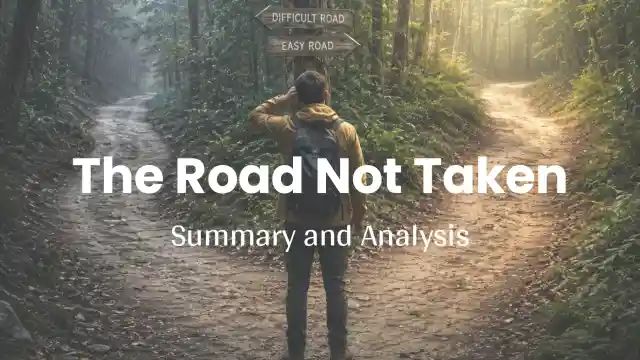
The poem opens with a traveller in a yellow wood, faced with two paths. He cannot take both, so he stops and looks ahead, trying to judge each road before choosing. That pause matters, because it creates a mood of hesitation rather than confidence.
Frost turns an ordinary scene into something larger. A simple walk in the woods becomes a picture of life itself, where every choice closes off another option. The speaker does not act quickly, and that delay makes the moment feel human and familiar.
Why the poem’s title creates instant interest
The title pulls readers in before the first line even begins. “The Road Not Taken” sounds like a phrase about loss, missed chances, and the path left behind. It also raises curiosity, because it makes you wonder what happened on the other road.
Many readers expect a neat moral lesson, perhaps one about following your own path. Instead, Frost gives something more complicated. The title points to absence, not triumph, and that shift changes the whole poem.
The original wording matters here, because the title reminds us that the poem is not only about the road chosen. It is also about the one that remains unseen, unexplored, and gone.
The poem is less a celebration of daring than a meditation on how people explain their choices later on.
The original text of the poem
Two roads diverged in a yellow wood, And sorry I could not travel both And be one traveller, long I stood And looked down one as far as I could To where it bent in the undergrowth;
Then took the other, as just as fair, And having perhaps the better claim, Because it was grassy and wanted wear; Though as for that the passing there Had worn them really about the same,
And both that morning equally lay In leaves no step had trodden black. Oh, I kept the first for another day! Yet knowing how way leads on to way, I doubted if I should ever come back.
I shall be telling this with a sigh Somewhere ages and ages hence: Two roads diverged in a wood, and I I took the one less travelled by, And that has made all the difference.
What makes the poem so memorable is the tension between what the speaker sees and what he later claims. The roads look nearly identical, yet the final lines suggest a grand life story. That gap between fact and narration is where Frost’s real meaning begins.
The Road Not Taken summary, stanza by stanza
Robert Frost’s The Road Not Taken is short, but each stanza shifts the speaker’s thought in a careful way. The poem begins with a simple choice in the woods and ends with a memory that feels bigger than the moment itself. Read stanza by stanza, the poem becomes much clearer, especially if you keep an eye on the details Frost repeats and the ones he quietly undercuts.
For the full text alongside the poem’s publication history, the Poetry Foundation’s page on “The Road Not Taken” is a reliable reference. You can also compare different critical readings in this discussion of Frost’s most famous poem.
First stanza: the speaker looks at both roads
The poem opens in a yellow wood, where the traveller faces a fork in the path. He stops because he cannot take both roads, and that simple fact gives the stanza its emotional weight. He wants to see where each route leads, so he looks as far as he can down one road, until the bend and the undergrowth hide what comes next.
That moment of pause matters. The speaker is not rushing ahead with certainty, and he is not treating the choice as trivial either. He is caught in the ordinary human problem of wanting to do everything at once, yet knowing that life only lets you choose one direction at a time.
He stands still, studies the split path, and feels the limits of choice before he even moves.
The road is physical, but the situation feels familiar. Most readers recognise that uneasy moment when a decision has to be made and the other option has to be left behind.
Second stanza: the choice is made, but both roads seem similar
In the second stanza, the speaker chooses one road because it looks slightly better. He says it had “perhaps the better claim” because it was grassy and seemed less worn. At first glance, that sounds like a clear reason.
Yet Frost quickly pulls that certainty apart. The speaker admits the two roads were “really about the same”, and that both lay covered with leaves that had not been stepped on heavily. The visible details, grass, wear, and fallen leaves, create the impression of difference, but the poem does not let that impression become fact.
This is where the poem becomes sly. The speaker wants to believe the choice meant something, but the evidence in the stanza says otherwise. If you want a neat moral lesson, Frost refuses to hand one over. He gives you two roads that look different for a moment, then tells you they are nearly identical.
For readers who want to compare the exact wording with line-by-line notes, this analysis of the poem’s stanza structure can help when revising the text.
Third stanza: the speaker doubts he will return
The third stanza moves from the present choice to the future. The speaker says he kept the first road “for another day”, but that hope is immediately checked by experience. He knows that one path leads to another, so going back is unlikely.
That is an important shift. The poem no longer focuses on which road looked better, it focuses on how choices work in real life. Once you take one step, the next step follows, and the route behind you fades into possibility rather than action.
The speaker’s doubt makes the poem feel honest. He is not pretending that every decision can be undone. Instead, he recognises that life keeps moving, and that the chance to return often disappears before you realise it has gone.
Fourth stanza: the famous ending and its quiet twist
The final stanza is the one most readers remember. The speaker imagines himself, far in the future, telling this story “with a sigh”. Then comes the line that has been quoted endlessly, “I took the one less travelled by, / And that has made all the difference.”
That ending sounds decisive, even proud, but it is more complicated than it first appears. The speaker says he will be telling the story later, which means he is already shaping the past into a neat narrative. The “sigh” can sound like regret, satisfaction, irony, or self-justification, depending on how you read it.
The ending does not close the poem cleanly, it leaves room for more than one reading.
Frost later explained that the sigh was meant as a kind of mock sigh, which pushes readers towards irony rather than simple celebration. So the last lines can be read as a serious claim about life choices, or as a subtle comment on how people turn ordinary decisions into grand stories about destiny.
The original text of The Road Not Taken
Two roads diverged in a yellow wood, And sorry I could not travel both And be one traveller, long I stood And looked down one as far as I could To where it bent in the undergrowth;
Then took the other, as just as fair, And having perhaps the better claim, Because it was grassy and wanted wear; Though as for that the passing there Had worn them really about the same,
And both that morning equally lay In leaves no step had trodden black. Oh, I kept the first for another day! Yet knowing how way leads on to way, I doubted if I should ever come back.
I shall be telling this with a sigh Somewhere ages and ages hence: Two roads diverged in a wood, and I I took the one less travelled by, And that has made all the difference.
Taken stanza by stanza, the poem is less about a heroic choice and more about how people remember choices afterwards. The roads matter, but the speaker’s story about the roads matters just as much.
A closer analysis of the poem’s meaning and message
The Road Not Taken is often praised as a poem about independence, but that reading is only half the story. Frost gives us a speaker who faces a choice with limited information, then later turns that choice into a tidy personal tale. The poem matters because it captures how people make decisions, then explain them to themselves afterwards.
The text of the poem is available on the Poetry Foundation’s page for “The Road Not Taken”, and a useful modern discussion of its common misreading appears in Lit Hub‘s analysis. Read closely, the poem is less about victory than about uncertainty, loss, and the stories we build around our own lives.
Choice is permanent, even when the options look alike
The speaker stands at a fork in the road and has to choose without knowing what lies ahead. That is the heart of the poem. He cannot test both routes, so he must decide with incomplete knowledge, which is exactly how most real-life choices work.
What makes the moment so convincing is that the speaker understands the cost straight away. He wants to travel both roads, but that is impossible. Once he takes one path, the other becomes unavailable, not because it was worse, but because time only moves in one direction.
That idea gives the poem its emotional force. A decision can feel small at the moment, yet it still shuts down another possible life. Frost does not dress this up as something grand. He lets the simple scene carry the weight.
The poem’s irony: both roads were almost the same
The key line comes when the speaker admits the roads were “really about the same”. That line changes everything. It undercuts the popular belief that the poem celebrates rebellion or bold individuality, because the speaker does not choose between one clearly ordinary path and one clearly extraordinary path.
Instead, the difference is much thinner. Both roads are “just as fair”, and both lie untouched under leaves. The speaker notices small visual clues, such as grass and wear, but the poem itself tells us those clues do not amount to much.
This is why The Road Not Taken feels ironic. The final claim about taking “the one less travelled by” sounds confident, yet the earlier lines do not support it. Frost presents a choice that looks meaningful from the inside, then shows how fragile that meaning really is.
The roads are almost identical, which is why the speaker’s later certainty feels suspect.
Regret, memory, and the story we tell ourselves later
The final stanza shifts the poem into memory. The speaker says that, ages later, he will tell the story “with a sigh”. That sigh can suggest regret, but it can also suggest self-justification. He may be sorry for what he lost, or he may be polishing the story so it sounds wiser than it was.
The future tense matters here. The speaker is not only recalling the choice, he is imagining how he will narrate it later. That means the poem is about memory as much as it is about action. He is already shaping the past into a version that feels easier to live with.
This is where the poem becomes psychologically sharp. People often turn messy choices into neat lessons. Frost catches that habit in motion, and that is why the ending stays with readers.
In the end, the poem does not hand out a simple lesson about bravery. It shows how a choice becomes part of a personal story, even when that story smooths over uncertainty. That is why The Road Not Taken still invites debate, and why its meaning feels larger than its small, quiet scene.
Poetic devices that give The Road Not Taken its power
Robert Frost’s The Road Not Taken feels simple on first reading, yet its strength comes from the way he builds meaning through poetic devices. The poem is calm, plainspoken, and musical at the same time, so the reader hears a quiet reflection while also sensing a much bigger life decision underneath.
The poem works because Frost does not overstate anything. Instead, he uses vivid images, flexible rhythm, and a subtle symbolic structure to make one walk in the woods feel like a turning point. That is why the poem stays in the mind long after the last line.
Imagery makes the fork in the road feel real
Frost opens with a scene you can picture at once: a yellow wood, two diverging roads, leaves underfoot, and undergrowth hiding the bend. These details are ordinary, but they are carefully chosen. The yellow colour suggests autumn, while the leaves and grassy path create a setting that feels both alive and temporary.
Because the scene is so visual, the reader can almost stand beside the speaker. The road is not just a line on the ground, it is a choice seen through the eyes of someone pausing to think. Frost uses that natural setting to mirror an inner decision, so the landscape and the speaker’s mind move together.
The poem’s imagery also narrows the view. The undergrowth blocks the eye, just as the future blocks certainty. You can see enough to decide, but not enough to know what comes next. That is part of the poem’s force, because the physical scene matches the limits of human judgement.
Symbolism turns a walk into a life lesson
The two roads are the poem’s central symbol. On the surface, they are paths through the woods. In meaning, they become the choices people face in life, such as careers, relationships, habits, and values. That is why readers keep returning to the poem, because the image is plain, but its meanings keep opening out.
One road seems “less travelled”, while the other appears more ordinary. Even so, Frost quickly complicates that idea by saying the roads were really about the same. The point is not that one path is obviously better. The point is that people often attach meaning to a choice after they have made it.
The roads matter because they are simple enough to feel universal, yet open enough to hold many meanings.
That flexibility is what gives the poem lasting power. A student can read it as a poem about growing up, while another reader sees it as a poem about regret or self-justification. The symbol stays fixed, but the interpretation shifts with each reader’s experience.
For a useful text comparison and a clear overview of the poem’s language, the Poetry Foundation’s version of The Road Not Taken is helpful. A line-by-line look at the poem’s figurative language is also available in Poem Analysis.
Tone, Rhythm, and rlRhyme keep the poem calm but thoughtful
The poem sounds conversational, almost as if the speaker is talking to himself. That relaxed tone matters, because it stops the poem from sounding grand or preachy. Frost lets the speaker think out loud, and the result feels honest, hesitant, and human.
The rhythm is mostly iambic tetrameter, which means each line tends to move in four steady beats. Frost does not keep that pattern rigid all the way through, and that slight variation keeps the poem from sounding mechanical. It reads smoothly, but not stiffly.
The rhyme scheme also adds quiet control. Each stanza follows an ABAAB pattern, which gives the poem shape without making it sound forced. The rhymes settle the ear, so the reader hears a reflective voice rather than a dramatic speech.
A few sound devices sharpen that effect:
- Alliteration appears in phrases like “wanted wear”, where the repeated w sound makes the line memorable.
- Repetition in “ages and ages” stretches the sense of time.
- Enjambment helps the lines run on naturally, which suits the speaker’s thoughtful pace.
Taken together, these devices make the poem sound measured and calm, even when the subject is uncertain. That balance is part of Frost’s skill. He writes about choice without sounding hurried by it.
Frost’s devices work together to do something quietly clever. The imagery gives the poem a real setting, the symbolism turns that setting into a life story, and the rhythm keeps everything understated. That combination is why The Road Not Taken feels so small on the page and so large in meaning.
Why so many readers misunderstand the poem
Robert Frost’s The Road Not Taken is one of the most quoted poems in English literature, yet it is also one of the most misunderstood. Many readers hear a message about bold self-reliance and assume the speaker is celebrating a brave, unusual decision. The poem is more complicated than that. It mixes choice, regret, irony, and self-persuasion, so the meaning shifts when you read beyond the final line.
That is why the poem keeps causing debate in classrooms and in public life. The ending sounds like a triumph, but the earlier lines keep pulling the meaning in another direction. If you want the full picture, you have to read the whole poem, not just the line everyone repeats.
The popular quote is often taken too literally
The last two lines, “I took the one less travelled by, / And that has made all the difference“, are often lifted out as a motivational slogan. On posters, speeches, and social media, they sound like a neat lesson about independence and courage. Taken alone, they seem to praise the person who dares to be different.
The trouble is that the poem itself does not support that simple reading. Earlier, the speaker says both roads were “really about the same”, which weakens the idea that one was clearly the braver or rarer choice. He also admits he is telling the story later, “ages and ages hence”, which means memory has already started shaping the facts.
That is why the quote can mislead readers. It sounds definitive, but the poem is full of hesitation. The speaker is not standing on a mountain peak and declaring victory, he is looking back and deciding how he wants the moment to sound.
The famous ending is memorable, but it is not a straightforward celebration of nonconformity.
If you want to compare the poem’s wording with a reliable text, the Poetry Foundation’s version of “The Road Not Taken” is a useful reference. For a sharper discussion of how the poem gets misread, The Paris Review’s essay on the poem is also worth a look.
Frost’s poem can sound inspirational, but the text is more complicated
The poem does have an uplifting surface. A traveller makes a choice, keeps moving, and later reflects on how that choice shaped life. That is exactly why so many readers see inspiration in it. The structure feels neat, the rhythm is steady, and the final line lands with force.
However, the poem also carries irony. The roads are nearly identical, the speaker cannot truly know what he gave up, and the “sigh” in the final stanza can suggest regret as easily as pride. Frost leaves room for both readings, but he does not let the ending become a simple cheer for personal ambition.
To understand the poem properly, pay attention to the earlier details, not just the final quote:
- The speaker is sorry he cannot travel both roads, which creates a tone of loss.
- He says the roads were “worn… really about the same”, which undercuts the idea of a dramatic split.
- He knows he probably will not come back, so the choice feels permanent.
- The future telling of the story suggests the speaker may be recasting the moment after the fact.
Read that way, The Road Not Taken becomes a poem about how people explain their choices to themselves. It is not only about the road chosen, it is also about the road left behind, and about the story the speaker later builds around both.
The poem’s power lies in that final tension. It sounds like certainty, but it grows out of doubt. That is why readers keep quoting it, and also why they keep getting it wrong.
Robert Frost’s poem is short enough to read in one sitting, yet the wording carries a lot of weight. The original text matters because every line shapes the poem’s tone, its rhythm, and the tension between choice and hindsight. If you want to understand why the poem is so often debated, start with the exact wording on the page.
For a reliable text, the Poetry Foundation’s version of The Road Not Taken is a useful reference, and the Poets.org edition is another trusted source. Reading the poem in full also helps with line-by-line study, because the final claim makes more sense when you see how carefully Frost builds towards it.
What the original wording reveals
The poem’s language is plain, but it is full of careful contradictions. The speaker says one road had “the better claim”, then admits both roads were “really about the same”. That tension is central, because it shows how easily people give meaning to a choice after the moment has passed.
A few details are especially important:
- “Sorry I could not travel both” shows immediate regret at the limits of choice.
- “Grassy and wanted wear” suggests one path looks less used, but only at first glance.
- “I kept the first for another day” sounds hopeful, yet the speaker doubts he will return.
- “With a sigh” leaves the ending open, so the tone can feel wistful, ironic, or self-assured.
The poem sounds simple, but the speaker keeps revising the meaning of his own choice.
A small textual detail that matters
There is also a minor but interesting version difference in Frost’s publication history. In early printings, one line later appeared in a slightly different form, and the final stanza is often studied for the way it turns memory into a polished story. That detail matters because it shows how Frost kept refining the poem’s surface while leaving its deeper ambiguity in place.
For students, this is the safest way to read the poem: follow the exact words first, then look at the meaning they create. Once you do that, The Road Not Taken stops sounding like a simple success story and starts sounding like a speaker trying to make sense of a choice that can never be repeated.
Conclusion
The Road Not Taken stays memorable because it turns one simple decision into a lasting reflection on choice, hindsight, and the stories people build about their own lives. Frost’s speaker faces uncertainty, makes a choice with limited knowledge, and later gives that moment a meaning it may not have had at the time.
That blend of plain language and careful irony is what makes the poem so useful for class discussion and exam revision. It rewards close reading, because the real message sits in the tension between what happens and how it is remembered.
Discover more from GYANKUNDLI
Subscribe to get the latest posts sent to your email.