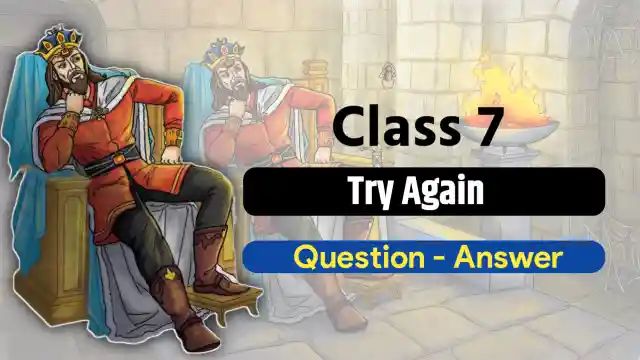
Try Again Question Answer Class 7 — Class 7 Poorvi English
Unit 1 — Lesson 2: TRY AGAIN (Poem by Eliza Cook)
Complete Solutions
LET US DISCUSS
Exercise I — Complete the Summary (Fill in the Blanks)
- low
- great
- despair
- mounted
- attempts
- conquered
- strive
- tried
Complete Summary: The poem, written in a narrative style, tells the story of King Bruce of Scotland, who was feeling low after failing multiple times to achieve something great for his people. In a moment of despair, he observed a spider trying to reach its web high above. The spider mounted every time it fell after getting close to its goal. It made nine attempts and finally succeeded. The king said that the spider had conquered and so would he. Inspired by the spider’s determination, King Bruce decided to strive. When he tried this time, he ultimately succeeded.
Exercise II — Complete the Following Sentences
1. We can say that the poet uses the narrative style because the poem tells a story with a clear sequence of events — it has characters (King Bruce and the spider), a setting, a conflict (repeated failure), and a resolution (eventual success), much like a story told in verse form.
2. The central idea of the poem is that one should never give up in the face of failure. Perseverance and determination, however small the source of inspiration may be, can lead us to ultimate success.
Exercise III — Pick Three Examples from the Poem
1. Lines that describe the spider’s efforts:
(i) “It soon began to cling and crawl / Straight up with strong endeavour”
(ii) “Up, up it ran, not a second to stay, / To utter the least complaint”
(iii) “Steadily, steadily, inch by inch, / Higher and higher he got”
2. Examples of Alliteration:
(i) “silken, filmy” — repetition of the ‘f’ sound (filmy, fine) and soft sibilant ‘s’
(ii) “steadily, steadily” — repetition of the ‘st’ sound
(iii) “cling and crawl” — repetition of the ‘c/cr’ sound
(Additional examples: “down it came,” “bold…brave,” “toils…tumbles”)
Exercise IV — Why Does the Poet Repeat These Words/Phrases?
“tried and tried” — The repetition emphasises King Bruce’s repeated, exhausting efforts and shows that his failure was not due to lack of trying but due to the sheer difficulty of his goal. It builds sympathy for the king.
“steadily, steadily” — This repetition slows down the pace of reading, making the reader feel the painstaking, careful, inch-by-inch progress of the spider. It creates a sense of tension and concentration.
“up, up” — This repetition conveys the upward momentum and unstoppable energy of the spider. It creates a sense of urgency and determination, visually and rhythmically suggesting continuous upward movement without pause.
Exercise V — Fill in the Blanks (Choose Correct Answer)
- The rhyme scheme of the poem is ABAB (Explanation: In each stanza, the 1st and 3rd lines rhyme, and the 2nd and 4th lines rhyme — e.g., “down/crown” and “think/sink”)
- ‘Bravo’ is an example of interjection (Explanation: ‘Bravo’ is an exclamatory word that expresses strong emotion — admiration and joy — and has no grammatical relation to the rest of the sentence)
- The poet uses ’twas and ’tis for the sake of rhythm (Explanation: Contracting “it was” to “’twas” and “it is” to “’tis” reduces syllable count, helping the lines fit the metrical pattern of the poem without breaking its rhythmic flow)
Exercise VI — Metaphors and Similes
Part 1 — Identify Metaphor (M) or Simile (S):
| No. | Sentence | Answer |
|---|---|---|
| (i) | He ran as fast as a cheetah. | S |
| (ii) | The world is a stage. | M |
| (iii) | The night was as dark as coal. | S |
| (iv) | He sang like an angel. | S |
| (v) | Her voice was music to his ears. | M |
| (vi) | The classroom was a zoo. | M |
| (vii) | The baby slept like a log. | S |
| (viii) | Her smile was as bright as the sun. | S |
| (ix) | The lake was a mirror, reflecting the sky. | M |
Part 2 — Transform Similes to Metaphors and Metaphors to Similes:
(iii) The book was a treasure chest, filled with endless adventures. (Metaphor → Simile)
✏️ The book was like a treasure chest, filled with endless adventures. OR ✏️ The book was as full of wonders as a treasure chest overflowing with riches.
(iv) Her laughter was a melody that brightened the darkest days. (Metaphor → Simile)
✏️ Her laughter was like a melody that brightened the darkest days. OR ✏️ Her laughter was as sweet and uplifting as a melody brightening the darkest days.
(v) The mountain stood as a guard, watching over the valley below. (Metaphor → Simile)
✏️ The mountain stood like a guard, watching over the valley below.
(vi) The night was like a velvet cloak, wrapping the world in mystery. (Simile → Metaphor)
✏️ The night was a velvet cloak, wrapping the world in mystery.
(vii) Her thoughts were like butterflies in a summer meadow. (Simile → Metaphor)
✏️ Her thoughts were butterflies fluttering freely in a summer meadow.
LET US THINK AND REFLECT
Exercise I — Read and Answer
Extract 1:
“He flung himself down in low despair…”
(i) The phrase that shows the physical expression of the King’s emotional state is: “flung himself down”
(The king physically throws himself down, which outwardly reflects his inner despair and exhaustion.)
(ii) The poet uses the word ‘low’ before despair to intensify the depth of the King’s hopelessness. ‘Low’ suggests that his despair is not ordinary sadness but a sunken, profound state of dejection — the lowest point emotionally that a person can reach. It also contrasts with the spider’s upward movement later in the poem, reinforcing the theme of rising above one’s lowest point.
(iii) In the line ‘And after a while he pondered there’, the word ‘pondered’ means:
B. thought
(The king sat quietly and reflected deeply on his situation before deciding to give up.)
(iv) The phrase ‘silken filmy clue’ creates an image of something that is:
very delicate and soft
(The spider’s thread is described as silken — smooth like silk — and filmy — thin and almost transparent — painting an image of something extraordinarily fragile yet functional.)
Extract 2:
“…when it toils so hard to reach and cling, And tumbles every time.”
(i) The correct option to complete the analogy — toil: hard :: _____ : _____
A. roll: tumble
(Just as ‘toil’ means to work hard, ‘roll’ and ‘tumble’ are related actions — tumbling is a form of rolling/falling. The analogy pairs an action with its related/resulting movement.)
(ii) Two characteristics of the spider highlighted in the line ‘But up the insect went once more’:
- Resilience — Despite falling repeatedly, the spider rises again immediately, showing it does not stay defeated.
- Determination / Perseverance — The phrase “once more” shows the spider does not accept failure as final; it always makes one more attempt.
(iii) The expression ‘Ah me!’ in the extract indicates a sense of:
B. stress
(The poet uses ‘Ah me!’ to express anxious suspense and nervous tension at the critical moment when the spider is very close to success but could still fail.)
(iv) Readers are able to relate to this extract because everyone has experienced moments in life when they are very close to achieving a goal but are uncertain whether they will succeed or fail. The feeling of being ‘just one step away’ from success, combined with the fear of failure at the last moment, is a deeply universal human experience that resonates with readers of all ages.
Exercise II — Answer the Following Questions
1. How does the first stanza help in setting the mood of the poem?
Ans. – The first stanza sets a sad and gloomy mood. King Bruce is shown as a king who is strong outside but very unhappy inside. He has failed many times and feels hopeless. This makes the reader feel his sadness and prepares us for the lesson of the poem.
2. Describe how King Bruce’s attitude changes from the beginning towards the end of the poem.
Ans. – In the beginning, King Bruce feels very sad and wants to give up. He thinks he cannot succeed.
But when he watches the spider trying again and again, his thinking changes. He feels inspired.
At the end, he becomes hopeful and brave. He decides to try again and finally succeeds.
3. The poet describes every action of the spider in great detail. What does this tell us about his attitude towards the spider?
Ans. – The poet describes the spider very carefully. This shows that he respects and admires the spider. He wants to show that even a small creature can be brave and strong. The spider becomes a symbol of hard work and patience.
4. How does the spider inspire us to overcome despair and not give up?
Ans. – The spider falls many times but never stops trying. It does not feel sad or give up. This teaches us that failure is not the end. If we keep trying again and again, we can succeed.
5. The poem teaches us that failures are stepping stones to success. Explain.
Ans. – The spider fails many times before reaching its web. Each failure helps it try better. In the same way, King Bruce also learns from his failures. The poem teaches us that failures help us grow and lead us to success.
6. The spider’s journey tells us that anyone can be a source of inspiration in our lives. Elaborate.
Ans. – The spider is a small and simple creature, yet it teaches a big lesson. This shows that we can learn from anyone or anything around us. Even small things in nature can inspire us to be strong and patient.
LET US LEARN
Exercise I — Opposites of Words from the Poem
| Word | Opposite |
|---|---|
| 1. up | down |
| 2. fast | slow |
| 3. glad | sad |
| 4. win | lose |
| 5. succeed | fail |
Exercise II — Choose Correct Meaning of Underlined Words
| Sentence | Underlined Word | Meaning | Own Sentence |
|---|---|---|---|
| (i) Please make every endeavour to arrive on time. | endeavour | 3. an attempt to do something new or difficult | She made every endeavour to pass her board exams with distinction. |
| (ii) Ants toil tirelessly to save food for rainy season. | toil | 1. work very hard and/or for a long time | Farmers toil in the fields from dawn to dusk to feed the nation. |
| (iii) We encourage all students to strive to do their best. | strive | 4. to try very hard to achieve something | Athletes strive every day to improve their performance before the competition. |
| (iv) The sailors braced themselves against the strong wind. | braced | 2. prepared themselves for something difficult | The students braced themselves for the tough entrance examination. |
Exercise III — Classify Words Based on Distance (Far or Near)
| FAR | NEAR |
|---|---|
| middle of nowhere | proximity |
| remoteness | vicinity |
| yonder | adjacent |
| afar | a stone’s throw |
| light year | hairline |
| farther | — |
(Note: “hairline” refers to a very thin, minute distance — suggesting closeness/nearness. “A stone’s throw” means a short, nearby distance.)
Exercise IV — Tongue Twister Activity
The line from the poem that serves as a tongue twister is:
‘Twas a delicate thread it had to tread
The challenge lies in the repeated ‘tr/thr/d’ sounds. Try saying it five times fast!
Student-created tongue twisters (examples for classroom use):
- “The slim spider spun a silky, slippery string.”
- “Bruce braced and bravely tried the treacherous trail.”
- “Crawling, clinging, climbing creatures cling to ceilings.”
LET US LISTEN
Exercise I — Guess the Answers (Before Listening)
(These are the correct answers to be verified after listening)
- What was the ant known for? → (i) determination
- Why was the ant unable to take the roti home? → (ii) It was too heavy to carry.
- What was the bird doing? → (ii) searching for food
- How did the bird make the ant feel? → (ii) inspired
- How did the fellow ants help? → (iii) by joining the ant in her efforts
LET US SPEAK
Narration Framework — Sample Answer for Students
Topic: A time when perseverance helped me succeed
Introduction: I remember a time when I felt like giving up completely. It was when I was preparing for my school’s inter-house elocution competition.
The Challenge: The challenge I faced was stage fright. Every time I stood before an audience, my voice trembled and my mind went blank. The problem seemed too big because no matter how many times I practised at home, I would freeze on stage.
Feeling Disheartened: At first, I felt completely discouraged and thought about withdrawing from the competition. I didn’t think I could succeed because my nervousness always seemed stronger than my preparation.
The Source of Motivation: But then, I remembered the poem “Try Again” — about King Bruce and the spider who fell nine times but kept climbing. I thought: if a tiny spider does not give up on its web, how can I give up on something I truly want?
Taking Action: After feeling inspired, I decided to practise before smaller groups first — my family, then my close friends. I gathered my strength, joined the school’s spoken word club, and asked my English teacher for guidance on breath control and confidence.
The Result: In the end, I was able to deliver my speech confidently and won second place in the competition. I felt proud because I had conquered my own fear, which was a greater victory than any trophy.
Reflection: This experience taught me that perseverance is truly the key to success. Now, I always remember that the greatest obstacle is often within ourselves, and with steady effort, it can be overcome.
LET US WRITE
Letter to a Cousin — Advising Not to Quit
45, Shanti Vihar
Jaipur
15 April 20XX
Dear Rahul,
Thank you for your letter. I understand that repeated failures can make you feel sad. But we should remember that failure is a part of life.
You may recall the story of King Bruce and the spider. The spider failed many times but did not give up and finally succeeded. We should learn the same lesson. Try to work step by step. Small efforts lead to big success. Stay positive and take care of your health.
Always remember your goal and keep trying. Hard work will surely bring success.
Yours affectionately,
Deepak
LET US EXPLORE
Activity I: (Classroom project — collect folk songs connected with nature in regional languages. Teacher to facilitate group compilation.)
Activity II: Differences between a Spider and an Ant
| Feature | Spider | Ant |
|---|---|---|
| Classification | Arachnid | Insect |
| Number of legs | 8 | 6 |
| Body parts | 2 (cephalothorax + abdomen) | 3 (head, thorax, abdomen) |
| Eyes | Usually 8 simple eyes | Compound eyes |
| Antennae | Absent | Present |
| Wings | Absent | Present in some |
| Produces silk | Yes | No |
| Lives in web/burrow | Web or burrow | Underground colony |
(Students should observe actual insects carefully from a safe distance and note their own observations.)
Activity III: (Hands-on craft activity — weave a spider web using sticks and wool, following Figures 1–4 in the textbook. Decorate with words from the poem like: endeavour, strive, conquer, steadily, bravo!)
Read This Also : The Day the River Spoke Question Answer Class 7
Discover more from GYANKUNDLI
Subscribe to get the latest posts sent to your email.