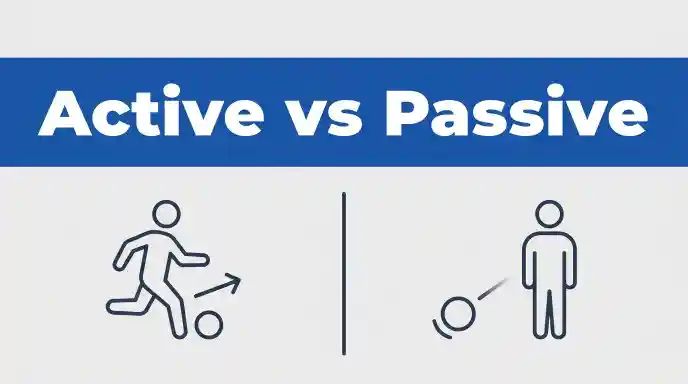
Active vs Passive Voice : Making the right grammar choice can provide your writing with much-needed clarity and directness. If you have ever compared “The boy kicked the ball” with “The ball was kicked by the boy,” you have already encountered the fundamental difference between active and passive voice.
Students encounter this topic regularly in grammar drills, writing tasks, and exam-style sentence transformation. Teachers explain these concepts frequently because a small shift in structure can change the focus of a whole sentence. Understanding how to use the active voice helps you write with more impact, while mastering the passive voice allows you to shift focus when the object is more important than the actor.
This cheat sheet keeps the rules short, practical, and easy to use.
Active vs Passive Voice Key Takeaways
- In active voice, the subject acts upon the object, which creates directness and improves the clarity of your writing.
- Using passive voice shifts the focus by placing the object before the subject, which is useful when the doer is unknown or less important.
- To identify passive voice, look for a form of the verb to be paired with a past participle.
- A strong grasp of active voice ensures your sentences remain punchy, while knowing when to use passive voice helps you maintain the right tone in formal essays.
- Every past participle indicates that the verb is being used in a passive construction, which often requires careful attention to sentence structure.
- When transforming sentences, ensure you retain the original tense and meaning, as exam questions frequently test your accuracy rather than your ability to provide long explanations.
What Active and Passive Voice mean
Active voice is the standard pattern in English where the subject performs the action. By contrast, passive voice shifts the focus so that the subject receives the action. Understanding the distinction between active voice and passive voice is essential for clarity in academic writing, as it dictates how you present information to your reader.
Compare these two sentences:
- Active: The teacher explained the rule.
- Passive: The rule was explained by the teacher.
Both sentences are grammatically correct. However, they place the spotlight on different elements. The active voice highlights the teacher, who is the agent performing the action. The passive voice highlights the rule, which is the object being acted upon. Using the active voice is often preferred for directness, but the passive voice serves a purpose when the action itself is more important than the agent.

This table makes the pattern easier to spot by breaking down the subject, verb, and object relationship:
| Voice | Basic pattern | Example | Main focus |
|---|---|---|---|
| Active | Subject + verb + object | Shakespeare wrote Hamlet. | The agent |
| Passive | Object + be + past participle + by + agent | Hamlet was written by Shakespeare. | The receiver |
| Active | Subject + verb | The cat chased the mouse. | The subject |
| Passive | Subject + be + past participle | The mouse was chased. | The receiver |
The core concept is focus rather than complexity. Passive voice is not incorrect, but it requires the verb to be as an auxiliary followed by a past participle. When you choose between active voice and passive voice, consider what you want your reader to prioritise.
Many sentences using the passive voice also choose to drop the agent entirely. For example, the sentence “The window was broken” is passive even though it does not name who performed the action. This can sometimes make the subject of the action appear hidden, which is a common point of confusion for students.
If you want a fuller classroom explanation, Purdue OWL’s guide to active and passive voice gives clear sentence-by-sentence examples.
How to spot Active and Passive Voice fast
You do not need to analyse every word to identify the structure. A few quick checks usually do the job.
First, find the main verb. Then ask who performs the action. If the subject performs it, the sentence is active. If the subject receives the action, the sentence is passive.
These rules help you identify active voice and passive voice during fast revision:
- Active voice usually follows a subject, verb, and object structure.
- Passive voice usually contains an auxiliary verb, such as a form of “be”, followed by a past participle.
- The doer may appear after a prepositional phrase starting with “by”, but it may also be omitted entirely.
- A passive sentence often sounds natural when you add the test phrase “by someone” to the end.
- Not every sentence with “is”, “was”, or “were” is passive.
If you can add “by someone” naturally to the end of a sentence, it is probably passive.
Here are some quick examples:
- Active: The class solved the problem.
- Passive: The problem was solved by the class.
- Active: The nurse checked the chart.
- Passive: The chart was checked.
Now for an important trap when learning about active vs passive voice. “She was tired” is not passive. In this instance, “tired” is simply an adjective describing her state, and no action moves from one person to another. In the same way, “The door was open” is not automatically a passive sentence.
Another trap appears in spoken English. Sentences using “got” can also be passive. “My bag got stolen” is passive because the bag received the action, which involves the use of a past participle.
One final point helps with exam questions. Some verbs do not take an object, so they usually cannot form a passive sentence. For example, “He slept” cannot be converted because “sleep” has no direct object in that context.
When to use Active Voice, and when Passive Voice helps
For most pieces of writing, the active voice is the better default. It sounds direct, lively, and easy to follow, which helps improve clarity in your essays, emails, and reports. By prioritising active voice, you can keep your sentences concise and reduce unnecessary wordiness.
For example, “The principal announced the result” feels stronger than “The result was announced by the principal“. The active version gets to the point faster, utilising action-oriented verbs to maintain a sense of directness that keeps the reader engaged.
Writers also choose the active voice because it effectively cuts through wordiness. Compare these:
- Weak: Mistakes were made.
- Clear: The committee made mistakes.
The second sentence identifies who acted, which provides much-needed clarity. That makes the meaning stronger and more honest.
Still, the passive voice has real uses, especially in specific fields. It is a staple of academic writing and scientific writing, where maintaining a sense of objectivity is often required. It also helps when the result matters more than the actor, or when you need to maintain a formal tone.
This table shows where each voice fits best.
| Use active voice when | Use passive voice when |
|---|---|
| You want clear, direct writing | The doer is unknown |
| The doer matters | The result matters more |
| You want strong exam answers | You want a formal tone |
| You want shorter sentences | The doer is obvious or irrelevant |
Here are common cases where passive voice makes sense:
The doer is unknown. “My cycle was stolen last night.”
The doer is less important than the action. “The hall was cleaned before the exam.”
The writer wants a formal tone or a process style, which is common in scientific writing. “The solution was heated to 60C.“
The focus belongs on the receiver, which is a common practice in academic writing. “The patient was discharged on Monday.“
So, the debate over active vs passive voice is not about good versus bad grammar. It is about choosing the right emphasis to ensure your writing is concise and focused. Grammarly’s comparison of active and passive voice gives more examples of that shift in tone and focus.
A simple conversion checklist
This is the section students often encounter in grammar exercises and MCQs. The rule is straightforward: keep the meaning, preserve the original tense, and switch the focus of the sentence.
Follow these steps in order:
- Identify the subject, the verb, and the object in the original sentence.
- Move the object into the primary subject position.
- Keep the same tense, but rebuild the verb string using an auxiliary verb like “be” followed by the past participle.
- Add the original subject after “by” if the sentence requires it.
- Check for agreement, pronouns, and sense, ensuring the subject, verb, and object align correctly.
This table shows how the change works:
| Original sentence | Changed sentence | Key point |
|---|---|---|
| The police arrested the thief. | The thief was arrested by the police. | Past simple stays past simple |
| They are announcing the results today. | The results are being announced today. | Present continuous stays present continuous |
| Someone has damaged the notice board. | The notice board has been damaged. | The doer can disappear |
| Shakespeare wrote Hamlet. | Hamlet was written by Shakespeare. | Object becomes subject |
| You must submit the form today. | The form must be submitted today. | Keep the modal verb |
Pronouns often change during conversion. “She praised him” becomes “He was praised by her.” If you forget that shift, the sentence will sound wrong.
Tense is the biggest exam trap. Students often change the active voice to passive voice and accidentally shift the timeframe. Do not do that. “They are building a bridge” must become “A bridge is being built,” not “A bridge was built.”
Sometimes, a passive voice sentence sounds better without the “by” phrase. “The answer was written in blue ink” is perfectly fine on its own. In contrast, “The answer was written by Ravi” only works when it is important to mention the actor.
Teachers often tell pupils to avoid the passive voice entirely, but that rule is too blunt. A better approach is this: use the active voice first, then choose the passive voice when the receiver of the action deserves the main place in the sentence.
We’ve got a quiz to check and improve your understanding of active and passive voices.


Now it is time to take another quiz on Active Passive Voice with 10 more questions.
Frequently Asked Questions
Is it ever wrong to use the Passive Voice?
No, the passive voice is not grammatically incorrect. It is a useful tool for academic or scientific writing when you need to focus on the result rather than the person performing the action.
How can I tell if a sentence is Passive if the doer is missing?
Look for a form of the verb “to be” followed by a past participle. If you can naturally add “by someone” to the end of the sentence, it is likely a passive construction even without an explicit agent.
Should I avoid the Passive Voice in my essays?
You should prioritise the active voice to keep your writing direct and punchy. However, you should use the passive voice when you need to maintain a formal tone or when the subject of your sentence is less important than the action itself.
Final Thoughts
Clear writing starts with intentional choices, and mastering active vs passive voice is the best way to ensure your message remains both crisp and professional. In most scenarios, active voice provides the most strength because it creates concise sentences that tell the reader exactly who performed the action.
However, passive voice still has a proper place in your toolkit. You should use passive voice when the focus belongs on the receiver of the work rather than the doer. By understanding these nuances, you will be able to transform any sentence with confidence, ensuring your writing style remains polished, engaging, and clear.
Here are RBSE Class 10 English Passive Voice Questions Answers
Discover more from GYANKUNDLI
Subscribe to get the latest posts sent to your email.