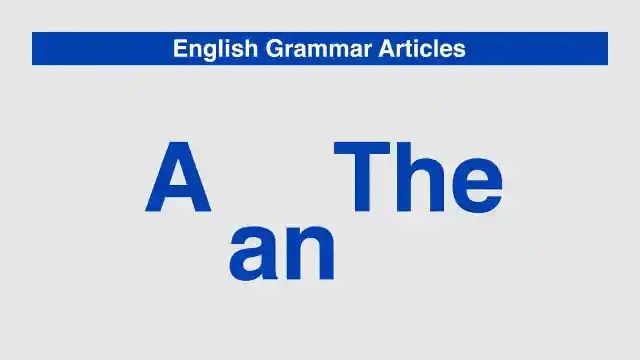
Many learners can write long answers in the English language, yet still hesitate over one small choice: a, an, the, or nothing at all. English grammar articles look tiny, but they change meaning fast.
If you choose the wrong article, a sentence can sound awkward, vague, or simply incorrect. The good news is that article use follows patterns, and once you see those patterns, the topic becomes much easier.
English Grammar Articles : Key Takeaways
- Use a and an with singular nouns when referring to a non-specific item.
- Select an based on a vowel sound rather than just the initial letter of the word.
- Use the to identify something unique, known to the reader, or previously mentioned in the text.
- Apply a zero article when discussing plural nouns or uncountable nouns in a general sense.
- Proper nouns, geographical locations, meals, languages, and institutions follow specific rules regarding article usage.
What Articles do in English Grammar
Articles are a vital part of speech that function as determiners. They signal to the reader how to interpret a noun, clarifying whether it refers to a specific noun or a general noun. By using these small words, you define whether the subject is known to the listener or simply one of many in a group.
Compare these two sentences:
- I saw a dog outside.
- I saw the dog outside.
In the first sentence, the dog is one of many non-specific nouns, meaning it is not a particular animal. In the second, the use of the article implies that both the speaker and the listener know exactly which dog is meant.
That is why articles matter so much. They do not merely decorate a sentence, as they actively guide meaning. A quick overview helps before the rules get more detailed:
| Article form | Type | Main use | Example |
|---|---|---|---|
| a | Indefinite article | One non-specific count noun | I need a pen. |
| an | Indefinite article | Same as a, before a vowel sound | She ate an orange. |
| the | Definite article | A specific, known, or unique noun | Please shut the door. |
| zero article | N/A | No article used | Books are useful. |
If you want a short reference on general and specific meaning, Purdue OWL’s guide to articles gives a clean summary.
The main idea is simple. First, decide whether the noun is a count noun and singular. Then, decide whether the intended meaning is general or specific.
How to use a and an
The indefinite article, a or an, typically precedes a singular noun. These terms act as a determiner, meaning “one” in a general sense, but not a specific item. As a general rule, the indefinite article is used when identifying a non-specific noun for the first time.
You use these articles when you mention something new:
- I bought a book yesterday.
- She met an engineer at the conference.
- He wants a bicycle for school.
You cannot normally use a or an with plural nouns or uncountable nouns. These structures are incorrect:
- She bought a books.
- We need an advice.
The corrected forms are:
- She bought books.
- We need some advice.
The sound rule, not the spelling rule
This is the rule learners forget most often. You must choose a or an based on the sound of the word before a noun, not the first letter you see.
Use an before a vowel sound, and a before a consonant sound.
In English, we look at the vowel or consonant quality of the start of the word. For example, use an if the word starts with a vowel sound, and a if the word begins with a consonant sound.
So these are correct:
- an apple (vowel)
- an hour (vowel sound due to the silent h)
- an honest reply (vowel)
- a university (consonant)
- a European country (consonant)
- a one-pound coin (consonant)
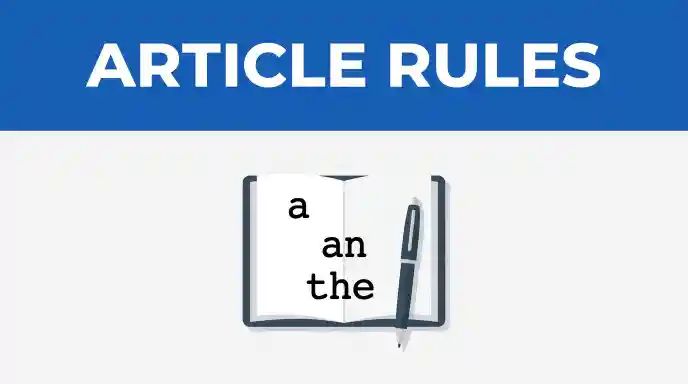
Why does this happen? The word hour begins with a vowel sound, while university begins with a “yoo” consonant sound. English listens to the sound before it looks at the vowel or consonant letter.
Sentence comparisons make this clearer:
- He waited for an hour.
- He studied at a university.
- She gave an honest answer.
- He works for a European company.
First mention and job descriptions
Use a or an when the person or thing is not yet identified. This often occurs during a first mention of non-specific nouns:
- I saw a teacher in the corridor.
- We found an old map in the cupboard.
Once the noun becomes known, the often follows later:
- I saw a teacher in the corridor. The teacher was speaking to the headmaster.
You also use a or an for someone’s job, role, or type:
- My sister is a doctor.
- He is an actor.
- She became a headteacher last year.
For students of literature, this pattern appears often in natural sentences: “I borrowed a copy of David Copperfield from the library.” The copy is one of many, so a is correct.
For extra classroom-style explanation and practice, this article lesson on Monkey English gives more examples.
When to use the
Use the definite article when the noun is a specific noun. This means the listener can identify it easily, even if the speaker does not explain every detail. Understanding when to use the definite article compared to an indefinite one helps you master the distinction between definite and indefinite meanings in your sentences.
Here are the most common cases.
When both people know the noun
- Open the window.
- Please pass the salt.
- Turn off the light.
In each case, the speaker expects the listener to know which window, salt, or light is meant.
When the Noun was mentioned earlier
- I saw a film last night. The film was too long.
- She bought a dress. The dress was blue.
This shift from the first mention to later mentions is one of the clearest article patterns in English.
With unique things
Some nouns take the because there is only one in the shared context:
- the sun
- the moon
- the Earth
- the internet
You also use the with superlatives, especially when using an adjective in the superlative degree, and with many ordinal numbers:
- She is the best player in the class.
- This is the first chapter.
With phrases that define the Noun
When extra words make a noun specific, the often appears:
- the book on the table
- the boy in the red jumper
- the teacher who helped me
Compare these pairs:
- I need a pen.
- I need the pen on your desk.
- We watched a match.
- We watched the match that went into extra time.
Historical events often take the because they refer to one known event. You say the French Revolution, and that choice feels natural in the same way as the Second World War.
When no Article is needed
The zero article concept means that you use no article at all. This often confuses learners because many other languages require an article in contexts where English does not.
When you speak about things in a general sense, the zero article is usually the correct choice.
General Plural Nouns
Use no article with plural nouns when you are referring to people or things in general:
- Books help us learn.
- Teachers need patience.
- Dogs can be loyal pets.
Do not write:
- The books help us learn.
You should only use an article here if you are referring to a specific set of books. Compare these two examples:
- Students need sleep.
- The students need sleep.
The first sentence refers to students in a general sense, while the second refers to a specific group, perhaps those in a particular classroom.
General Uncountable Nouns
Similarly, use no article with uncountable nouns when you are speaking about them in a general capacity:
- Water is essential.
- Music can calm people.
- Advice is useful.
- Information travels quickly.
However, you must use the when the meaning becomes specific:
- The water in this bottle is warm.
- The information in that report is wrong.
Languages, school subjects, and meals
English usually omits articles before names of languages and most school subjects:
- She speaks English and Hindi.
- He studies history and mathematics.
Meals also typically do not require an article:
- We had breakfast at 7.00 am.
- They ate lunch in the canteen.
- Dinner was excellent.
Nevertheless, if the meal is defined by a specific context, you should use the:
- The lunch we had at the hotel was expensive.
Proper Nouns
Most proper nouns, including the names of people, towns, countries, and books, do not take an article:
- Riya lives in Jaipur.
- Charles Dickens wrote David Copperfield.
- They visited India last summer.
This is why you say “I am reading David Copperfield” rather than “the David Copperfield.” There are certain exceptions to these rules, and those instances are important enough to discuss in the following section.
Geography, institutions, and other tricky cases
Place names often follow specific patterns, yet mastering article usage can be challenging due to a few stubborn exceptions.
Countries, cities, and streets
Most proper nouns representing countries and cities do not require an article:
- India
- France
- London
- Jaipur
Similarly, most street names appear without an article:
- Oxford Street
- Baker Street
However, some geographical names require the, usually because the title refers to a group, a river, a sea, or a specific region:
- the United Kingdom
- the United States
- the Netherlands
- the Ganges
- the Thames
- the Alps
- the Arabian Sea
Mountains, lakes, and islands
Single mountains usually take no article:
- Mount Everest
- Ben Nevis
Lakes typically function without an article before the word Lake:
- Lake Windermere
- Lake Victoria
Conversely, island groups almost always take the:
- the Maldives
- the Philippines
Institutions: school, college, hospital, prison, church
English speakers often omit the article when referring to an institution for its primary purpose:
- She is at school.
- Her grandfather is in hospital.
- He went to prison for theft.
- They are in church.
Use the when you are referring to the building itself, rather than the intended purpose of the institution:
- I went to the school to meet the headteacher.
- She visited her aunt at the hospital.
- The tourists photographed the church.
This distinction is important in British English, particularly regarding the word hospital. In the UK, saying someone is in hospital is the standard way to indicate that a patient is currently receiving medical treatment.
Common mistakes in English Articles
Many errors regarding the rules for articles stem from four specific areas: countability, phonetic sounds, specificity, or memorised exceptions. By identifying these common mistakes, you can refine your writing and speak with greater precision.
A frequent error occurs when using singular nouns. In English, you typically need a determiner before these words. Writing “She bought book” is incorrect; instead, you must use “She bought a book” or “She bought the book”.
Another issue arises when writers focus on spelling rather than the actual sound of a word. Learners often mistakenly write “an university” because the word begins with the vowel letter u. However, the correct form is “a university” because the word begins with a consonant sound. Similarly, use an before a vowel sound, even if the word starts with a silent consonant.
Specificity is another area where learners struggle. The choice between the indefinite article and the definite article changes the meaning entirely. Consider these examples:
- I need a charger. (Any charger will do.)
- I need the charger you borrowed. (A specific, identified charger.)
- He is in school. (He is a student.)
- His mother is waiting outside the school. (A specific physical building.)
Proper nouns also create confusion. We say “the United Kingdom” but simply “India”. Likewise, we use “the Thames” but omit the article for “Lake District” and “Lake Victoria”.
To improve your accuracy, keep these four quick fixes in mind:
- Check whether the noun is singular and countable.
- Listen to the opening sound before choosing the indefinite article, ensuring you match it to a vowel or consonant sound.
- Use the definite article when the noun is already identified or specific.
- Use the zero article for most general plurals, uncountable nouns, and names.
If you want additional practice, this short YouTube lesson on articles can help you hear how to apply these rules more clearly.
Quick practice with answers
Test your knowledge of English grammar and improve your sentence structure by trying these questions before checking the answers.
- She bought ___ umbrella.
- We visited ___ museum near the station.
- ___ milk in this tea tastes strange.
- My brother is ___ teacher.
- They speak ___ Spanish at home.
- He was in ___ hospital for two weeks.
- We sailed across ___ Indian Ocean.
- I saw ___ cat. ___ cat was sleeping on my car.
- ___ honesty matters in exams.
- They had ___ breakfast before class.
Answers
- an umbrella
- the museum, if both people know which one; a museum, if it is not specific
- The milk, because it is the milk in this tea
- a teacher (we use ‘a’ before this word because it begins with a consonant sound)
- zero article, Spanish
- zero article in British English, in hospital, if he was a patient
- the Indian Ocean
- a cat; the cat
- zero article, Honesty
- zero article, breakfast
If you got stuck on numbers 2, 3, 6, or 8, that is normal. Those questions test the real heart of article use, whether the noun is general, specific, or part of a fixed expression.
Frequently Asked Questions
Why do I use ‘an’ before ‘hour’ but ‘a’ before ‘university’?
You must choose your article based on the initial sound of the word rather than its spelling. Since ‘hour’ begins with a silent ‘h’, it starts with a vowel sound, requiring ‘an’, whereas ‘university’ begins with a consonant ‘yoo’ sound, which requires ‘a’.
When should I use the ‘Zero Article’?
You use the zero article when discussing plural nouns or uncountable nouns in a general, rather than specific, sense. For example, you would say ‘Music is relaxing’ as a general statement, but ‘The music in this room is loud’ when referring to something specific.
Do I need an Article before names of countries or cities?
Generally, no; most proper nouns like ‘London’, ‘India’, or ‘France’ take no article. However, you should use ‘the’ for countries that are plural or represent a group, such as ‘the United Kingdom’, ‘the Netherlands’, or ‘the Philippines’.
How do I know if I should use ‘a’ or ‘the’ for an institution?
If you are referring to the primary purpose of an institution, such as a patient being in ‘hospital’ or a student being at ‘school’, you typically use the zero article. If you are referring to the physical building itself, such as meeting someone outside ‘the school’, you must use ‘the’.
Conclusion
Mastering English grammar articles becomes significantly easier when you stop treating them as arbitrary words and start viewing them as essential meaning signals. By understanding the core distinctions between definite and indefinite choices, you can effectively clarify exactly what your nouns represent. A, an, the, and the zero article each serve a specific purpose in the English language, helping to define countability, sound, and specificity.
Once you apply these fundamental rules, most choices will naturally fall into place. While certain geography or institution cases may require some memorisation, they are much easier to grasp once you see the broader logic. As you continue to refine your writing, remember that the definite article and its counterparts are the building blocks of precise communication. With a solid grasp of these grammar rules, you will be well on your way to achieving greater clarity and confidence in your English communication.
Discover more from GYANKUNDLI
Subscribe to get the latest posts sent to your email.