A sentence can sound perfect, then one verb throws the whole meaning off. If you have ever written “I am knowing” or “I have seen him yesterday,” you already know how tricky English tenses can be when navigating complex English grammar rules.
The good news is that tense choice becomes easier once you see the pattern. When you understand the timing of an action and the context of the sentence, the forms stop feeling random and start making sense.
English Grammar Tenses : Key Takeaways
- English verb tenses indicate when an event occurs and how the action unfolds over time.
- Most school grammar courses teach 12 main tense forms, grouped into present, past, and future.
- Each tense has its own specific pattern for affirmative, negative, and interrogative sentences.
- Learners often confuse finished time, ongoing action, and actions linked to the present.
- The best way to improve is to match the tense to the meaning, rather than relying solely on time words.
How Tense works in English
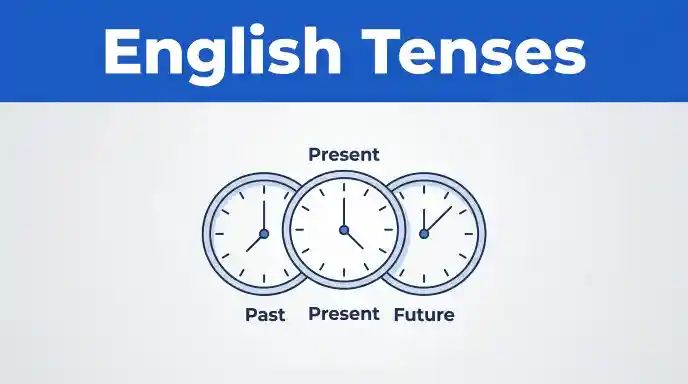
Tense tells you where an action sits in time. It may show something happening now, something finished, or something expected later. It also shows whether the action is habitual, continuous, completed, or continuing over a period.
Some advanced grammar discussions separate tense from grammatical aspects. In other words, they treat past and present as core tenses, then explain simple, continuous, and perfect forms as distinct aspects. For everyday learning, though, most school books and exam papers teach 12 main verb tenses, and that model remains the most practical for students.
For a reliable refresher, Grammarly’s guide to verb tenses gives a useful overview of the main forms.
A quick way to read the system is to look at the four common patterns first. Mastering these requires understanding verb conjugation, which involves modifying the root form or infinitive form of a verb to fit the required time frame.
| Form | Main idea | Example |
|---|---|---|
| Simple | fact, habit, single event | She writes every day. |
| Continuous | action in progress | She is writing now. |
| Perfect | link between two times | She has written the email. |
| Perfect continuous | duration over time | She has been writing for an hour. |
This matters in exams as well as in real writing. Multiple-choice questions can test recognition, but your own sentences show whether you truly control the tense.
Present Tenses in English Grammar
Present forms do more than describe what is happening now. They also cover habits, fixed arrangements, recent results, and actions that started in the past but continue into the present.
Present Simple
The simple present is used for routines, facts, general truths, and states. Affirmative pattern: subject + base verb. Note that for the third person singular, you must add an -s or -es suffix to the verb. Negative pattern: subject + do/does not + base verb. Question pattern: do/does + subject + base verb?
Examples: “I revise after dinner.” “She lives near the city centre.” “Does your train leave at 8.10?” Use this tense for habits, permanent situations, instructions, and timetables.
Present Continuous
Use the present continuous for actions happening now or around now. It also works for temporary situations and near-future arrangements. This tense uses the present participle (the verb-ing form). Affirmative pattern: subject + am/is/are + verb-ing. Negative pattern: subject + am/is/are not + verb-ing. Question pattern: am/is/are + subject + verb-ing?
Examples: “I am reading a grammar guide.” “They are staying with their uncle this week.” “Are you meeting the teacher tomorrow?” Choose it for actions in progress, changing situations, and fixed plans.
Present Perfect
Use the present perfect for actions connected to the present. The exact time is not stated, or the result remains relevant. This structure relies on auxiliary verbs (have/has) followed by the past participle. Affirmative pattern: subject + has/have + past participle. Negative pattern: subject + has/have not + past participle. Question pattern: has/have + subject + past participle?
Examples: “I have finished my homework.” “She has visited London several times.” “Have you ever read David Copperfield?” Use it for life experience, recent completion, and unfinished time periods such as “today”, “this week”, or “so far”.
Present Perfect Continuous
Use the present perfect continuous for actions that started in the past and continue now, or have stopped only recently. The focus is on duration or repeated activity. Affirmative pattern: subject + has/have been + verb-ing. Negative pattern: subject + has/have not been + verb-ing. Question pattern: has/have + subject + been + verb-ing?
Examples: “I have been studying since 6 pm.” “She has been working on that essay all morning.” “How long have you been waiting?” Use it when you want to stress the length of time, the effort involved, or an unfinished activity.
Past Tenses and when to use them
Past forms help you place events in a clear order. They show finished actions, background activity, earlier past events, and duration before a past point.
Past Simple
The simple past is used for completed actions at a definite time in the past. When forming sentences, remember that regular verbs typically add -ed to the base form, whereas irregular verbs often change their form entirely and must be learned individually.
Affirmative pattern: subject + past form of the verb. Negative pattern: subject + did not + base verb. Question pattern: did + subject + base verb?
Examples: “I watched the match last night.” “She wrote the answer quickly.” “Did they arrive on Monday?”
Use it with finished time expressions such as “yesterday”, “last year”, or “in 2024”.
Past Continuous
Use the past continuous for an action that was in progress at a particular time in the past. This tense relies on auxiliary verbs, specifically was or were, to set the background for another event.
Affirmative pattern: subject + was/were + verb-ing. Negative pattern: subject + was/were not + verb-ing. Question pattern: was/were + subject + verb-ing?
Examples: “I was revising at 9 pm.” “They were walking home when it started to rain.” “Was she speaking to the headteacher?”
Use it for interrupted actions, background scenes, and two actions happening at the same time in the past.
Past Perfect
Use the past perfect for an action completed before another past action or time. This tense requires the past participle form of the main verb following the auxiliary had.
Affirmative pattern: subject + had + past participle. Negative pattern: subject + had not + past participle. Question pattern: had + subject + past participle?
Examples: “I had finished the test before the bell rang.” “She had left when we reached the station.” “Had they met before the interview?”
Use it to show sequence clearly when two past moments could otherwise confuse the reader.
Past Perfect Continuous
Use the past perfect continuous for an action that continued for some time before a past point. The focus is on duration.
Affirmative pattern: subject + had been + verb-ing. Negative pattern: subject + had not been + verb-ing. Question pattern: had + subject + been + verb-ing?
Examples: “I had been reading for two hours before dinner.” “They had been waiting since noon.” “How long had he been teaching there?”
Use it when the length or repeated nature of an earlier past activity matters.
Future Tenses without the guesswork
English future meaning is slightly different from present and past meaning. In practice, learners study four common future tense forms, although English also uses “be going to” and present forms for future plans.
Future Simple
Use the simple future for decisions made at the moment of speaking, promises, offers, and predictions. When making predictions, English speakers often rely on will, which is one of the most common modal verbs. Affirmative pattern: subject + will + base verb. Negative pattern: subject + will not + base verb. Question pattern: will + subject + base verb?
Examples: “I will help you after class.” “She will probably pass the exam.” “Will they call this evening?”
Use it for spontaneous decisions, neutral predictions, and formal statements about the future.
Future Continuous
Use the future continuous for an action that will be in progress at a certain time in the future.
Affirmative pattern: subject + will be + verb-ing. Negative pattern: subject + will not be + verb-ing. Question pattern: will + subject + be + verb-ing?
Examples: “I will be travelling next week.” “They will be taking the test at 10 am.” “Will you be using the library later?”
Use it for planned ongoing future actions and polite questions about someone’s plans.
Future Perfect
Use the future perfect for an action that will be completed before a future time or event.
Affirmative pattern: subject + will have + past participle. Negative pattern: subject + will not have + past participle. Question pattern: will + subject + have + past participle?
Examples: “I will have finished the chapter by Friday.” “She will have completed her degree next year.” “Will they have arrived before noon?”
Use it when you need a deadline or completion point in the future.
Future Perfect Continuous
Use the future perfect continuous for an action that will continue up to a future point. It highlights duration.
Affirmative pattern: subject + will have been + verb-ing. Negative pattern: subject + will not have been + verb-ing. Question pattern: will + subject + have been + verb-ing?
Examples: “By June, I will have been teaching for ten years.” “They will have been waiting for an hour by then.” “Will she have been working here long?”
Use it for long-lasting actions measured up to a future moment.
Common Tense mistakes learners make
Many tense errors stem from one fundamental issue: learners often choose a grammatical form by memory rather than by meaning. Several mistakes appear consistently across all levels of study.
- Learners frequently confuse the present perfect and simple past. Write “I saw him yesterday,” not “I have seen him yesterday,” because “yesterday” refers to a finished time period.
- Some students incorrectly apply the progressive tense to stative verbs. Write “I know the answer,” not “I am knowing the answer.” Verbs such as know, like, believe, and understand typically remain in simple forms.
- Questions and negatives often omit necessary auxiliary verbs. Write “Did you go?” and “She doesn’t like tea,” not “Did you went?” or “She not likes tea.”
- Writers sometimes shift tense within the same paragraph without a logical reason. If you begin by describing a past event, remain in the past tense unless the time frame clearly shifts.
- Tense and voice are distinct concepts. Tense indicates when an action occurs, whereas voice indicates whether the subject performs the action or receives it.
Time words are useful, but meaning ultimately decides the tense.
Another common issue arises in stories and essays when students rely exclusively on the simple past for every sentence, which makes the narrative flow feel flat. A more sophisticated approach might be, “He had locked the door before he left,” as this construction clarifies which action occurred first. Distinguishing between these subtle nuances, particularly when comparing the simple past with the present perfect, is essential for improving your overall accuracy and clarity in English.
How to choose the right Tense in writing and speaking
Mastering English verb tenses requires practice, but choosing the right one becomes much easier once you consider the timing of an action relative to the speaker. Start with the time frame. Ask whether the action is happening now, happened before, or is expected later. Then ask a second question: is it a habit, a single action, a completed result, or a continuing activity?
This quick guide can help when you feel stuck.
| Meaning | Likely tense | Example |
|---|---|---|
| Habit or fact | Present simple | She studies every evening. |
| Action happening now | Present continuous | She is studying now. |
| Finished event at a known past time | Past simple | She studied last night. |
| Past action linked to now | Present perfect | She has studied enough for today. |
| Future plan already arranged | Present continuous or going to | She is meeting her tutor tomorrow. |
The table gives you a fast starting point. After that, check whether the sentence needs a stronger sense of duration, sequence, or completion.
A few habits improve how you select verb tenses quickly. Read your sentence with the time expression removed. If the tense still matches the meaning, you are probably right. Also, rewrite one sentence in two or three tenses, then compare the meaning. For example, “I live in Leeds”, “I am living in Leeds”, and “I have lived in Leeds for five years” all point to different situations.
For speaking, practise chunks rather than isolated verbs. Familiarising yourself with the infinitive form and its variations will assist with complex verb conjugation, ensuring you can navigate from the root form to more advanced structures with ease. Say full patterns aloud: “Have you finished?”, “I was waiting”, “We will be leaving soon”. This builds speed and accuracy together. If you want a quick spoken recap, this short video on English verb tenses is useful for revision.
Most importantly, keep your reading active. When you read a story, article, or model answer, notice why the writer chose that tense. Over time, your ear improves, and the right form starts to sound natural.
Frequently Asked Questions
Is it better to memorise lists of tenses or learn the rules?
While knowing the forms is important, focusing on the meaning and context is much more effective. Memorising lists often leads to mechanical errors, whereas understanding whether an action is completed, ongoing, or habitual helps you select the right form naturally.
Why can I not use the Present Continuous with verbs like ‘know’ or ‘believe’?
These are known as stative verbs, which describe states of being rather than active physical movements. Using them in the continuous form sounds unnatural because these verbs refer to permanent or semi-permanent conditions that do not typically fluctuate in the same way an action does.
How do I decide between the Past Simple and the Present Perfect?
The past simple is for events finished at a specific time in the past, such as ‘yesterday’ or ‘last year’. Use the present perfect when the timing is undefined or if the action has a direct, ongoing connection to the present moment.
Does the Tense I choose change the meaning of my sentence?
Absolutely, as the tense dictates the relationship between your actions and time. For example, saying ‘I lived in London’ implies you no longer do, whereas ‘I have lived in London’ suggests you still reside there or have a recent connection to the city.
Conclusion
Mastering English tenses is less about memorising long charts and more about visualising how time functions within a sentence. Once you connect each form to its specific purpose, English tenses become significantly easier to use in both your daily speech and your professional writing.
While English grammar rules can sometimes seem complex, keeping your focus on the intended meaning first allows you to build sentences with the correct patterns. A learner who can place actions in time accurately will always sound more confident, more precise, and far more natural when navigating various verb tenses.
Discover more from GYANKUNDLI
Subscribe to get the latest posts sent to your email.