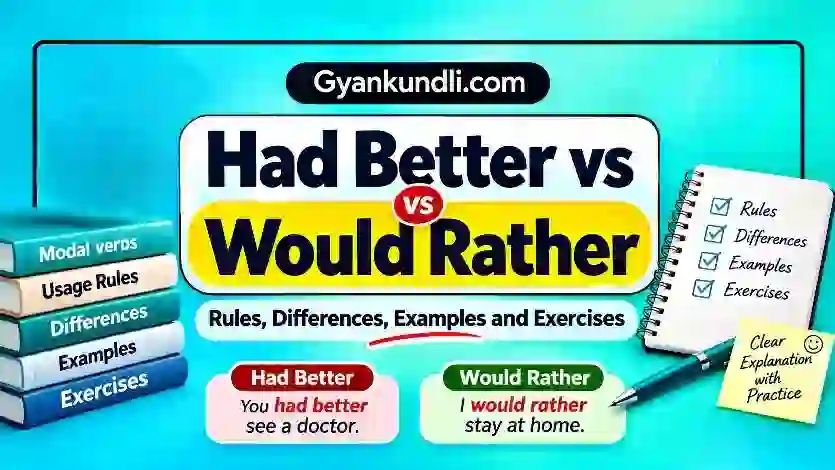
Had Better vs Would Rather is an important topic in English Grammar for competitive examinations. Students often get confused between these two expressions because both are followed by the base form of a verb in many sentences. However, their meanings and uses are different.
In competitive examinations such as RPSC, SSC, REET, Banking and other teaching recruitment examinations, questions based on these expressions may appear in the form of fill in the blanks, sentence improvement, error detection and multiple-choice questions.
In this article, we will learn the meaning, rules, differences and uses of had better and would rather with simple examples. We will also practise examination-oriented questions to understand how these expressions are used in sentences.
1. What is Had Better?
Had better is used to give strong advice, make a warning or suggest that someone should do something in a particular situation.
It tells us that a particular action is advisable and that there may be an unpleasant result if the advice is not followed.
Although the expression contains the word had, it generally refers to the present or future, not the past.
Examples of Had Better
- You had better study hard for the examination.
- We had better leave now, or we will miss the train.
- You had better consult a doctor.
- She had better complete her homework today.
- The weather is getting worse. We had better return home.
In these sentences, had better gives advice or suggests an action that should be taken.
2. Rules of Had Better
Rule 1: Had Better + Base Form of Verb (V1)
After had better, we always use the first form of the verb without ‘to’.
Structure:
Subject + had better + V1 + object.
| Correct Sentence | Incorrect Sentence |
|---|---|
| You had better go now. | You had better to go now. |
| He had better study regularly. | He had better studies regularly. |
| We had better leave early. | We had better leaving early. |
| She had better consult a doctor. | She had better consulted a doctor. |
Remember: Never use ‘to’, V2 or V-ing immediately after had better.
Rule 2: Negative Form – Had Better Not + V1
To make a negative sentence, use not immediately after had better.
Structure:
Subject + had better + not + V1.
Examples:
- You had better not waste your time.
- He had better not drive so fast.
- We had better not disturb the teacher.
- She had better not go out alone at night.
- You had better not miss the examination.
Important: The correct form is had better not go, not had not better go.
Rule 3: Had Better Is Used for Present or Future Advice
Although had is the second form of have, the expression had better does not normally refer to a past action.
Examples:
- You had better take an umbrella. It may rain.
- He had better prepare for the interview.
- They had better reach the station on time.
All these sentences refer to actions that should be taken now or in the future.
Rule 4: Had Better Can Be Used as a Warning
We can use had better when we want to warn someone about the possible result of an action.
Examples:
- You had better stop making noise, or the teacher will punish you.
- You had better tell the truth, or you may get into trouble.
- He had better be careful while driving.
3. What is Would Rather?
Would rather is used to express preference or choice. It tells us what someone prefers to do or which option someone likes more.
It is commonly used when a person has two or more choices.
Examples:
- I would rather read a book than watch television.
- She would rather stay at home than go to the market.
- He would rather walk than take a bus.
- We would rather play cricket than watch a movie.
- I would rather drink tea than coffee.
In these examples, the speaker expresses a preference between two activities or things.
4. Rules of Would Rather
Rule 1: Would Rather + Base Form of Verb (V1)
When the subject of would rather and the subject performing the action are the same, use the first form of the verb without ‘to’.
Structure:
Subject + would rather + V1 + object.
Examples:
- I would rather stay at home.
- He would rather work alone.
- They would rather travel by train.
- She would rather study English.
- We would rather wait here.
Incorrect: I would rather to stay at home.
Correct: I would rather stay at home.
Rule 2: Would Rather + Not + V1
To express a negative preference, place not after would rather.
Structure:
Subject + would rather + not + V1.
Examples:
- I would rather not discuss this matter.
- He would rather not attend the meeting.
- She would rather not travel at night.
- We would rather not waste our time.
- They would rather not go outside.
Remember that not comes before the base form of the verb.
Rule 3: Would Rather + V1 + Than + V1
When comparing two actions, we use than after the first action.
Structure:
Subject + would rather + V1 + than + V1.
Examples:
- I would rather teach than work in an office.
- She would rather sing than dance.
- He would rather walk than drive.
- They would rather study than play.
- We would rather travel by train than travel by bus.
Important examination rule: Use parallel structures on both sides of than.
Correct: I would rather walk than run.
Incorrect: I would rather walk than running.
Rule 4: Would Rather + Subject + Past Simple
This is one of the most important rules for competitive examinations.
When the person expressing the preference and the person performing the action are different, we generally use the past simple tense after the second subject.
Structure:
Subject + would rather + subject + V2.
Examples:
- I would rather you stayed here.
- She would rather he came early.
- We would rather they played honestly.
- I would rather you did not tell anyone.
- He would rather his son studied medicine.
Important: Although the verb is in the past form, the sentence generally expresses a present or future preference, not a past action.
Compare:
- I would rather stay at home. (I prefer to stay.)
- I would rather you stayed at home. (I prefer that you stay.)
Rule 5: Would Rather + Subject + Had + V3
When expressing a preference or wish about a past action that has already happened, use the past perfect tense.
Structure:
Subject + would rather + subject + had + V3.
Examples:
- I would rather you had informed me earlier.
- She would rather he had accepted the offer.
- We would rather they had arrived on time.
- He would rather I had told him the truth.
These sentences express dissatisfaction or a different preference about a past situation.
Negative structure:
Subject + would rather + subject + had not + V3.
Example:
I would rather you had not wasted your money.
5. Had Better vs Would Rather: Main Differences
This is the most important part of the topic for examination preparation.
| Had Better | Would Rather |
|---|---|
| Expresses strong advice or warning. | Expresses preference or choice. |
| Suggests what someone should do. | Expresses what someone prefers to do. |
| Followed by V1 without ‘to’. | Followed by V1 without ‘to’ when the subject is the same. |
| Usually refers to the present or future. | Can express present, future or past preference. |
| Example: You had better study. | Example: I would rather study. |
| Example: He had better not go. | Example: He would rather not go. |
Compare These Sentences
1. Had Better:
You had better take a taxi.
Meaning: Taking a taxi is advisable.
2. Would Rather:
I would rather take a taxi.
Meaning: Taking a taxi is my preference.
3. Had Better:
You had better work hard.
Meaning: I am advising you to work hard.
4. Would Rather:
I would rather work hard than waste my time.
Meaning: I prefer working hard to wasting my time.
The difference is simple: had better gives advice, whereas would rather expresses preference.
6. Important Examination Rules and Common Errors
Students should remember the following points while solving English Grammar questions.
| Incorrect | Correct |
|---|---|
| You had better to leave. | You had better leave. |
| He had better goes. | He had better go. |
| I would rather to study. | I would rather study. |
| She would rather going. | She would rather go. |
| I would rather you go. | I would rather you went. |
| I would rather you did not went. | I would rather you did not go. |
| He would rather walks than runs. | He would rather walk than run. |
| You had not better speak. | You had better not speak. |
Remember These Five Golden Rules
- Had better + V1.
- Had better not + V1.
- Would rather + V1 (same subject).
- Would rather + subject + V2 (different subject, present or future preference).
- Would rather + subject + had + V3 (past preference).
7. Previous Examination Questions and Important Exam Patterns
The following examples include a traceable previous-board question pattern and questions prepared in the style of competitive examinations. They are useful for understanding the types of grammatical structures tested.
Question 1: Previous Board Examination Pattern – HSC 2023
A published HSC 2023 examination question collection records would rather and had better among the phrases supplied for completing sentences.
Complete the following sentences:
(a) A warrior ______ die than surrender to enemies.
(b) It may rain today. We ______ take an umbrella.
Answers:
(a) would rather
(b) had better
Explanation:
- Would rather is used because the warrior prefers death to surrender.
- Had better is used because taking an umbrella is advisable.
Question 2: Previous Examination Question Pattern – Kerala PSC
Choose the correct option:
You had better ______ me later.
(a) calling
(b) call
(c) called
(d) to call
Answer: (b) call
Explanation: The base form of the verb is used after had better.
Question 3: Competitive Examination Practice
I’d much rather make a phone call than ______ an email.
(a) sending
(b) to send
(c) to sending
(d) send
Answer: (d) send
Explanation: After would rather, the base form of the verb is used. Both actions should have the same grammatical form.
Question 4: Competitive Examination Practice
She would rather you ______ after 10 o’clock.
(a) didn’t phone
(b) haven’t phoned
(c) don’t phone
(d) won’t phone
Answer: (a) didn’t phone
Explanation: When a different subject follows would rather, we generally use the past simple for a present or future preference.
Question 5: Competitive Examination Practice
You ______ start waking up earlier.
(a) should rather
(b) would rather
(c) had better
(d) rather better
Answer: (c) had better
Explanation: The sentence gives strong advice. Therefore, had better is appropriate.
8. Practice Exercise: Had Better vs Would Rather MCQs
Choose the correct option. These questions are designed according to the level and pattern of competitive examinations.
Q1. You had better ______ your homework before going out.
(a) to complete
(b) completing
(c) complete
(d) completed
Q2. I would rather ______ at home than go to the cinema.
(a) stayed
(b) stay
(c) staying
(d) to stay
Q3. She would rather you ______ the truth.
(a) tell
(b) tells
(c) told
(d) telling
Q4. You had better not ______ late for the examination.
(a) be
(b) to be
(c) being
(d) been
Q5. He would rather walk than ______ a bus.
(a) taking
(b) took
(c) to take
(d) take
Q6. I would rather you ______ me before making this decision.
(a) consult
(b) consulted
(c) consulting
(d) have consulted
Q7. We had better ______ now, or we will miss the train.
(a) leaving
(b) left
(c) leave
(d) to leave
Q8. She would rather ______ silent than argue with him.
(a) remains
(b) remain
(c) remaining
(d) remained
Q9. I would rather you ______ that expensive car last year.
(a) did not buy
(b) had not bought
(c) do not buy
(d) have not bought
Q10. You had better ______ a doctor immediately.
(a) consult
(b) consulted
(c) consulting
(d) to consult
Q11. I’d ______ stay at home than attend the party.
(a) better
(b) rather
(c) best
(d) prefer
Q12. They would rather we ______ the meeting tomorrow.
(a) attend
(b) attends
(c) attended
(d) attending
Q13. You ______ not waste your time on unnecessary activities.
(a) would rather
(b) had better
(c) would better
(d) had rather
Q14. I would rather not ______ about this matter.
(a) talking
(b) talked
(c) talk
(d) to talk
Q15. He had better ______ carefully before making a decision.
(a) thinks
(b) thought
(c) thinking
(d) think
Answer Key with Explanations
| Question | Answer | Explanation |
|---|---|---|
| 1 | (c) complete | Had better + V1 |
| 2 | (b) stay | Would rather + V1 |
| 3 | (c) told | Different subject + past simple |
| 4 | (a) be | Had better not + V1 |
| 5 | (d) take | Parallel structure |
| 6 | (b) consulted | Different subject + past simple |
| 7 | (c) leave | Had better + V1 |
| 8 | (b) remain | Would rather + V1 |
| 9 | (b) had not bought | Past preference |
| 10 | (a) consult | Had better + V1 |
| 11 | (b) rather | Would rather |
| 12 | (c) attended | Different subject + past simple |
| 13 | (b) had better | Strong advice |
| 14 | (c) talk | Would rather not + V1 |
| 15 | (d) think | Had better + V1 |
Conclusion
Had better and would rather are two important expressions in English Grammar. Although both may be followed by the first form of a verb, their meanings are different.
Remember these simple rules:
- Had better = Strong advice or warning
- Would rather = Preference or choice
- Had better + V1
- Would rather + V1
- Would rather + subject + V2 (different subject, present or future preference)
- Would rather + subject + had + V3 (past preference)
For competitive examinations, practise these rules regularly and pay special attention to the difference between the use of V1 and V2. A clear understanding of these structures will help you solve fill-in-the-blanks, error-detection and sentence-improvement questions correctly.
Discover more from GYANKUNDLI
Subscribe to get the latest posts sent to your email.