RBSE Class 10 English Question Paper 2025 Solution Answer Key & Pdf

RBSE Class 10 English Question Paper 2025 Solution Answer Key & Pdf

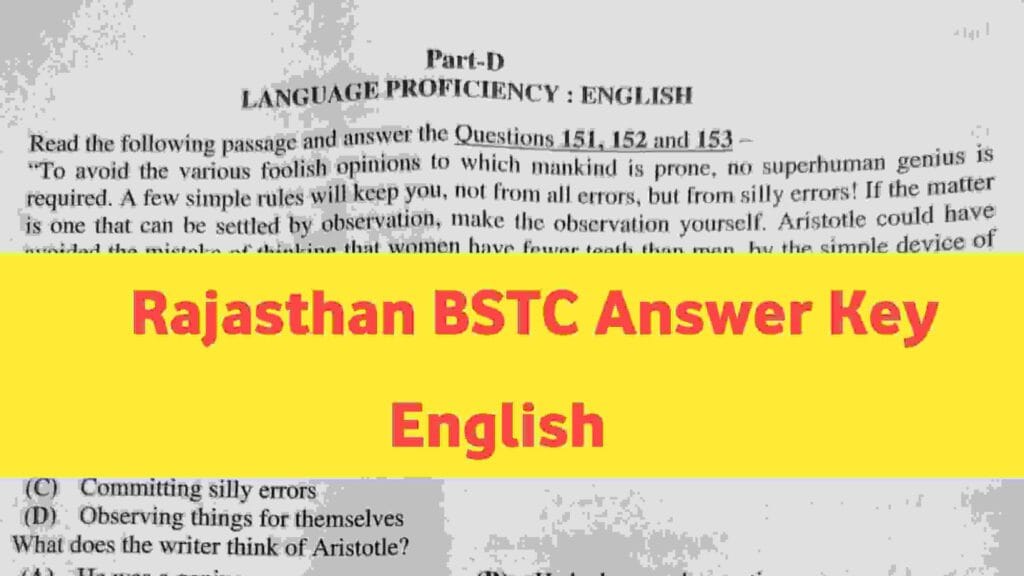
In this blog post we are going to give you the pdf file of RBSE Class 10 English Question Paper 2025 held on 06 March 2025. Before downloading the pdf file of the paper go through the article thoroughly. We will also provide the answer key of RBSE Class 10 English Paper 2025. RBSE Class […]

RBSE Class 10 English Question Paper 2025 Solution Answer Key & Pdf Read More »

present perfect tense examples

Present Perfect Tense Examples : 20 MCQs With Answers

What is Present Perfect Tense? According to Merriam Webster Dictionary Present Perfect Tense is a verb tense that is traditionally formed in English with HAVE and a PAST PARTICIPLE and that expresses an action or state begun in the past and completed at the time of speaking (as in “I have finished“) or continuing in

Present Perfect Tense Examples : 20 MCQs With Answers Read More »

Present Continuous Tense Examples : 30 MCQs with Answers

30 MCQs on the Present Continuous Tense Examples : The present continuous tense is a crucial aspect of the English language that expresses an action or event happening at the moment of speaking or a temporary situation. It is formed by using the present participle (verb + -ing) along with the appropriate form of the

Present Continuous Tense Examples : 30 MCQs with Answers Read More »
Simple Present Tense MCQs 22 mcqs with answers

Simple Present Tense MCQs for Class 10

Simple Present Tense MCQs for Class 10 : 22 MCQs with answers The simple present tense is used to describe the actions that occur regularly, consistently, or are true at the present moment. It is used for various purposes such as: Habits: For example, “I brush my teeth every morning.” (This denotes a regular action.)General

Simple Present Tense MCQs for Class 10 Read More »

British English and American English

British English and American English : Differences You Need to Know 

1. British English and American English : Introduction In this blog, we’ll explore the differences between British English and American English. They’re like cousins of the same language family, but they’ve picked up their own ways of speaking, spelling, and saying things. Understanding these differences helps us become better at English and gives us a

British English and American English : Differences You Need to Know  Read More »

RPSC 2ND GRADE 2022 MARKS

RPSC 2ND GRADE 2022 SCORECARD : CHECK YOUR MARKS

The scorecards for RPSC 2nd Grade 2022 Teacher Recruitment have been released, now all candidates can check their marks and scores from their exams. The Rajasthan Public Service Commission has released the scores for RPSC second-grade teacher recruitment. The written examination for this recruitment was conducted from December 21 to December 27, 2022. The result

RPSC 2ND GRADE 2022 SCORECARD : CHECK YOUR MARKS Read More »

Present perfect tense examples

Present Perfect Tense : Use and Examples

The Present Perfect Tense ( auxiliary has/have + past participle of verb) is used when we wish to express the idea that some activity that took place in the past or a situation that originated in the past but it has connection with the present in some way. Present Perfect Tense : Form The Present

Present Perfect Tense : Use and Examples Read More »

Present Continuous Tense : Explanation, Use and Examples

Present Continuous Tense : Explanation, Use and Examples

The Present Continuous Tense, also known as the Present Progressive Tense, is a verb tense used to describe temporary actions that are currently taking place, or to describe future plans. The Present Continuous Tense denotes that actions are in progress at the time of speaking. It indicates that an action is happening right now. Present

Present Continuous Tense : Explanation, Use and Examples Read More »

Present Simple Tense

Present Simple Tense : Explanation and Examples

Present Simple Tense : introduction The Present Simple Tense is the form of verb used to describe habitual actions or habits, general truths, situations that are not changing, timeless facts, routine activities, permanet states and events that are planned in near future. We also use the Present Simple Tense for scheduled future events, commands and

Present Simple Tense : Explanation and Examples Read More »

Negative Capability

John Keats & Negative Capability

What is Negative Capability? Negative capability, a concept crafted by the renowned Romantic poet John Keats in 1817, explores the essence of artistic creation, particularly in the literature. Keats marveled at Shakespeare’s unparalleled ability to embrace uncertainties, mysteries, and doubts without striving for concrete facts or reason, as he expressed in a letter to his

John Keats & Negative Capability Read More »

Scroll to Top