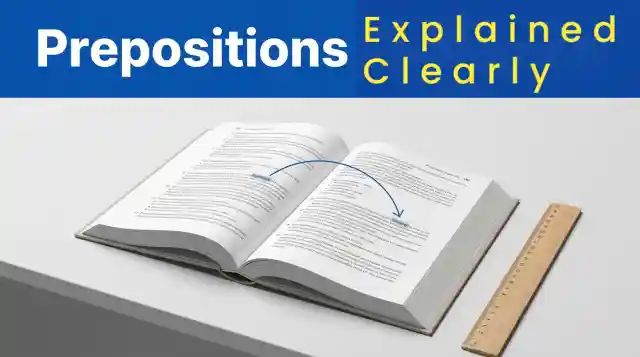
Parts of Speech Prepositions : A sentence can sound right or wrong because of one small word. Prepositions show relationships of place, time, direction, cause, and connection, so they help readers and listeners follow meaning without effort.
That is why this part of speech matters in essays, exam answers, classroom teaching, and everyday speech. Prepositions often feel tricky because many of them are learnt through use, not through one neat rule. Once you understand their job, they become much easier to notice and use well.
Parts of Speech Prepositions : Key Takeaways
- Prepositions link a noun, pronoun, or noun phrase to another part of the sentence.
- They often form prepositional phrases, such as “after school” or “under the bed”.
- Small changes in prepositions can change meaning or make English sound unnatural.
- The best way to learn them is through patterns, practice, and regular reading.
Parts of speech and Prepositions, the basics you need first
A preposition is a word that links a noun, pronoun, or noun phrase to another word in the sentence. It shows how ideas connect, whether that connection is about place, time, movement, cause, or something more abstract.
Prepositions are one part of speech, but they don’t usually work alone. They depend on other words to complete their meaning. If you study grammar for exams, this is the core point to remember.
How Prepositions connect words in a sentence
Most prepositions come before a noun or pronoun. Together, they form a prepositional phrase, such as “in the garden”, “after lunch”, “with her”, or “for the exam”.
That phrase adds detail to the sentence. In “The bag is under the chair”, the phrase “under the chair” explains location. In “We spoke after class”, the phrase “after class” explains time. In “She worked for her family”, the phrase shows purpose or relationship, not place.
A prepositional phrase does not usually stand alone as a full sentence. “Under the chair” gives useful detail, but it needs a main clause to complete the thought.
If you want another quick explanation, Grammarly has a clear preposition guide with simple examples.
Why Prepositions are important in grammar and writing
Prepositions make sentences exact. Without them, ideas stay vague or sound incomplete. With the right one, meaning becomes sharper.
Compare these examples: “She arrived at school” and “She arrived in school”. The first sounds natural when you mean the location. The second can sound odd unless you mean she was already inside the building. A tiny change creates a different effect.
The same thing happens with word patterns. We say “interested in music”, not “interested on music”. We say “responsible for the work”, not “responsible of the work”.
A good preposition often feels invisible, because the sentence simply sounds right.
The main types of Prepositions with clear examples
You will meet several broad groups of prepositions in school grammar, textbooks, and daily English. These categories help, but they are not sealed boxes. One preposition can fit more than one group, depending on the sentence.
Prepositions of place and position
Prepositions of place show where something is. Common examples include in, on, under, between, beside, above, and behind.
“In” usually places something inside a space. “The keys are in my bag.” “The children are in the classroom.” “On” often shows contact with a surface. “Your notebook is on the desk.” “Under” shows a lower position. “The cat is under the table.”
Some prepositions help you picture a more exact position. “Between” usually refers to two people or things, as in “The library is between the bank and the post office.” “Beside” means next to, while “behind” places something at the back. “Above” means higher than, but not necessarily touching.
These words matter because they build a clear mental image. If a learner writes “The picture is behind the wall” instead of “on the wall”, the reader will stop and wonder what is meant.
Prepositions of time and duration
Prepositions of time tell us when something happens. The most common are at, on, in, before, after, during, since, and for.
Use “at” for specific times, such as “at 7 o’clock” or “at noon”. Use “on” for days and dates, such as “on Monday” or “on 10 Feb 2026”. Use “in” for longer periods, such as “in July”, “in winter”, or “in 2026”.
Duration needs extra care. “Since” shows a starting point, as in “She has lived here since 2022”. “For” shows length of time, as in “She has lived here for three years”. “During” places an action inside a period, as in “No one spoke during the film”.
Students often memorise these separately, but they make more sense when you compare them in real sentences.
Prepositions of direction, movement, and cause
These prepositions show where someone or something moves, or why something happens. Common examples include to, into, towards, from, through, because of, and due to.
“To” shows destination. “We walked to the station.” “Into” shows movement from outside to inside. “He went into the room.” “Towards” shows direction, but not always arrival. “She ran towards the gate.” “From” shows origin. “The parcel came from Leeds.” “Through” shows movement within something. “The train passed through the tunnel.”
Cause works in a similar way. “The match was cancelled because of rain.” “The delay was due to fog.” In both cases, the preposition helps explain the reason.
Prepositional Phrases and how they work in real sentences
A prepositional phrase begins with a preposition and ends with its object. That object is usually a noun, pronoun, or noun phrase. Once you can spot the phrase, reading and sentence analysis become much easier.
A useful classroom handout from the University of Victoria gives more examples of using prepositions in sentences.
How to spot the object of a Preposition
The object is the word or group of words that follows the preposition. In “under the bed”, the object is “the bed”. In “with her”, the object is “her”. In “after the meeting”, the object is “the meeting”.
This pattern helps with pronouns too. Standard English uses object forms after prepositions, so we say “between you and me”, “for him”, and “with us”. Many students write “between you and I”, but that form does not fit after a preposition.
Once you know where the object sits, you can identify the whole phrase more confidently.
When a Prepositional Phrase adds detail to a noun or verb
A prepositional phrase can describe a noun. In “The boy in the blue jumper waved”, the phrase “in the blue jumper” tells us which boy.
It can also describe a verb. In “The boy waved from the window”, the phrase “from the window” tells us where he waved from.
That difference matters in grammar questions. One phrase points to a noun. The other adds detail to the action. In both cases, the phrase cannot usually stand alone as a complete sentence, because it depends on the rest of the clause.
Common Preposition mistakes students make
Prepositions cause errors because English often follows patterns rather than perfect logic. A learner may know the meaning of a word, yet still choose the wrong preposition beside it.
Confusing similar Prepositions like in, on, and at
This is one of the most common trouble spots. A short comparison makes the pattern easier to remember.
| Use | at | on | in |
|---|---|---|---|
| Place | at the door | on the wall | in the room |
| Time | at 6 pm | on Friday | in August |
A simple guide helps. Use at for points, on for surfaces and days, and in for spaces and longer periods. The pattern does not solve every sentence, but it works often enough to guide most learners.
Ending sentences with Prepositions, and when it is acceptable
Older grammar teaching often warned against ending a sentence with a preposition. Modern English is less strict, especially in speech and natural writing.
“Who are you talking to?” sounds normal. “To whom are you talking?” is correct, but it sounds more formal. The same applies to “This is the topic I told you about.” Most readers accept that sentence without a problem.
In formal essays, classroom grammar exercises, or mark schemes that favour older rules, a teacher may still prefer the more formal style. For most everyday writing, natural word order is the better choice.
Prepositions that are often overused or used wrongly
Some prepositions belong to fixed patterns. Because of that, you often need to learn the whole phrase, not the single word.
Common examples include “different from”, “interested in”, “responsible for”, “insist on”, “good at”, and “depend on”. These combinations appear again and again in reading and exams.
A wrong preposition can make a sentence sound translated rather than natural. “Good in maths” may appear in speech, but many school contexts prefer “good at maths”. “Insist for” sounds wrong in standard English. “Insist on” fits.
How to master Prepositions through reading, practice, and revision
Prepositions become easier when you meet them often in real sentences. Short drills help, but repeated exposure matters more than last-minute memorising.
Learn Prepositions in chunks, not as single words
It helps to learn phrases such as “interested in”, “good at”, “afraid of”, and “depend on”. These chunks stay in memory better than isolated word lists.
Reading supports this process. When you notice a phrase in a story, article, or model answer, write it down as a full unit. Students remember natural combinations more quickly when they see them used well.
Teachers can support this by grouping common patterns together instead of teaching long, disconnected lists.
Use short exercises to check meaning and accuracy
Gap-fill work, sentence correction, and reading aloud all help. Each one checks a different skill. Gap-fills test recognition. Correction questions show whether a learner can spot an error. Reading aloud helps the ear notice what sounds natural.
For revision and class tests, short-answer and objective questions can check accuracy quickly, but they should not be the only method. A learner who picks the right option in a multiple-choice item may still struggle to write a full sentence. Because of that, sentence writing is worth including in homework and classroom assessment.
If you want extra revision, this 25-minute preposition lesson offers a longer walkthrough with examples.
Conclusion
Prepositions are small words with a big job. They show relationships, sharpen meaning, and make English sound natural.
Once you understand how they link ideas, the subject feels less confusing. Regular reading, short practice tasks, and attention to common word patterns will make prepositions easier over time. The more often you notice them in real sentences, the less often you will need to guess.
Discover more from GYANKUNDLI
Subscribe to get the latest posts sent to your email.