REET English Notes Pdf : In this blog post we will provide the notes prepared by Mayur Sharma Sir for REET English Language 2. Below is a structured summary of these notes, making complex topics easy to understand.
Key Topics Covered in Mayur Sharma Sir’s Notes for REET English Language 2
- Linking Devices
- Subject-Verb Agreement
- Inferences
- Literary Devices : Alliteration, Assonance, Simile, Personification, Metaphor, Rhyme
- Grammar – Modals
- Phrasal Verbs and Idioms
- Literary Terms : Elegy, Sonnet, Short Story, Drama
- Phonetics
- Principles of Teaching English, Difficulties in Learning English: Role of Home Language and Multilingualism, Communicative Approach to English Language Teaching Role of Multilingualism in Language Learning, Strategies to Overcome Difficulties, Methods of Evaluation in Language Teaching, Remedial Teaching
A Brief Overview of REET English Notes Pdf
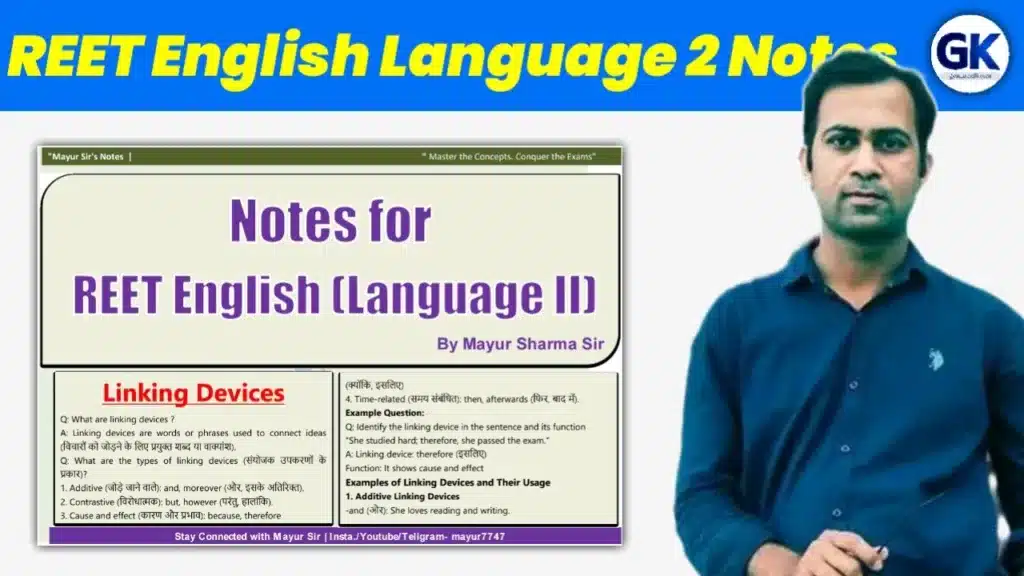
Linking Devices
Definition: Words or phrases that connect ideas in a sentence.
Types:
✅ Additive : and, moreover, also
✅ Contrastive : but, however, on the other hand
✅ Cause & Effect : because, therefore, thus
✅ Time-related : then, afterwards, meanwhile
Example:
“She was late; therefore, she missed the
train..”
➡️ Linking device: therefore
➡️ Function: Shows cause and effect.
Subject-Verb Concord
✅ Singular subject = Singular verb → The dog barks.
✅ Plural subject = Plural verb → The dogs bark.
✅ Collective nouns take singular verbs → The team is playing well.
✅ Words like “each,” “everyone,” “nobody” take singular verbs → Each student has a book.
✅ Uncountable nouns take singular verbs → Water boils at 100°C.
✅ Neither…nor, either…or → Verb agrees with nearest subject.
Example:
“Neither the teacher nor the students were present.”
➡️ Verb “were” agrees with “students” (plural).
Figures of Speech
Alliteration
Repetition of consonant sounds.
✅ “Philip’s phone fell flat on the floor.”
Assonance
Repetition of vowel sounds.
✅ “The rain in Spain stays mainly in the plain.”
Simile
Comparison using “like” or “as”.
✅ “She is as brave as a lion.”
Metaphor
Direct comparison without “like” or “as”.
✅ “Time is a thief.”
Personification
Giving human qualities to non-living things.
✅ “The leaves whispered secrets to the ground.”
Idioms & Phrases
✅ Break the ice: Start a conversation
✅ Bite the bullet: Face a tough situation bravely
✅ Burn the midnight oil: Work late at night
✅ Hit the sack: Go to bed
✅ Cry over spilt milk: Regret something that cannot be changed
Poetry Forms in English
Elegy
A poem expressing sorrow for the dead.
✅ Example: “Elegy Written in a Country Churchyard” by Thomas Gray
Sonnet
A 14-line poem with a specific rhyme scheme.
✅ Types of Sonnets:
- Petrarchan Sonnet (ABBAABBA CDECDE)
- Shakespearean Sonnet (ABAB CDCD EFEF GG)
✅ Example: William Shakespeare’s “Sonnet 18” (“Shall I compare thee to a summer’s day?”)
Drama Elements
✅ Plot : Storyline
✅ Characters : People in the drama
✅ Dialogue : Conversations
✅ Theme : Central idea
✅ Setting : Time & place
📌 Important Terms:
✔️ Soliloquy: A character speaks alone on stage
✔️ Dramatic Irony: Audience knows something that characters don’t
✔️ Tragic Hero: A flawed character whose downfall is inevitable
✔️ Climax: The most intense moment
📘 Short Story Elements
✅ Limited characters & setting
✅ Single event or theme
✅ Conflict leading to resolution
✅ Often has a twist ending
Example:
➡️ Edgar Allan Poe’s “The Tell-Tale Heart”
🔤 Grammar: Modals
Modals are auxiliary verbs expressing necessity, possibility, permission, etc.
✅ Can: Ability / Permission (He can swim.)
✅ Could: Past ability / Polite request (Could you help me?)
✅ May: Permission / Probability (May I come in?)
✅ Might: Slight possibility (She might come.)
✅ Shall: Offers / Future actions (Shall we dance?)
✅ Should: Advice / Expectation (You should study.)
✅ Must: Necessity (You must wear a helmet.)
✅ Would: Polite request / Conditional (Would you like some tea?)
REET Exam (English Lanuage 2nd) Preparation Tips
✔️ Revise these grammar rules & literary concepts daily.
✔️ Practice MCQs on linking devices, modals, and subject-verb agreement.
✔️ Memorize at least 10 idioms & phrases each week.
✔️ Read and analyze Shakespearean & modern sonnets.
✔️ Solve previous years’ REET English Language 2 papers.
REET English Notes Pdf Download Link : Click Here
Conclusion
Mayur Sharma Sir’s notes provide a comprehensive guide to REET English Language 2 preparation. Focus on grammar, figures of speech, poetry, and drama elements to enhance your performance.
For more study resources, visit Gyankundli – your trusted education portal.
FAQs
Q1. What is the difference between simile and metaphor?
✔️ Simile uses “like” or “as” (e.g., “She is as brave as a lion“).
✔️ Metaphor makes a direct comparison (e.g., “Time is a thief”).
Q2. What is a sonnet?
✔️ A 14-line poem with a specific rhyme scheme and meter.
Q3. What are modals?
✔️ Modals are auxiliary verbs like can, may, must, should, etc., that modify the meaning of the main verb.
Q4. What is dramatic irony?
✔️ When the audience knows something the characters do not.
Keep Learning & Stay Ahead!
Follow Mayur Sharma Sir for more updates:
- Instagram: @miscellaneous_mayur
- YouTube: Miscellaneous Mayur
- Telegram: t.me/mayur7747
➡️ For more English study material, visit Gyankundli!
Discover more from GYANKUNDLI
Subscribe to get the latest posts sent to your email.