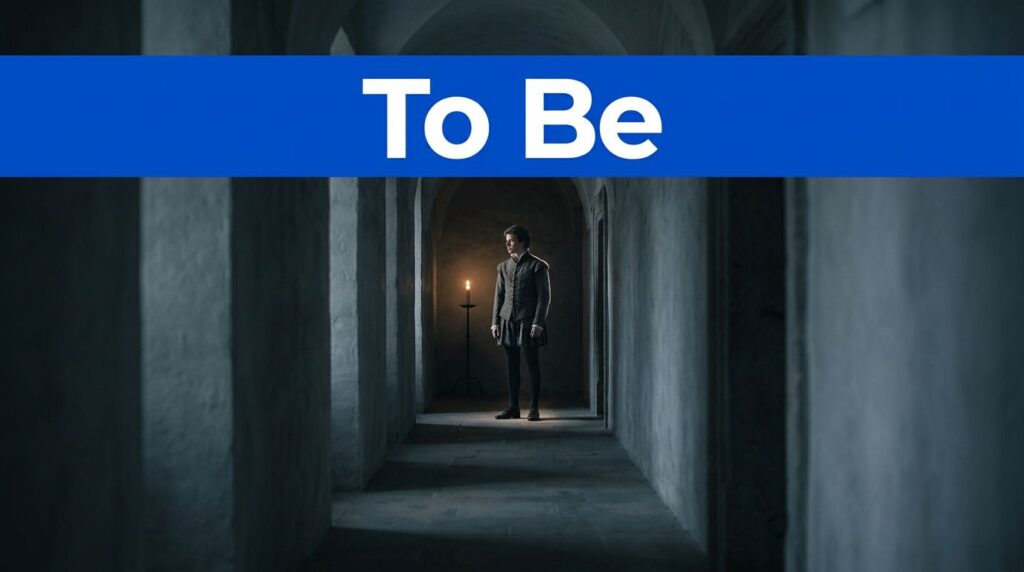
The most quoted line in The Tragedy of Hamlet is also one of the most misread. In Hamlet by William Shakespeare, which remains famously known as Shakespeare’s longest play, “To be, or not to be” is not only a question about death. It is a profound meditation on action, fear, and endurance, capturing the internal struggle of the Prince of Denmark as he wanders the halls of Elsinore Castle and reflects on how deep thought can drain the colour from decision.
Key Takeaways
- “To be, or not to be” functions as a profound existential meditation on the struggle between action and inaction, rather than a simple consideration of suicide.
- Shakespeare uses the soliloquy to explore the universal human tendency for “the pale cast of thought” to weaken resolution, a pattern that defines Hamlet’s tragic paralysis.
- The speech is deeply contextual, occurring while Hamlet is being watched, which highlights the tension between his private internal turmoil and the public surveillance within Elsinore.
- Through evocative imagery like “a sea of troubles” and “the undiscover’d country,” Shakespeare transforms individual grief into a reflection on the common burdens of mortal life.
Why this soliloquy still matters
“To be or not to be” has slipped so far into popular culture that it can feel overfamiliar. Yet once you return it to its place in Hamlet, it becomes sharp again. These 34 lines, which rank among the most famous soliloquies in theatre history, carry an astonishing amount of pressure. They resonate not because they sound grand, but because they pin down a problem nearly everyone knows: you suffer, you think, you hesitate, and then you wonder whether hesitation is wisdom or cowardice.
Readers often meet this speech, spoken by the Prince of Denmark, in the so-called nunnery scene, then reduce it to a single issue: suicide. That reading is there, and it matters. Hamlet does weigh life against death. Still, the speech reaches further than that. Shakespeare is not writing a slogan about despair. He is tracing the movement of a mind as it turns experience into questions.
That is why the speech works for so many kinds of readers. A student can use it to revise theme, imagery, and character. A university student can use it to think about inwardness, ethics, and dramatic form. A teacher can use it to show how one speech opens into the whole play.
The soliloquy lasts only a moment on stage. On the page, it can feel as if it contains whole shelves of philosophy.
The scene before Hamlet speaks
Context changes everything. Hamlet enters this moment already burdened by grief, disgust, and suspicion. The ghost of King Hamlet has told him that King Claudius murdered the old king and has demanded revenge. Hamlet now knows what he believes to be the truth, yet he still cannot act with the direct force that revenge tragedy seems to demand.
At this point in the play, the court has been trying to explain the strange behaviour of the prince. King Claudius and Queen Gertrude have spoken with Rosencrantz and Guildenstern, who are attempting to uncover the cause of his distress. Meanwhile, Polonius believes he understands the prince and has arranged for Ophelia to be used as part of a test. Within the halls of Elsinore Castle, King Claudius and Polonius withdraw to spy whilst Hamlet speaks. He appears alone, but the scene is crowded with surveillance, and Hamlet fakes madness as a tactical manoeuvre within the fraught political state of Denmark.
That matters because the soliloquy is private in tone, even though it sits inside a public trap. The speech opens the inner life at the very point where Hamlet is most watched.
Some readers object to calling Hamlet indecisive because the action of the play unfolds over a short span. On a literal clock, that objection has force. On a tragic stage, it misses the point. Shakespeare compresses experience. What matters is not how many calendar days have passed, but how often Hamlet circles the same crisis. His delay becomes a pattern of mind.
Many critics and teachers describe that pattern as his hamartia, his tragic flaw. Whether or not you use that term, indecision is central to how the play feels.
“To be, or not to be”: the question itself
At the simplest level, Hamlet asks whether it is better to live or not to live. “To be” means to exist, while “not to be” means to cease existing. Yet, the line quickly grows larger than that. In this speech, “to be” also suggests becoming, acting, and standing in the world with purpose. For the Prince of Denmark, this question is not merely theoretical; it is a profound struggle with his personal identity and his heavy duty to the state of Denmark. “Not to be” can suggest withdrawal, surrender, or a total refusal to engage with the corruption surrounding him.
The line also gains force from rhythm. Shakespeare writes mostly in blank verse, usually iambic pentameter, and this opening slightly unsettles the expected movement. While a character like Polonius might misinterpret these rhythms as mere madness or rambling, they actually represent the precise mental turmoil of a man grappling with existence. Readers often stress it as a familiar quotation, but the placement of stress changes the meaning. If “is” in “that is the question” carries weight, the line sounds more immediate, as if Hamlet has finally reached the true issue. If “be” carries the weight, the thought becomes more general, almost philosophical.
That small shift matters because this speech belongs to both Hamlet and everyone else. It is personal pain and public truth at once.
A few key phrases help fix the speech in your mind:
| Phrase | Plain meaning | Why it matters |
|---|---|---|
| “To be, or not to be” | to live or not live | it also asks whether to act or withdraw |
| “Slings and arrows of outrageous fortune” | random injuries thrown by life | suffering feels external and relentless |
| “A sea of troubles” | an overwhelming mass of pain | resistance looks heroic and hopeless at once |
| “This mortal coil” | the tangled round of human life | daily existence becomes repetitive and weary |
| “The pale cast of thought” | thought draining colour from resolve | overthinking weakens action |
Once you read the opening this way, the speech stops sounding like a museum piece. It starts sounding painfully current.
What it means to suffer, and what it means to resist
Hamlet’s next move is to frame the issue in moral terms: “Whether ’tis nobler in the mind to suffer”. The word nobler is the hinge. He is not only asking what hurts less. He is asking what is more honourable.
To suffer “the slings and arrows of outrageous fortune” is to endure life’s attacks without striking back. Fortune here means circumstance, accident, bad luck, and the harsh turn of events. The word “outrageous” gives that fortune a moral sting. Life does not merely inconvenience us. At times it behaves as if it has violated what should be bearable.
There is an old biblical echo here too. Human life often appears full of trouble, and Hamlet knows it. His language makes misery sound both personal and ordinary, as if suffering is part of the inheritance of being born.
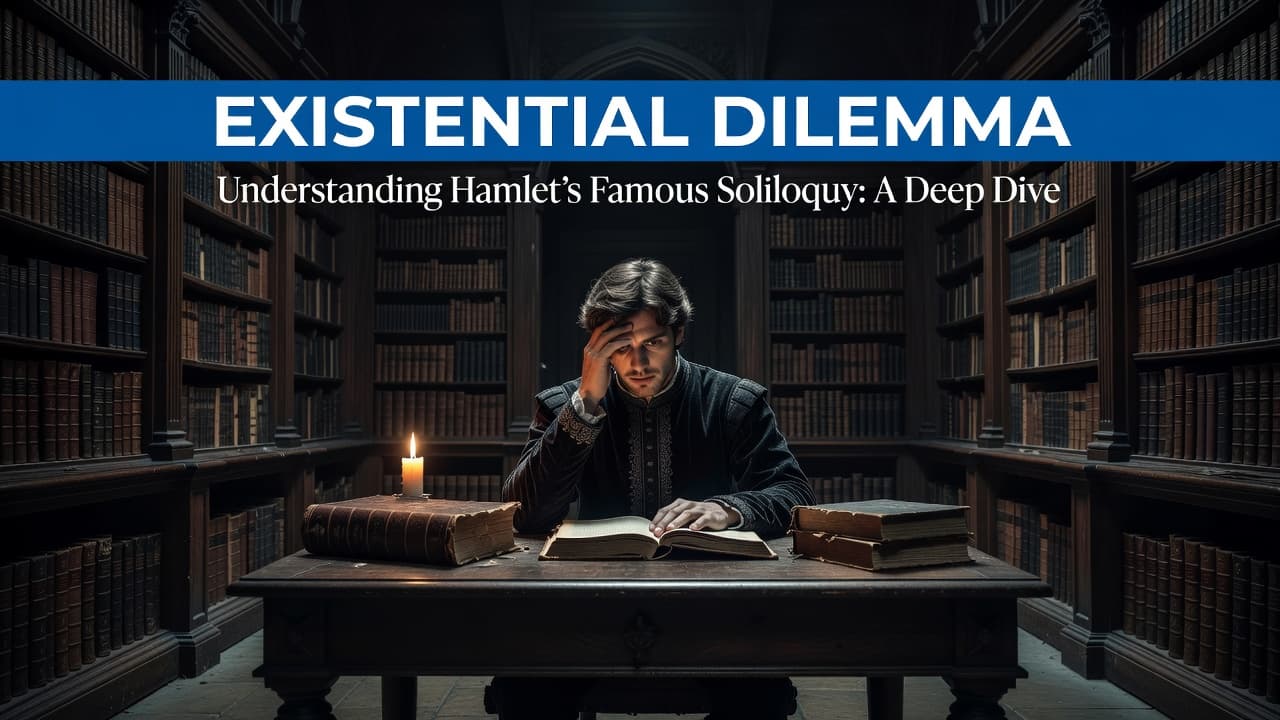
Then Shakespeare turns the image. Instead of missiles from fortune, we get “a sea of troubles”. A sea is heavier than arrows because it is not one blow. It is a mass, wave after wave, impossible to count and impossible to stop. That makes the next phrase startling: “to take arms against a sea of troubles”. As a quintessential revenge tragedy, the play relies on this central tension. Taking up arms is the expected path for a hero, yet Shakespeare makes the image sound brave and futile at the same time. This internal conflict is heightened by how his existential paralysis impacts his fraught relationships with Ophelia and Polonius, leaving him unable to act on his desire for justice.
That is why the line remains open. Does Hamlet mean ending his suffering by resisting it? Does he mean the revenge demanded by the plot? Does he mean death by his own hand? The ambiguity is part of the speech’s power. Shakespeare keeps the language wide enough to hold all three possibilities.
Death as sleep, and the problem of the dream
Once Hamlet imagines death, he reaches for a softer word: sleep. That is metonymy at work, one state standing in for another. Sleep suggests rest, release, and a pause from pain. When Hamlet says, “To die, to sleep”, the appeal is obvious. Who has not wanted, in a hard season, a full stop from thought?
He pushes the idea further. Death would end the heart-ache and the thousand natural shocks that flesh is heir to. That phrase matters for exam writing because “heir to” means inherited. Suffering is not an odd exception; it comes with human life. The shocks are not only surprises either. They are blows, jolts, and impacts that the body and mind must absorb.
So death begins to sound like a consummation devoutly to be wish’d. Here, “consummation” means completion, a final settling, and almost a binding close. Hamlet momentarily imagines a clean ending to pain. Interestingly, scholars often compare the text of the First Quarto to the more famous First Folio to see how Hamlet’s hesitation evolves across different versions. While the sentiments remain similar, the nuance in his philosophical musings reflects his growing inner turmoil.
Then the speech catches on itself: “To die, to sleep; To sleep, perchance to dream, ay, there’s the rub.”
“To sleep, perchance to dream” changes everything because rest may not be empty.
The repeated “to sleep” links one thought to the next and mimics a mind worrying a point it cannot let go. The problem is no longer death itself. The problem is what might follow it. If sleep contains dreams, then death may contain some form of consciousness too.
That fear sharpens when we consider the Prince of Denmark and how he must “shuffle off this mortal coil”. The term “mortal coil” suggests the tangled, repetitive business of living, the daily round that traps the Prince of Denmark in habit, labour, and exhaustion. Some readers have wondered whether “shuffle” hints at a tired movement, which suits the line well. Life ends less like a triumphant march than a worn-out dragging away, highlighting the heavy burdens carried by the Prince of Denmark throughout the play.
When Hamlet says the thought must give us pause, he names a universal check. We stop because we do not know what lies after the stop.
“Whips and scorns of time”: the pains Hamlet lists
Hamlet does not stay abstract for long. He begins naming the specific injuries that make life in the state of Denmark feel intolerable. This list gives the speech both social and emotional force; it is not merely a prince feeling sorry for himself, but a catalogue of the universal burdens that people endure.
His examples move across private pain and public injustice, often reflecting the characters surrounding him:
- “The oppressor’s wrong” points to the brute unfairness and abuse of power wielded by King Claudius.
- “The proud man’s contumely” mirrors the insufferable arrogance often displayed by Polonius.
- “The pangs of dispriz’d love” reflects Hamlet’s own guilt and pain regarding his treatment of Ophelia.
- “The law’s delay” attacks slow justice, which remains a lingering threat within the corrupt court.
- “The insolence of office” condemns the petty tyranny from those in authority, a feeling echoed by the frustrations of Horatio and the vengeful fire of Laertes.
Then comes one of the knottier phrases: “the spurns that patient merit of th’unworthy takes”. The sense is harsh and clear enough. A decent person behaves with patience and worth, yet still gets kicked aside by those who do not deserve such patience. Goodness does not guarantee fair treatment.
Hamlet’s point is brutal. Why bear all this when a man might make “his quietus” with “a bare bodkin”? A quietus is a final settling of account, and a bodkin is a dagger. The grand scale of “fortune” and “sea of troubles” collapses into one small instrument.
He adds another physical image, “Who would fardels bear, to grunt and sweat under a weary life”. A fardel is a burden or a pack. Life becomes manual labour, not romance.
Then the speech turns again. Death is “the undiscover’d country, from whose bourn no traveller returns”. The word “bourn” means boundary. Death is a border no one crosses back over with a guidebook in hand. Even the ghost does not cancel that mystery; it gives Hamlet fear, not certainty.
A useful way to grasp the logic is to picture everyone placing their troubles in labelled bags on a floor, then being told to pick any bag to carry home. Most people would still reach for their own. Known pain often feels safer than unknown pain. That is Hamlet’s point when he says we bear the ills we have rather than fly to others we do not know.
“Conscience doth make cowards of us all”
This is the line that lifts the speech from Hamlet’s personal crisis into a universal truth about human behaviour. In this context, conscience does not primarily signify moral guilt. Instead, it refers to consciousness, awareness, and the mind’s tendency to consider both consequences and alternatives simultaneously.
Hamlet’s complaint is not that people think. It is that thought can strip action of nerve.
That is why the next image is so memorable: “the native hue of resolution is sicklied o’er with the pale cast of thought”. Resolution has a natural colour, bright, warm, and energetic. Thought can bleach it. Plans that once felt alive start looking sickly, a state that the Prince of Denmark knows all too well as he struggles to move past his own introspection. While characters like Polonius and Laertes often represent impulsive action, Hamlet remains trapped by his own analytical nature. Even Horatio, acting as a stoic observer, watches as the Prince of Denmark finds his resolution sicklied o’er by the weight of his own intellect.
The closing image continues the same movement. Actions of great force and importance begin with direction, like a strong current. Then, thought bends the current away from its course. They “lose the name of action”. In other words, nothing happens.
This is not confined to revenge tragedy. It happens in ordinary life all the time. Someone wants to speak honestly to a person they love, but rehearses the risks until the chance disappears. Another person has a real business idea, then thinks so long about failure that the idea never leaves the notebook. A student knows what topic to write on, then second-guesses every line until the essay stalls.
Hamlet lives in that space. He wants revenge, but reflection keeps delaying the deed. Later in the play, he finds reasons not to strike even when opportunity stands in front of him. Yet Shakespeare does not leave the problem at the level of plot. He gives it to “us all”. That is why the speech remains so unsettling. It catches not only despair, but the hesitation that keeps us from our goals.
How to read the soliloquy well
Once you understand the argument, read the speech aloud. The language is not decoration. Its power comes from movement, the back-and-forth of a mind testing one path against another. The rhythm often feels like thought arguing with itself, which is a hallmark of the finest soliloquies in the English language. This internal conflict is a recurring theme, much like the play-within-a-play where Hamlet uses art to test the conscience of the King before taking definitive action.
Iambic pentameter helps because it gives the speech a pulse. Blank verse is not a cage, though. Shakespeare bends it where feeling needs pressure. A stress placed slightly differently can make the line sound personal, universal, resigned, or urgent. That is one reason teachers often ask students not only what the speech means, but how it sounds. It is the contrast between these moments of deep reflection and the eventual violent action of the fencing match that defines Hamlet’s tragic trajectory.
A few literary devices are worth holding onto for revision:
- Metaphor shapes the speech through phrases like “sea of troubles” and “mortal coil”.
- Metonymy appears when “sleep” stands in for death.
- Rhetorical questions keep the argument unsettled and alive.
- Repetition and sound patterning press the thought forward, even when Hamlet himself cannot move.
If you want a clean version of the speech with notes beside it, NoSweatShakespeare’s text and analysis is useful. For a second student-friendly reading, PrepScholar’s soliloquy guide gives a clear summary. You might also look for resources that explain the perspective of Horatio, the loyal friend who remains to tell the story after the final curtain falls. Read these guides, then come back to the lines themselves. The speech grows richer every time you return to it aloud.
Frequently Asked Questions
Is Hamlet definitely considering suicide in this soliloquy?
While the prospect of ending one’s life is a primary component of the speech, it is not the sole focus. Hamlet uses the possibility of death to weigh the relative bravery of enduring life’s “outrageous fortune” versus taking action to end it, turning the speech into a broader philosophical inquiry into human suffering.
What does “the pale cast of thought” signify?
This phrase describes how excessive contemplation drains the vitality and urgency from our intentions. Hamlet suggests that when we over-analyse the potential risks and consequences of our actions, we lose the drive to execute them, effectively stalling our ability to engage with the world.
Why does Hamlet call death an “undiscover’d country”?
He uses this metaphor to explain why we fear death and choose to endure the difficulties of life instead. Because no one returns from death to explain what happens after life ends, the uncertainty of the afterlife becomes a source of dread that keeps us anchored to our current suffering.
How does the play’s setting influence the soliloquy?
Although the speech is an internal monologue, Hamlet is in a physically compromised position, being monitored by Claudius and Polonius. This surveillance creates an ironic contrast between his private vulnerability and his public perception as a madman, highlighting the dangerous political climate of the Danish court.
Final thoughts on Hamlet’s question
The greatness of this soliloquy lies in its honesty. It begins with Hamlet’s misery, but it does not stay enclosed within one character. It widens into a recognisable human pattern: we suffer, we imagine escape, we fear the unknown, and then we watch thought weaken resolve.
This internal conflict radiates outward, affecting those caught in the prince’s orbit. The hesitation expressed in the speech leaves King Claudius, Queen Gertrude, and Polonius vulnerable to the gathering storm of his inaction. Because Hamlet cannot resolve his own existential dilemma, the state of Denmark remains fractured, eventually paving the way for the arrival of Fortinbras to claim a throne left empty by the collapse of the royal house.
That is why Hamlet still feels alive. The speech does not offer comfort, and it does not settle the question. It gives language to the moment when action and reflection pull against each other.
Read it slowly, and the famous line stops sounding famous. It starts sounding true.
Discover more from GYANKUNDLI
Subscribe to get the latest posts sent to your email.