A sentence without a verb feels unfinished. Something has to happen, exist, or connect one idea to another, and that job belongs to the verb.
When students study the eight parts of speech, verbs often need the closest attention because they change form and meaning. Understanding these parts of speech verbs is essential, as once you master how they function, your reading, writing, and grammar exercises become much easier.
Key Takeaways
- Verbs express action, state, or connection, and every complete clause requires at least one finite verb to function.
- English verbs are organised into several categories, including main verbs, auxiliary verbs, modal verbs, linking verbs, transitive verbs, and intransitive verbs.
- Small modifications to verb forms allow you to clarify tense, subject-verb agreement, and whether an action is ongoing or completed.
- Finite verbs are essential for building complete clauses, whereas non-finite verbs serve important supporting roles within a sentence.
- Consistent practice with real-world examples helps you recognise and correct verb errors with greater ease.
What makes a word a verb
A verb is the part of speech that tells you what the subject does, is, feels, or becomes. In simple terms, it gives life to the sentence. Without it, the sentence has no proper movement or meaning, and it often lacks a clear direct object to receive that action.
Many learners first hear that verbs are simple action words. While that helps, it is only half the story. It is more accurate to distinguish between action verbs (also known as dynamic verbs), which describe physical or mental processes as in Birds fly or The child laughed, and verbs that indicate a state of being (often called stative verbs), as in The room is quiet or She seems worried.
Amongst the parts of speech, verbs do more work than most words. They can show time, link ideas, build questions, and form negatives. Compare these examples:
The students write neatly. The students are writing neatly. Do the students write neatly? The students do not write neatly.
Each sentence centres on a verb, but the form changes the meaning. That is why verbs matter so much in grammar.
A complete clause usually needs a finite verb. In The bell rang, the verb rang completes the clause. In After the bell, there is no finite verb, so the group of words is incomplete.
Verbs also appear in a verb phrase. A verb phrase contains a main verb and, at times, one or more helping verbs to clarify the tense or mood. In She has finished her homework, the full verb phrase is has finished. The main meaning sits in finished, while the helping verb has helps show time.
Commands work the same way. In Open the window, the subject you is understood, but the verb open still carries the sentence.
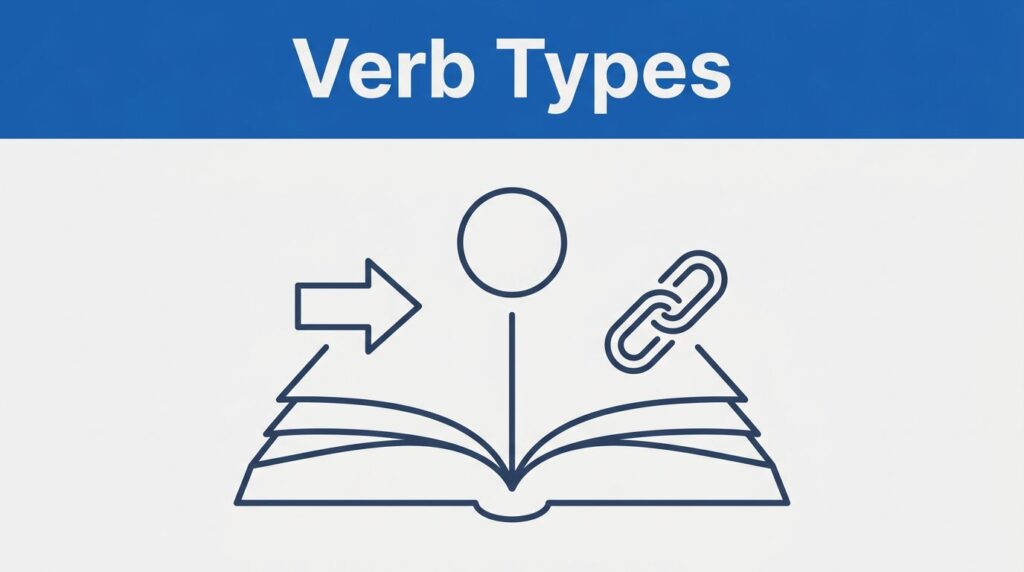
Major types of verbs at a glance
The main verb categories become clearer when you compare them side by side.
| Type of verb | What it does | Example sentence | Verb word or phrase |
|---|---|---|---|
| Main verb | Carries the core meaning | The teacher explains the rule. | explains |
| Auxiliary verbs | Help the main verb | The teacher has explained the rule. | has explained |
| Modal verbs | Show ability, possibility, permission, or duty | The teacher can explain the rule. | can explain |
| Linking verbs | Connect the subject to a description or identity | The teacher seems patient. | seems |
| Transitive verbs | Take a direct object | The teacher explained the rule. | explained |
| Intransitive verbs | Do not take a direct object | The baby slept. | slept |
These groups are useful, but they can overlap. A verb can belong to more than one category depending on how it is used. In She wrote a letter, wrote is a main verb and one of the transitive verbs because it takes a direct object, which is the letter. In She wrote for an hour, the same verb is still a main verb, but now it functions as one of the intransitive verbs because it does not require a direct object to complete its meaning.
It is also worth noting the role of phrasal verbs. These consist of a main verb combined with a particle or preposition, such as look up or break down, to create a single, distinct meaning.
Some verbs change role from one sentence to another. Look at taste:
The soup tastes salty.
The chef tasted the soup.
In the first sentence, tastes is one of the linking verbs because it connects soup with salty. In the second, tasted is one of the transitive verbs because it takes the object soup.
Three verbs deserve extra attention: be, do, and have. They often act as main verbs, but they also work as auxiliary verbs. That is why they appear so often in school grammar exercises.
How verb forms change meaning
English verbs change form to show time and agreement. This process, known as verb conjugation, starts from the root form and alters the word to fit the needs of the sentence.
Take the regular verb walk. Its common forms are walk, walks, walked, and walking. The form walked represents the simple past tense, showing an action already completed. Now compare the irregular verbs like go, which include go, goes, went, going, and gone. Irregular verbs do not follow one fixed pattern, so they require extra practice to master.
Subject-verb agreement is the reason behind the s in he walks. You write I walk, you walk, and they walk, but you must add that s for third-person singular subjects like he or she. One missing s is a common error in writing.
Verb forms also help build tense and aspect:
- She writes every day.
- She is writing now (continuous tense using the present participle).
- She has written the answer (perfect tense using the past participle).
- She had written the answer before the bell rang.
Each sentence uses a different verb form or phrase. As a result, the reader understands whether the action is routine, currently in progress, or complete.
A verb can show time, completion, and possibility, often with only one extra word.
The verb be is especially important because it is highly irregular: am, is, are, was, were, been, and being. Students meet it early, yet it remains a frequent source of mistakes.
Verb forms also help construct the passive voice. Compare the active voice sentence, The class solved the problem, with the passive voice version, The problem was solved by the class. The second sentence uses was solved, which combines the verb be with a past participle.
Once you notice these patterns, verb forms stop feeling random. They follow clear rules to convey specific information within a sentence.
Finite and non-finite verbs made simple
A finite verb can stand as the main verb of a clause. It shows tense and often agrees with the subject. In the sentence, “The train arrives at six,” “arrives” is finite. Similarly, in “The train arrived late,” “arrived” is finite.
A non-finite verb does not work that way. It does not show tense by itself, and it cannot usually complete a clause alone. English has three common non-finite forms: gerunds and infinitives, as well as participles.
Look at these examples:
To read widely improves vocabulary. Reading widely improves vocabulary. The broken window needs repair.
In the first sentence, “to read” is an infinitive. In the second, “reading” acts as a gerund. In the third, “broken” is a past participle.
The tricky part is that some non-finite forms look like ordinary verbs. The word “reading” can act as a gerund in “Reading helps memory,” but it also serves as a present participle when part of a verb phrase, such as in “She is reading.” The form is identical, but the grammatical role is different.
This distinction matters in exams because questions often ask you to identify the main verb of the clause. In the sentence, “After finishing the paper, the student checked every answer,” “checked” is the finite verb. “Finishing” is a non-finite form. When you learn to identify gerunds and infinitives within a sentence, you will find that sentence analysis becomes much simpler. If you can spot the finite verb first, the rest of the structure will naturally fall into place.
Common verb mistakes and quick practice
Many verb errors appear in the same few areas. First, students often struggle with subject-verb agreement. For example, the phrase “He go to school” is incorrect and should be “He goes to school.” Next, learners frequently confuse past forms and the past participle. Therefore, “She has went” should be corrected to “She has gone.” Another common issue is a missing auxiliary verb. In the continuous tense, “They playing football” is incomplete and requires the auxiliary “are” to become “They are playing football.”
Tense shifts can also create confusion. If a paragraph begins in the simple past tense, it should usually remain in that tense unless there is a clear change in the timeline. Compare “The poet described nature and then compares it to youth.” The second verb should match the first, so “compares” should be changed to “compared.”
Teachers often remind learners to read their work aloud when checking verbs. This method works because awkward verb patterns sound wrong immediately, even when they look acceptable at first glance.
Try identifying the verb or verb phrase in each sentence below before reading the explanations.
- The children are playing in the park.
- Meera has written her answer clearly.
- The soup smells fresh.
- After finishing the test, Rahul walked home.
In sentence 1, “are playing” is a verb phrase in the continuous tense, with “are” acting as the auxiliary and “playing” as the main verb. In sentence 2, “has written” is the verb phrase, using the past participle “written.” In sentence 3, “smells” is a linking verb because it connects the subject “soup” with the adjective “fresh.” In sentence 4, “walked” is the finite verb in the simple past tense, while “finishing” is a non-finite form.
Short practice sessions like this build accuracy quickly. They also help students move from simply memorising rules to recognising how different verb types function in real writing.
Frequently Asked Questions
What is the difference between a main verb and an auxiliary verb?
A main verb carries the primary meaning of the sentence, such as an action or a state of being. An auxiliary verb, or helping verb, is used alongside the main verb to clarify tense, mood, or voice.
How can I tell if a verb is transitive or intransitive?
A transitive verb requires a direct object to receive the action, while an intransitive verb does not need an object to complete its meaning. You can often identify a transitive verb by asking who or what received the action of the verb.
Why do some verbs change their form?
Verbs change form, a process known as conjugation, to indicate specific details like the time of an action or the subject involved. These adjustments are essential for showing the correct tense and ensuring proper subject-verb agreement within a sentence.
Can a word be both a linking verb and an action verb?
Yes, some verbs can change function depending on the context of the sentence. For example, a word like “taste” might act as a linking verb when describing a quality of the subject, but it becomes an action verb when describing someone performing the act of tasting.
Verbs make sentences work
A sentence without a verb still feels incomplete, and that simple test is worth remembering. If you can find the word that shows action, a state of being, or a connection, you have successfully located the centre of the clause.
Once you recognise various verb types and forms, English grammar becomes far more orderly. Verbs tell you when something happens, how it happens, and how the rest of the sentence fits together. By mastering these components, you ensure your writing is clear and precise, confirming that verbs are truly the most vital part of English grammar.
Discover more from GYANKUNDLI
Subscribe to get the latest posts sent to your email.